


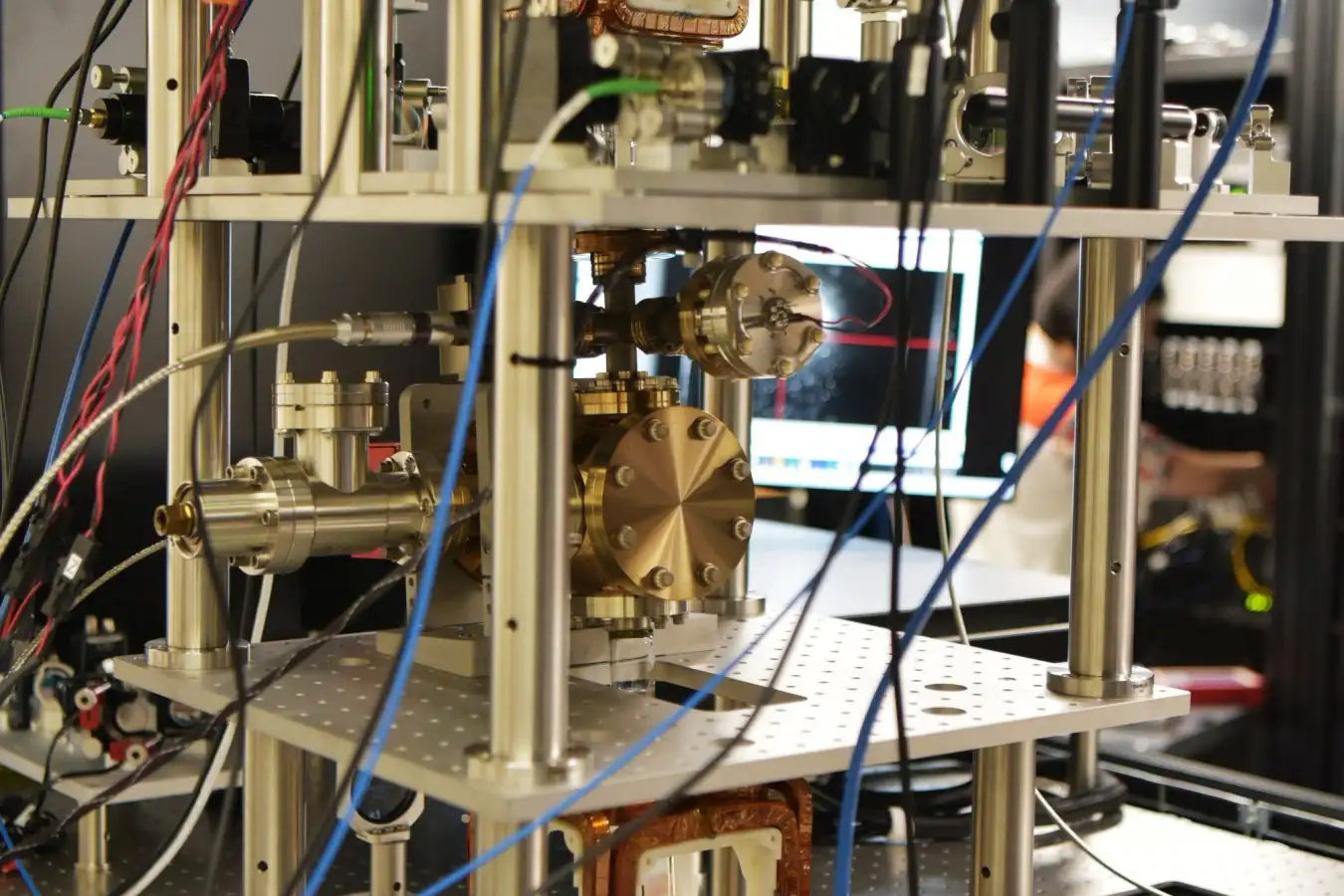

Libra Quantum Computer Prototype
Credit: Cuella
A promising, error-resistant quantum computer could be operational within just two years, according to researchers from the quantum computing firm QuEra.
Quantum computing technology is advancing rapidly, driving significant growth in the industry. One of the major challenges currently faced in applying quantum computers to fields such as chemistry, materials science, and drug development is their inherent error-proneness, limiting the complexity of calculations. However, Yuval Boger and his team at QuEra are optimistic about overcoming this significant hurdle.
The Libra quantum computer, designed to be fault-tolerant (capable of identifying and correcting its own errors), is projected to become available by 2028, distributed via a cloud partnership with Amazon Web Services (AWS). As of now, fully operational, fault-tolerant quantum computers are nonexistent. “Launching the first fault-tolerant quantum computer will be akin to breaking the sound barrier,” asserts Borger.
The foundational elements of Libra, known as qubits, consist of electrically neutral atoms maintained at ultra-low temperatures and manipulated by lasers. The device is expected to incorporate between 10,000 and 15,000 qubits, arranged into 256 groups referred to as logical qubits. Even if some qubits within a group prove unreliable, each will only experience a failure once per million errors.
QuEra’s team anticipates that Libra will enable “mega-quops,” or one million operations, by 2025. Quantum computing authority John Preskill, from the California Institute of Technology, stated that the mega-quop machine could signify the dawn of a new quantum computing era. However, for QuEra’s vision to materialize, significant advancements are necessary; currently, the largest available array of neutral atom qubits encompasses 6,100 units, which have yet to be employed in practical computations. Moreover, the highest number of error-corrected logical qubits ever produced stands at 48. Industry leaders like IBM predict fault-tolerant quantum computers could be feasible starting in 2029.
Jonathan King from Atom Computing, which also develops a neutral atom quantum computer, emphasizes that a fully operational quantum system necessitates the integration of numerous scientific and technological innovations beyond laboratory prototypes. Borger explained that QuEra is currently testing five experimental machines to refine various Libra features, including managing defective atoms due to temperature fluctuations and harmonizing the numerous lasers involved in the process.
“The focus is shifting from 90% science to 10% engineering, leaning more heavily towards engineering,” noted Borger. The QuEra team is also enhancing the way conventional computers control and monitor qubits and collaborating with AWS to incorporate Libra into their established cloud framework.
“Much work remains,” warns Thomas Wong from Creighton University. “While reaching our goals by 2028 is plausible, it’s equally possible that delays will extend the timeline.” Joe Fitzsimmons from Horizon Quantum Computing recognizes that while QuEra’s ambitions are bold, the company has a proven history of making headway in quantum error correction. He adds that various methods exist for qubit creation, yet the neutral atom technique facilitates conversions between qubits and logical qubits, potentially providing a crucial advantage.
If all goes according to plan, a pivotal question still remains about the applications of the MegaQuop machine. Borger points out that it is poised to excel in complex simulations of physical systems and material sciences that are currently insurmountable for both traditional and existing quantum computers. He aspires for researchers to leverage it to innovate better quantum computing algorithms for future fault-tolerant machines. “I wouldn’t be surprised if many of the ultimately significant algorithms remain undiscovered,” says Borger.
According to Wong, Libra is likely to evolve into a discovery-oriented tool, paving the way for groundbreaking applications. “I believe QuEra aims to set the research agenda for the community to explore the potential of harnessing 256 logical qubits,” he explains.
Topics:
Source: www.newscientist.com