


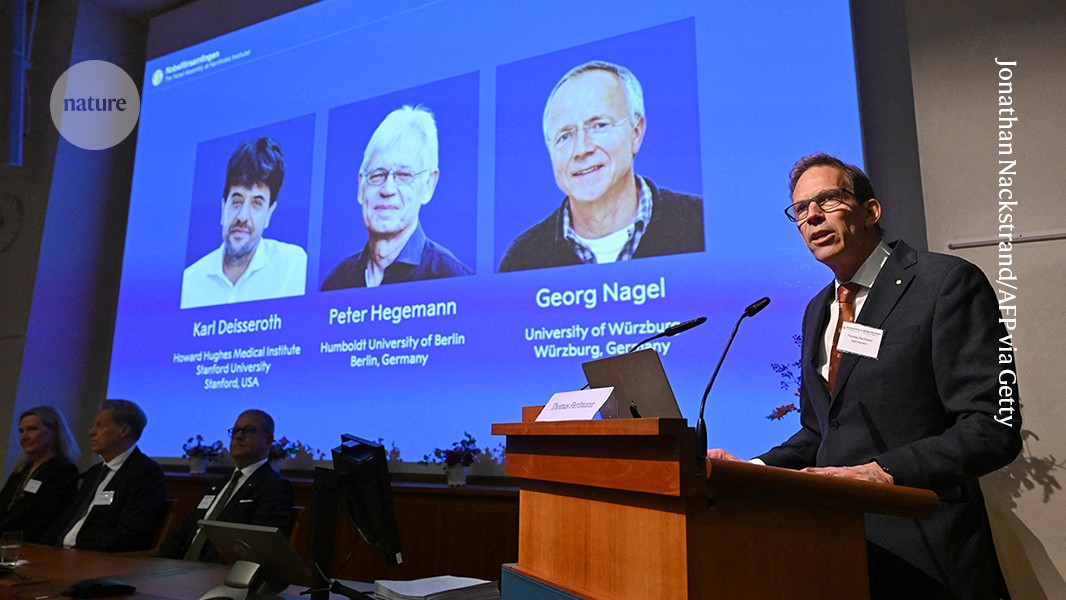
Karl Deiseroth, Peter Hegemann and Georg Nagel have been awarded the 2026 Nobel Prize in Medicine or Physiology for their discoveries in optogenetics, Nobel Committee Director-General Thomas Perlman (right) announced.
Credit: Jonathan Knackstrand/AFP via Getty
Optogenetics Wins the 2026 Nobel Prize in Physiology or Medicine
A technology that uses pulses of light to control neurons in the brain has been awarded the 2026 Nobel Prize in Physiology or Medicine. Optogenetics has transformed neuroscience by giving researchers a precise way to control brain cells and investigate cause and effect.
The prize will be shared by Karl Deiseroth of Stanford University in California, Peter Hegemann of Humboldt University in Berlin, and Georg Nagel of the University of Wurzburg in Germany. They will divide prize money of 12 million Swedish kronor (US$1.2 million).
“Optogenetics offers the opportunity to map the brain in ways we could only dream of before,” said Per Svenningsson, chair of the Nobel Committee for Physiology or Medicine, in a press release announcing the award.
How optogenetics became a powerful neuroscience tool
In the early 2000s, Hegemann and Nagel were working together at the Max Planck Institute for Biochemistry in Martinsried, Germany, when they discovered light-sensitive proteins in algae. In the alga Chlamydomonas reinhardtii, they identified channelrhodopsin1,2. In response to blue light, the protein opens, allowing charged molecules to enter the cell and creating a small electrical charge.
Deisseroth and his colleagues inserted the gene encoding channelrhodopsin into rodent neurons. They found that the protein could make the cells fire and communicate with other neurons. This approach soon became known as optogenetics and changed the way scientists study the brain.
Optogenetics allows researchers to control the activity of individual neurons and brain circuits with high precision, then study the effects on behavior and other biological processes. The technology has enabled scientists to examine how specific cells contribute to brain function.
The laureates’ work “fundamentally changed the way neuroscience is done” and “impacted areas of biology far beyond that, opening up new therapeutic possibilities,” said Louis Costa, a neuroscientist and director of the Allen Institute in Seattle, Washington.
“I first met Karl 23 years ago, and he was already thinking deeply about how to control the activity of specific neurons to understand and change behavior,” Costa said. “Karl’s commitment to sharing not just his discoveries, but tools and reagents at scale, was equally transformative.”
Optogenetics opens new possibilities for brain research and medicine
The discovery and application of channelrhodopsin created a diverse “optogenetics toolkit” that allows scientists in many fields to study light-induced cellular activity.
Optogenetic tools have helped researchers better understand brain function in health and in diseases including depression, schizophrenia and Alzheimer’s disease. Scientists are also investigating the technology as a treatment for some types of blindness.
Optogenetics has already been used to partially restore vision in patients with retinitis pigmentosa, a disease that damages light-sensitive cells in the eye.
Source: www.nature.com