


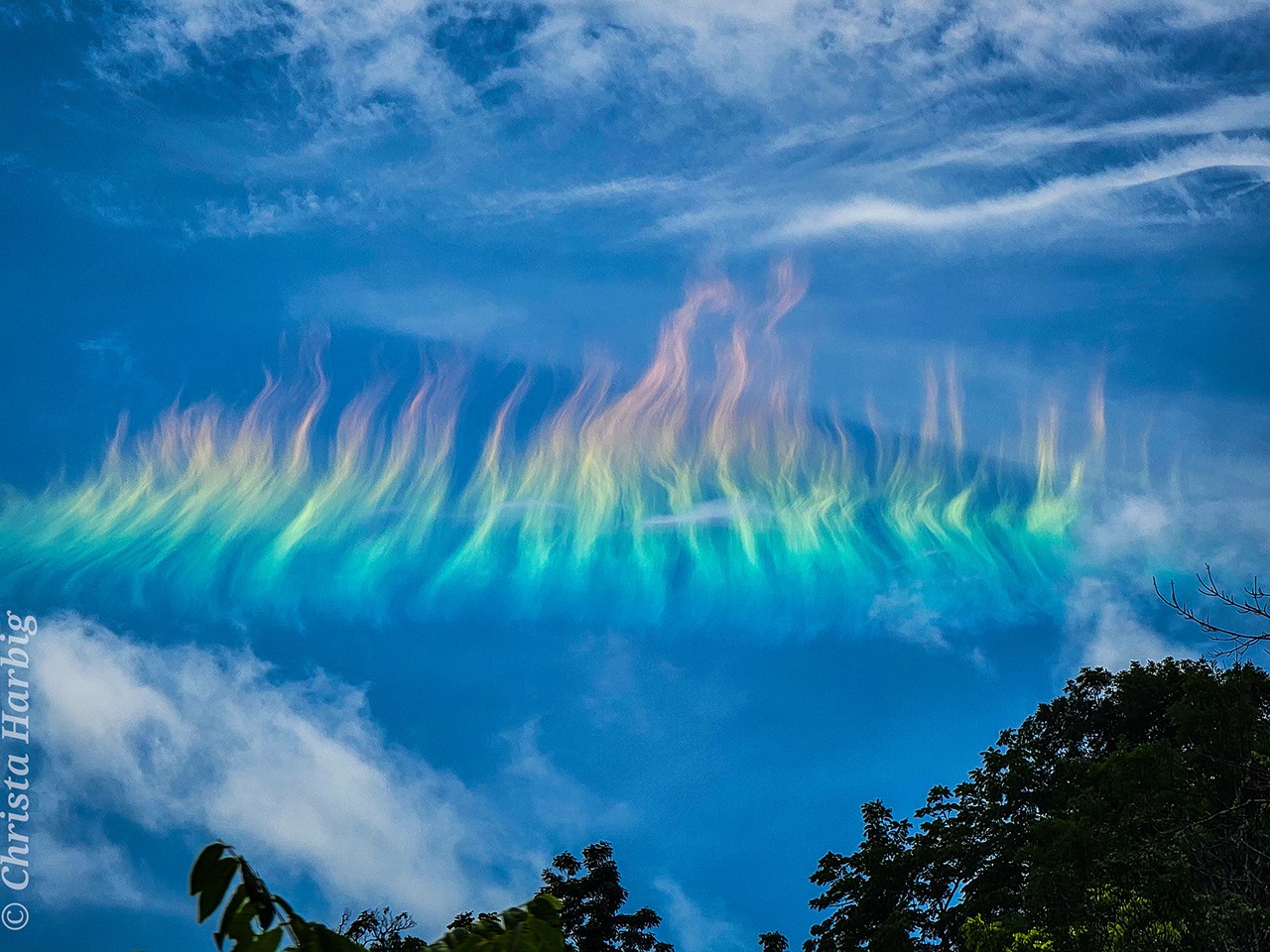
Explanation: What is creating this colorful cloud formation? The vibrant display is a circumhorizontal arc, often called a “fire rainbow” because of its flame-like colors. It forms when sunlight passes through flat, hexagonal ice crystals suspended in high-altitude cirrus clouds. For a circumhorizontal arc to appear, the Sun must be at least 58 degrees above the horizon, and the cirrus clouds must contain horizontally aligned ice crystals. In this case, the clouds were identified as cirrus fibratus. These flat, hexagonal ice crystals must be aligned horizontally so they can refract sunlight in a similar direction. Because this precise combination of sunlight, cloud type, altitude, and crystal alignment is relatively uncommon, circumhorizontal arcs are unusual atmospheric phenomena. This fire rainbow was photographed in 2021 near North Fork Mountain in West Virginia, USA.
Tomorrow’s picture: meteoric photobomb
Source: science.nasa.gov