


Spacecraft are typically protected from dangerous impacts using specialized debris shields. One common design is the Whipple shield, which consists of a thin outer bumper positioned a short distance from the spacecraft’s main wall. The bumper is designed to break apart incoming debris and spread its impact energy across a larger area of the spacecraft structure. Over the years, engineers have improved Whipple shields with multiple bumpers and cushioning materials placed between rigid layers, creating so-called “stuffed” Whipple shields.
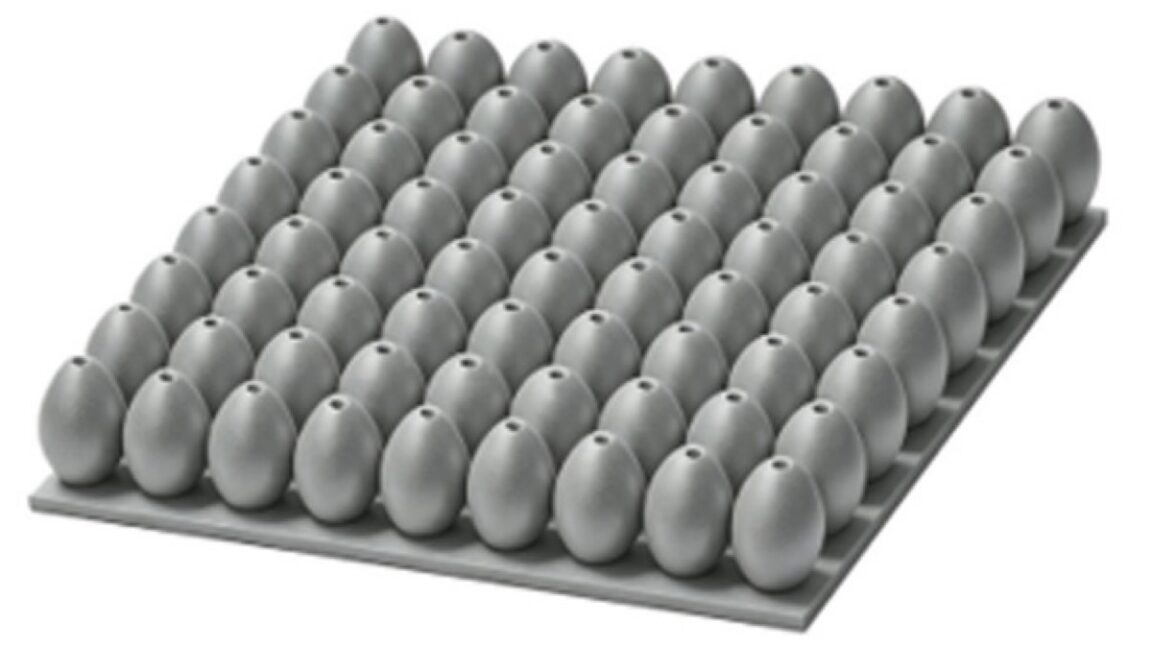
In a new study, researchers explored whether the impact-resistant structure of an eggshell could make spacecraft shielding even more effective. Inspired by the familiar trick of standing on an egg carton without breaking the eggs, the team developed three-dimensional aluminum designs that mimic the geometry and biomechanical properties of eggshells. The researchers created three test structures: solid aluminum plates, water-filled aluminum spheres positioned between aluminum plates, and an array of water-filled, eggshell-shaped structures.
Using computer simulations and experiments with lightweight gas guns, the researchers evaluated how each design performed during hypervelocity impacts. The water-filled eggshell arrays delivered the strongest results. They reduced projectile velocity by nearly 65 percent, compared with a 51 percent reduction for a simple aluminum plate. According to the researchers, the water inside the eggshell-shaped structures helps distribute impact energy and limits the propagation of shock waves through the protective material.
The team also tested several eggshell configurations and found that the most effective design held each egg-shaped unit upright, with its narrow tip touching the upper aluminum plate. Additional testing will be needed to optimize the geometry, materials, and energy-absorption capabilities of the system, but the early findings suggest that bio-inspired eggshell structures could lead to improved spacecraft shielding and other lightweight impact-protection technologies.
“Although a single eggshell breaks easily when subjected to localized forces, the protection mechanism of an array of eggshells is quite different,” co-author Yuxin Wang said. Wang received his Ph.D. from Dalian University of Technology in China. “The coordinated deformation of these eggshell units converts local impact loads into energy dissipation distributed throughout the metastructure, thereby significantly improving the impact performance of the target plate. We hope that this work can draw further attention to bio-based protective structures.”
Journal of Applied Physics, 2026. DOI: 10.1063/5.0324502 (About DOI).
Source: arstechnica.com