


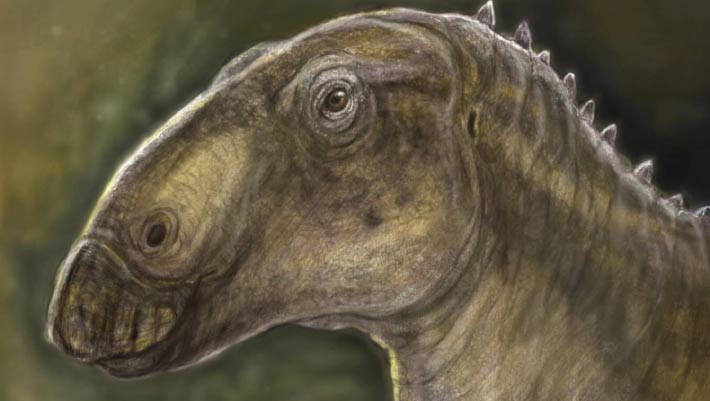
An international collaboration among Romanian, Hungarian, and Italian paleontologists has unveiled a new genus and species of herbivorous duck-billed dinosaur from an incomplete skeleton discovered in the Hersheg Basin, a geological formation in the Carpathian Mountains of present-day Romania.
Cryptohadros Karayae thrived during the Maastrichtian epoch of the Cretaceous period, which spanned roughly 70 million years.
This dinosaur belongs to the Hadrosauridae family, a group of herbivorous ornithischians known for their distinct duck-bill features and close relatives.
The holotype specimen of this species was uncovered from continental deposits at the vertebrate site of Fantanelle-3, situated near the village of Valioara within the Haseg Basin, Romania, specifically in the Denshu – Ciula Formation.
This area is renowned among paleontologists for the discovery of rare dinosaur fossils.
“Complete skeletons, including skull fragments, vertebrae, and limb bones, are exceedingly rare in the Haseg Basin, particularly for hadrosaur fossils,” stated Dr. Attila Sisi from ELTE Eötvös Lorand University.
“Most sites yield only isolated bone fragments from this dinosaur group, which were mistakenly attributed to previously known species, often lacking distinctive characteristics, like Thelmatosaurus.”
The Cryptohadros Karayae specimen includes partial remains, comprising the skull, rib fragments, caudal vertebrae, and portions of the hind limb.
Despite its fragmentary nature, this material was sufficient to differentiate the new species from other known dinosaurs, particularly Thelmatosaurus transsylvanicus, a duck-billed dinosaur that has been misidentified for over a century.
The discovery suggests that at least two closely related duck-billed dinosaur species coexisted in the region during the Late Cretaceous.
“The similarities with the new species Thelmatosaurus indicate close relations, which are notably high,” remarked János Magyar, a PhD student at ELTE Eötvös Lorand University and the Hungarian Museum of Natural History.
“The differences lie almost exclusively in the morphology of the skull elements.”
According to the researchers, Cryptohadros Karayae, Thelmatosaurus transsylvanicus, and Tethyshadros from Italy constitute a newly recognized evolutionary group named Telmatosauridae, representing a unique lineage that evolved in the island environments of southeastern Europe.
“Our phylogenetic analysis reveals particularly close relationships among all known Late Cretaceous hadrosaurids of southeastern Europe, including Thelmatosaurus, Tethyshadros, and Cryptohadros, which form a small endemic clade termed Telmatosauridae,” they noted.
“Moreover, these analyses identify several distinct evolutionary lineages of hadrosaurids within the European archipelago during the Late Cretaceous, and suggest that from the Albian (113-100 million years ago) to the Maastrichtian (72-66 million years ago), at least six dispersal events occurred from Asia towards North America and/or Europe.”
The absence of recently arrived European hadrosaurid lineages in the island fauna of southeastern Europe reinforces earlier theories proposing a direct migration route from Asia to the islands of southwestern Europe at the end of the Cretaceous, circumventing southeastern Europe.
The discovery of Cryptohadros Karayae is detailed in a study published in the Journal of Systematic Paleontology.
_____
Janos Magyar et al. 2026. A new early Maastrichtian “duck-billed” dinosaur from the Haseg Basin (Densus-Siura Formation, Romania) documents a unique clade of non-hadrosaurid hadrosaurids from the southeastern Late Cretaceous European archipelago. Journal of Systematic Paleontology 24(1); doi: 10.1080/14772019.2025.2607800
Source: www.sci.news