


Close Menu
HitechubHitechub
    What's Hot
    Science

    The Mona Lisa reveals another secret

    Science

    Unlocking Multitasking: How Science Reveals Your Brain’s Potential with Practice

    Gadgets

    Effects of Different Electronic Gadgets on Students

    Important Pages:
    • About Us
    • Privacy Policy
    • Terms & Conditions
    Facebook X (Twitter) Instagram Pinterest
    Facebook X (Twitter) Instagram
    HitechubHitechub
    Thursday, June 4
    • Technology
      1. AI
      2. Gadgets
      3. View All

      This is the most popular CEO in the world

      Sectors in which “Chat-GPT” is most often used

      AI Pioneer Expresses Concern About Potential for AI to Surpass Humanity

      Artificial intelligence has begun to “swallow” professions

      What’s new in Android 14

      Europeans have about 700 million old mobile phones in their drawers

      Here’s how you can tell if your phone is being tapped

      “Sneaker X” – computer case in the shape of a sneaker

      Russian Gamers Unite to Prevent Nuclear War: Join the Fight Online

      Challenges of Space Travel: Why Journeying to Space is So Difficult

      NASA Astronaut Casts Historic Vote from Space

      Discover the Future of Comfort: What If You Could Wear a Chair?

    • Science
      1. Space
      2. Wheels
      3. View All

      Galaxies in the universe are growing more slowly than they should

      “Espace” presented the new lander “Apex 1.0”

      The largest asteroid sample ever collected has arrived on Earth

      (VIDEO) Incredible flight of the Parker Solar Probe

      Toyota wants to make a new generation battery with a range of up to 1,200 km

      Meet Toyota’s lunar “baby” that could make exploring the Moon easier

      Microlino – Is this the perfect city car?

      Alfa Romeo 4C gets an electric successor

      Discover the Giant Scorpion That Dominated Ancient Britain in the Devonian Period

      Pigeons Utilize Superparamagnetic Immune Cells in Their Livers to Detect Earth’s Magnetic Field

      Webb Telescope Discovers Methane in Interstellar Comet 3I/ATLAS

      Silent Spring: How Rachel Carson’s 1962 Science Book Transformed the World

    HitechubHitechub
    Home » Exploring Earth’s Mysterious Triple Symmetry and Its Impact on Climate Change
    Science

    Exploring Earth’s Mysterious Triple Symmetry and Its Impact on Climate Change

    Share Facebook Twitter Pinterest WhatsApp
    Share
    Facebook Twitter LinkedIn Pinterest WhatsApp
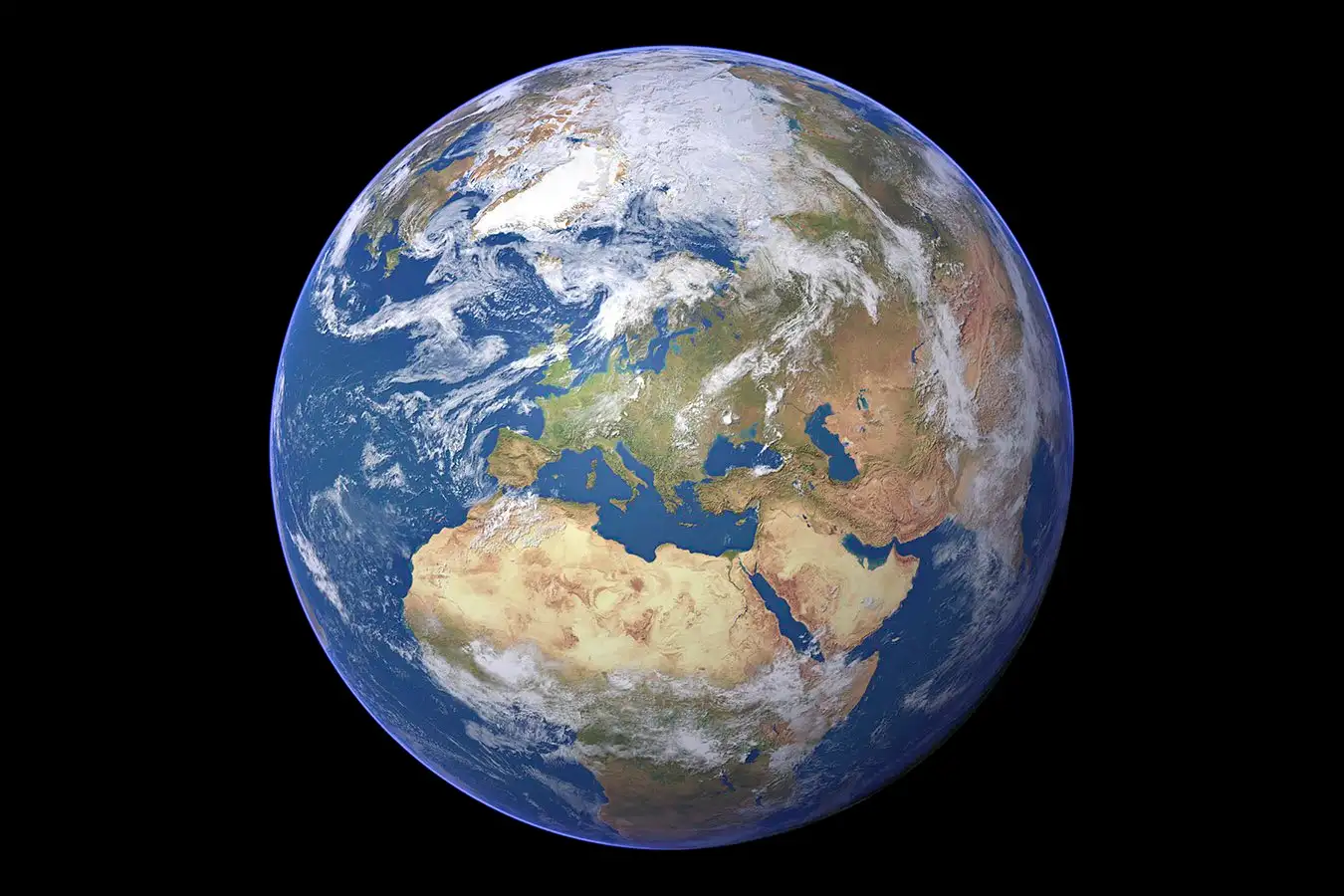
    27 degrees east meridian

    The 27 degrees east meridian divides the Earth into two equally reflective halves, running through Europe and Africa.

    Planetary Visions Limited/Science Photo Library

    A critical line traversing Africa, Europe, Alaska, and both poles separates the Earth into two halves, each reflecting an equal amount of light. This newly discovered symmetry may significantly influence Earth’s climate.

    Historically, it has been recognized that the albedo, or reflectivity, of the northern and southern hemispheres is nearly the same. Jiang Hao and researchers from the National Oceanic and Atmospheric Administration have identified an additional symmetry line at 27 degrees east longitude and 153 degrees west longitude.

    This line delineates hemispheres that are approximately equivalent in three key metrics: clear sky albedo, cloud reflectance, and ice-free ocean coverage. This symmetry has endured over the 25 years of satellite data examined by Zhang et al.

    Initially skeptical, Zhang became convinced of the significant nature of this East-West symmetry due to its uniqueness, persistence, and triple symmetry characteristics. “One might expect to find a single split with equal total reflection, but the presence of a distinct and stable east-west split that also balances land and ocean distribution along with clear and cloudy sky reflections is remarkable, especially considering cloud variability,” he explains.

    Over 25 years of satellite data, the east-west symmetry remains centered around 27 degrees east. However, the precise line shifts incrementally each year, with researchers finding these fluctuations closely tied to the phases of the El Niño Southern Oscillation (ENSO), a global climate phenomenon linked to changes in Pacific Ocean sea surface temperatures.

    “In essence, this symmetry may not merely be a geometric coincidence,” Zhang asserts. “It could play a crucial role in one of the most significant modes of climate change on Earth. ENSO may function as a large-scale mechanism that helps sustain long-term east-west symmetry centered around 27 degrees east longitude.”

    Ovind Hodnebrok, a researcher from the International Center for Climate Research in Oslo, Norway, expressed initial doubt about the findings.

    “I was somewhat skeptical regarding the east-west symmetry separated by roughly 27 degrees east longitude,” says Hodnebrok. “Intuitively, it seems less obvious compared to the equator, leading me to believe it might just be coincidental.”

    However, he now acknowledges the potential robustness of this feature, deeming it an intriguing property of Earth.

    Connections to ENSO may also bear significance. Unlike the diminishing north-south symmetry due to climate change effects on sea ice and clouds, the east-west symmetry currently maintains stability, although predictive models indicate it may weaken in the future. “Emerging asymmetries could indicate shifts in atmospheric circulation,” he warns.

    Martin Uecker, a researcher at the University of New South Wales in Sydney, argues that the east-west symmetry may indeed be coincidental.

    “Earth’s weather and climate transmit easily across longitudes,” Uecker notes. “The Earth’s rotation generates easterly and westerly wind bands that circle the planet, and atmospheric disturbances tend to travel east-west.”

    Zhang suggests that understanding mechanisms preserving east-west symmetry could be relevant for geoengineering endeavors. For instance, efforts to enhance albedo in one hemisphere might be counteracted by global feedback loops.

    “Before confidently claiming the effects of geoengineering, we require a deeper understanding of how clouds, circulation, precipitation, and planetary reflectance interact within the Earth system,” Chan concludes.

    Topics:

    Source: www.newscientist.com

    Share. Facebook Twitter Pinterest LinkedIn WhatsApp
    Previous ArticleThe Impacts of El Niño: Potential Negative Effects and What Lies Ahead
    Next Article Thriving Complex Colonial Life During the Cambrian Explosion: Unveiling Ancient Ecosystems

    Related Posts

    Science

    Discover the Giant Scorpion That Dominated Ancient Britain in the Devonian Period

    Science

    Pigeons Utilize Superparamagnetic Immune Cells in Their Livers to Detect Earth’s Magnetic Field

    Science

    Webb Telescope Discovers Methane in Interstellar Comet 3I/ATLAS

    Science

    Silent Spring: How Rachel Carson’s 1962 Science Book Transformed the World

    Science

    New Axolotl Fossil Discovered in Mexico: A Significant Paleontological Find

    Science

    When Food is Scarce: This Single-Celled Organism Becomes a Giant Man-Eater for Survival

    Science

    Unlocking Multitasking: How Science Reveals Your Brain’s Potential with Practice

    Science

    Revealing the Truth: Stonehenge’s Altar Stones Likely Not Transported by Glaciers

    Add A Comment
    Leave A Reply Cancel Reply

    Stay In Touch
    • Facebook
    • Twitter
    • Instagram
    • Pinterest
    Top Picks
    Science

    Structural changes in the women’s brain during the menstrual cycle?

    The results, which have yet to be peer-reviewed, suggest that structural changes in the brain during menstruation may not be limited to those regions associated with the menstrual cycle.

    Exploring Earth’s Mysterious Triple Symmetry and Its Impact on Climate Change

    Test flight of an air taxi in Jerusalem

    The most powerful supercomputer in Europe

    Understanding the Dying Process: Insights from Medical Experts on What Happens When We Die

    Most Popular
    Science

    New Axolotl Fossil Discovered in Mexico: A Significant Paleontological Find

    Technology

    This is the northernmost photovoltaic plant in the world

    Categories
    • AI (13)
    • Gadgets (10)
    • Science (47)
    • Space (9)
    • Technology (37)
    • Wheels (9)
    Our Picks
    Gadgets

    PlayStation 5 becomes a completely silent console and gets more space

    Science

    Ötzi’s Frozen Remains: Potential Home to Active Microorganisms

    © 2026 Hitechub.
    • Home
    • About Us
    • Privacy Policy
    • Terms & Conditions

    Type above and press Enter to search. Press Esc to cancel.

    We are using cookies to give you the best experience on our website.

    You can find out more about which cookies we are using or switch them off in .

    Ad Blocker Enabled!
    Ad Blocker Enabled!
    Our website is made possible by displaying online advertisements to our visitors. Please support us by disabling your Ad Blocker.
    Hitechub
    Powered by  GDPR Cookie Compliance
    Privacy Overview

    This website uses cookies so that we can provide you with the best user experience possible. Cookie information is stored in your browser and performs functions such as recognising you when you return to our website and helping our team to understand which sections of the website you find most interesting and useful.

    Strictly Necessary Cookies

    Strictly Necessary Cookie should be enabled at all times so that we can save your preferences for cookie settings.