


Metal Detectorists Discover One of Germany’s Largest Roman Silver Coin Hoards
A metal detector discovery in western Germany has revealed one of the largest hoards of Roman silver coins from the reign of Emperor Hadrian ever found in the country.
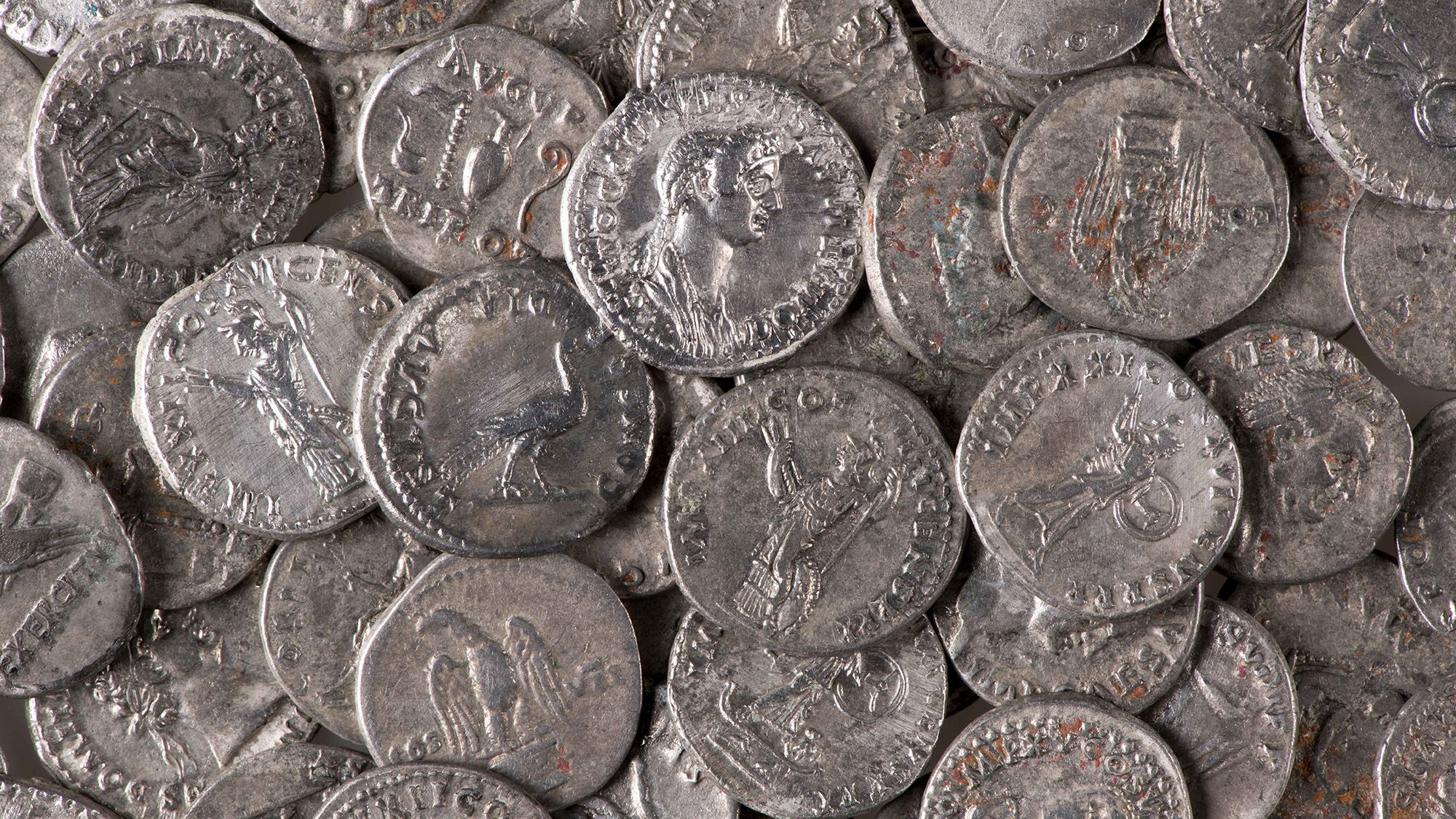
The hoard contains 934 silver denarii, an early standard currency of the Roman Empire, and weighs nearly 7 pounds (3.1 kilograms). Initial reports described the discovery as containing about 900 coins.
Roman coin hoard found near Cologne
The treasure was discovered about a year ago in a field near Wesseling, a small city a few miles south of Cologne. The coins are now on display at the LVR-Landesmuseum Bonn, also known as the Rhineland Museum.
Archaeologists believe the hoard was buried during the reign of Emperor Hadrian, who ruled from A.D. 117 to 138. The newest coins were minted in A.D. 124 or 125.
However, the collection spans more than three centuries. The oldest coin was minted in 148 B.C. during the Roman Republic, while most of the coins date from the reigns of the Flavian emperors Vespasian, Titus and Domitian, who ruled from A.D. 69 to 96.
Image credit: Marcel Zanjani/LVR-Office for the Preservation of Archaeological Monuments in the Rhineland
A metal detector signaled an even bigger discovery
Metal detectorist Oliver Riedl uncovered 15 coins before realizing that the ground contained something much larger. His detector continued to signal beneath the surface, prompting him to stop digging and report the find to archaeological authorities.
“It was clear there was something bigger on the ground here,” Riedl said in a statement.
Riedl is licensed by the state to use a metal detector and has received training from local archaeological authorities. Archaeologists from the Rhineland government then investigated the site and recovered the complete hoard.
Rather than removing the coins individually, researchers excavated the entire lump of soil containing them. The block was examined with X-rays before it was opened, according to the statement.
Why were the Roman coins buried?
Erich Classen, head of archaeology for the Rhineland government, said the original owners appear to have collected most of the coins around A.D. 100. They may have buried the hoard during Hadrian’s reign, shortly after the latest coins were minted.
The reason for burying the money remains unknown. One possibility is that the owner wanted to keep the coins safe at a time when banks did not exist.
“It is possible that the owner died first without being able to pass on knowledge of the coin,” Classen said.
The hoard was found near the Roman frontier
Marjanko Pilekić, a numismatist at the German Historical Museum in Berlin who was not involved in the discovery, said the location is especially significant. The hoard was found just inside the northern frontier of the Roman Empire, near the Rhine River and the Roman limes.
Pilekić told Live Science that the location supports the idea that the hoard was intentionally buried soon after the newest coins were produced.
Outside the Roman Empire, in a region the Romans called Barbaricum, coin hoards were often buried much later, he said.
How much was the Roman silver hoard worth?
The hoard would have represented a considerable fortune in the second century A.D. Local archaeologists say a Roman legionary earned about 300 denarii per year during Hadrian’s reign, although roughly half of that amount was deducted for food and equipment.
According to Rahel Otte, who led the excavation, a legionary would have needed to save all available income for about six years to accumulate the equivalent of the Wesseling hoard.
Researchers are unsure who buried the coins. Otte said the owner may have been someone who lived in one of the Roman mansions in the area.
How much do you know about ancient Rome’s famous leaders? Take the Roman emperor quiz.
Source: www.livescience.com