


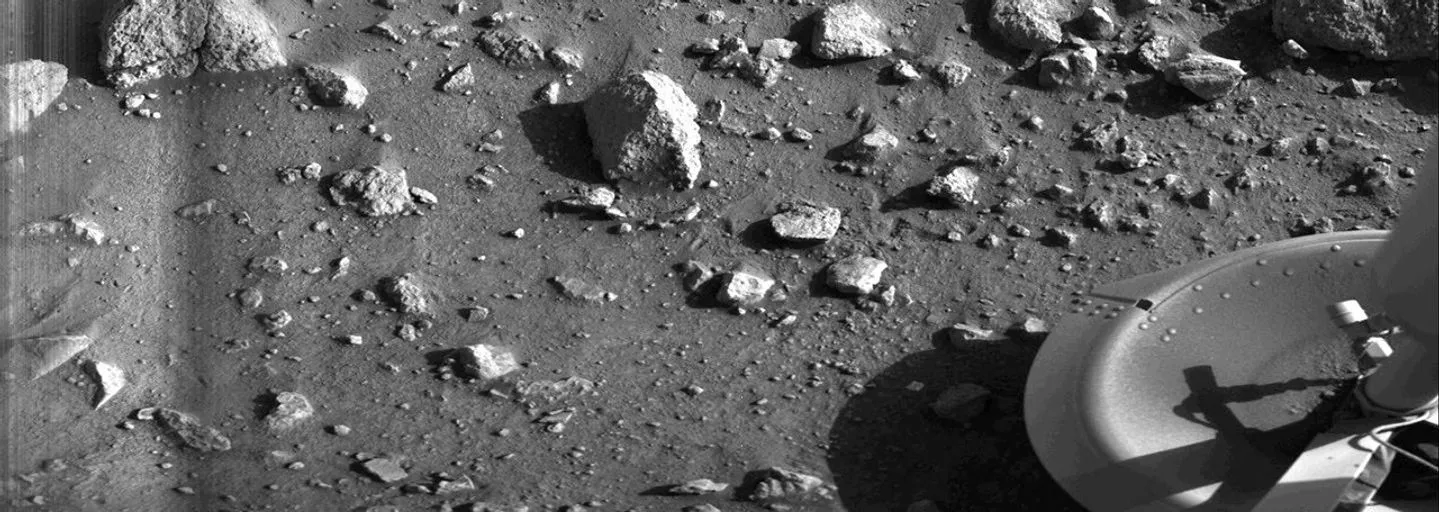
Fifty years ago, NASA’s Viking 1 and 2 landers achieved groundbreaking success by landing on Mars, marking a pivotal moment in planetary exploration. This milestone was made possible by a dedicated team at NASA Langley Research Center in Hampton, Virginia. Their unwavering leadership and technical expertise transformed a visionary concept into a mission that revolutionized our understanding of space exploration.
In 1968, NASA appointed Langley to spearhead the ambitious Viking Project, the first U.S. mission to safely land on Mars and search for extraterrestrial life. Project manager James S. Martin Jr. emphasized the importance of clear priorities, meticulous engineering reviews, and the commitment to rigorously test every system to ensure its functionality for Martian conditions.
Langley engineers confronted an unprecedented challenge: decelerating a spacecraft as it entered the Martian atmosphere at speeds exceeding 10,000 miles per hour. They leveraged their expertise in atmospheric reentry aerodynamics, thermal shielding, and parachute technology. This research yielded innovative solutions, including protective aeroshells, heat shields, and advanced supersonic parachutes. These systems were developed through extensive wind tunnel testing and analytical problem-solving, establishing Langley as a leader in entry, descent, and landing technologies.
Moreover, Langley pioneered a novel approach for identifying safe landing sites on Mars. Researchers integrated images from Viking orbiters with radar data from Earth-based observatories to pinpoint areas that optimally combine scientific potential and engineering safety. This method has since become standard practice for all Mars missions.
The Viking missions also transformed mission team dynamics. Engineers and scientists adapted their daily schedules to accommodate the Martian day, or ‘Sol,’ which is slightly longer than 24 hours. This approach remains in use for ground missions today.
The evolution of the Viking missions stemmed from critical programmatic shifts. The early Voyager Mars lander concept, which envisioned two large landers atop a single Saturn V rocket, was scrapped due to high costs and risks. Langley played a crucial role in developing a more feasible roadmap, pairing each lander with its orbiting satellite and adopting the Titan IIIE-Centaur rocket. This redesign ensured the mission’s success while preserving its scientific objectives.
Viking set a precedent for NASA’s future solar system exploration strategies. This involved scouting with orbiters, validating landing sites with reliable data, and deploying systems that had undergone extensive testing. The “planetary playbook” shaped by Langley has served as a guiding framework for subsequent Mars missions, including Curiosity and Perseverance.
The two Viking landers returned thousands of images and revolutionary data, revealing a complex Martian climate and geological history that continues to intrigue scientists. Although no humans have set foot on Mars yet, the Viking missions proved that operating on another planet is both possible and achievable.
As we approach the 50th anniversary of Viking’s landing, Langley’s influence remains significant. The center continues to drive advancements in entry, descent, and landing technologies while exploring concepts that will support future human exploration. The same spirit of innovation and curiosity that propelled the Vikings continues to inspire the work conducted in Hampton today, as they relentlessly push towards the next frontier.
Source: www.nasa.gov