


Human laughter, characterized by rapid and rhythmically timed bursts, is not exclusively human. Recent studies by researchers from the University of Warwick and the University of Portsmouth reveal that all great apes, including orangutans, gorillas, and chimpanzees, share a similar timing structure for laughter. This indicates that our common ancestor with these species exhibited recognizable laughter at least 15 million years ago.
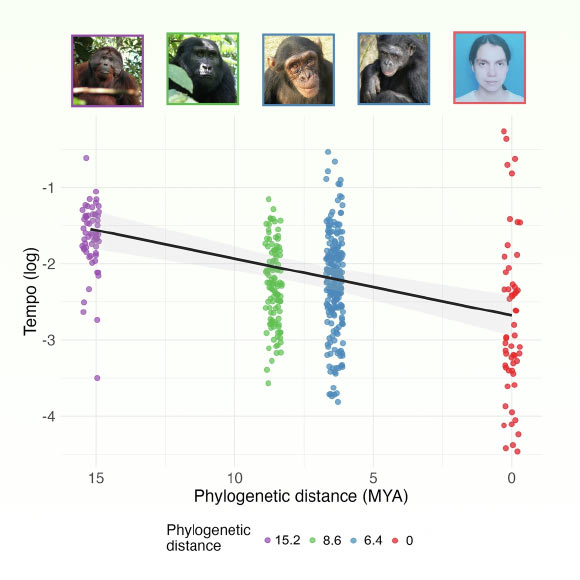
Tempo changes in laughter within five great ape species (orangutans, gorillas, bonobos, chimpanzees, and humans): Each point indicates an individual observation. Color represents systematic distance (1 million years ago). Each square features an image of the corresponding species. Image credit: De Gregorio et al., 10.1038/s42003-026-10499-z.
According to Chiara de Gregorio, a lead researcher at the University of Warwick, “The challenge with studying the origins of sounds like laughter is due to the lack of fossil evidence.”
“Analyzing the behavior of our closest living relatives, the non-human great apes, offers the only current model to understand the vocal capabilities and adaptations that are potentially lost among our ancestors.”
“Despite distinct vocalizations evolving in major hominid lineages, one vocalization remains consistent across species and age categories: laughter.”
In their groundbreaking research, scientists documented laughter during tickle play and social interactions among 17 individuals from all five great ape species.
The study comprised four orangutans, two gorillas, three bonobos, four chimpanzees, and four humans, including children ranging from 6 months to 7 years old.
Each species displayed laughter characterized as isochronous, meaning the bursts occurred at regular intervals, a feature also noticeable in music and speech rhythms.
This fundamental rhythmic structure is believed to have emerged in our common ancestor 15 million years ago and has been remarkably preserved; modern great apes exhibit this same basic pattern.
However, notable differences were identified along the evolutionary lineage. The laughter of species closer to humans is faster, more varied, and more responsive to social contexts.
Humans were unique in their ability to adjust the tempo of laughter based on whether they were tickled or engaged in free play.
The researchers found that variations in human laughter timing are perceived as warmer and more socially positive, indicating that rhythmic flexibility carries significant social implications.
Dr. Adriano Lamelia, also from the University of Warwick, stated, “Assessing the vocal capabilities of extinct ancestors directly is challenging.”
“Laughter, which has ancient evolutionary roots, continues to be a shared trait among extant great apes, providing a critical insight into the vocal changes throughout human evolution leading to the emergence of the first humans.”
“This discovery contradicts the traditional view that the first humans suddenly acquired unique vocal control; instead, it suggests a continuum of vocal abilities refined over 15 million years.”
These findings were published in the Journal on June 25, 2026, in Communication Biology.
_____
C. De Gregorio et al. 2026. The rhythm and timing of laughter reveal that human vocal plasticity belongs to the hominid continuum. Commune Biol 9,824; doi: 10.1038/s42003-026-10499-z
Source: www.sci.news