


Iranian students and researchers are facing disrupted careers, separation from their families and prolonged uncertainty as conflict in Iran, internet shutdowns and changing US immigration policies affect their education and work. Researchers interviewed by Nature described being unable to return to the United States, losing job offers and research opportunities, and struggling to communicate with relatives in Iran. The Careers team is using pseudonyms because of concerns about the safety of the researchers and their families, as well as possible effects on their careers.
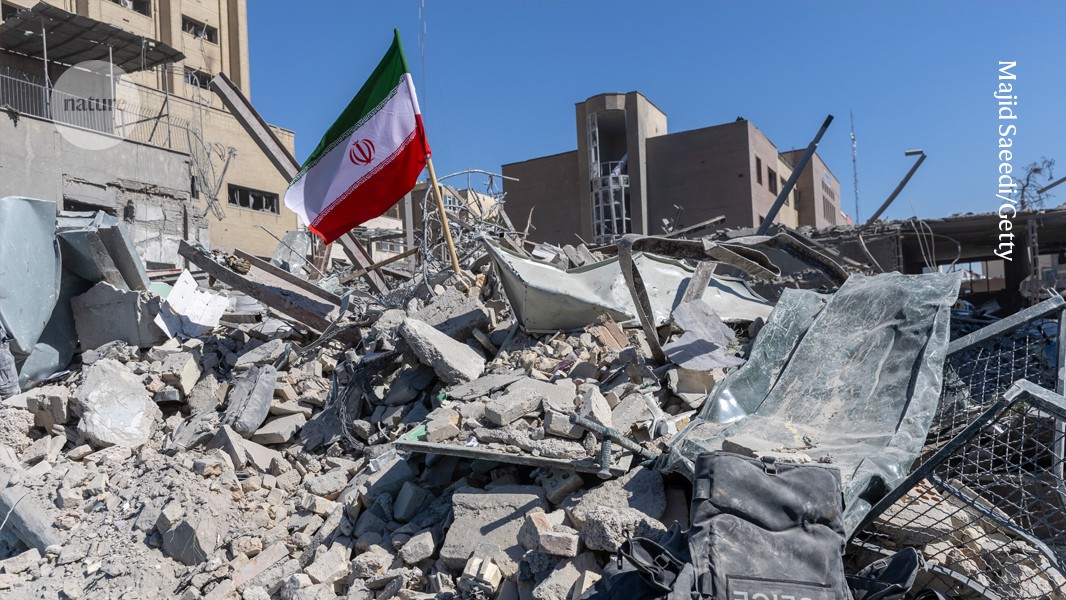
A destroyed police building in Tehran, where the Iranian conflict has seriously disrupted the lives of people, including students both domestically and internationally. Credit: Majid Saeedi/Getty
Babak hopes to complete his PhD in 2028. He began the programme in 2024 at a university in the southern United States and started writing his first paper on healthcare-related research in July of this year. But he finds it difficult to concentrate while switching between reading papers and coding.
“I have to check the news to find out if my country has been bombed,” said Babak, who is originally from Iran.
The past year has been tumultuous for Iranians. The country has been affected by violence involving foreign countries and its own government, changing the lives of many Iranian students and early-career researchers both in Iran and abroad. Iranians in the United States have also faced travel, visa and work restrictions. According to Open Doors, an annual report published by the Institute of International Education in New York City, about 12,000 Iranian graduate students were studying in the United States during the 2024–25 academic year.
In June 2025, Israel bombed Iranian nuclear and military facilities, and Iran retaliated with missile and drone strikes against Israel, beginning what became known as the 12-Day War. The United States later joined the conflict and attacked Iranian nuclear facilities. In December and January, an economic crisis in Iran, with inflation reaching 42%, sparked nationwide protests. The Iranian government killed as many as 30,000 people while suppressing the demonstrations, according to estimates cited by The Guardian.
Then, in February, the United States and Israel attacked Iran over its disputed nuclear-weapons programme. The attacks killed an estimated 20,000 military and civilian personnel across the countries involved, according to the independent open-source information platform Iran War Live.
One student told Nature that shelling forced their family to leave their home in the city and seek refuge with relatives in a village. The Iranian government shut down the country’s internet for nearly three months, from February to May. Iranian researchers living abroad were unable to communicate consistently with their families.
Changes to US immigration policy added to the pressure. In June 2025, the administration of President Donald Trump issued a travel ban covering people from 12 countries, including Iran, with limited exceptions and case-by-case waivers. The presidential proclamation cited Iran’s designation as a “state sponsor of terrorism”.

‘Heartbreaking’: Iranian scientists lose labs, libraries and freedom
In December 2025 and January 2026, two executive-branch memorandums citing national-security concerns created further uncertainty for Iranian researchers already in the United States. Together, the memorandums expanded the travel ban to 39 countries and effectively froze the processing of applications from those countries, including student visas, permanent-residence applications, also known as green cards, and work permits.
From December until June, the federal government neither approved nor denied applications for work permits or changes to legal status. People from the 39 countries were therefore left in bureaucratic limbo. For Iranian researchers in the United States, uncertainty about their careers was compounded by concern for loved ones in Iran, leaving many feeling that they had little control over their futures.
The researchers who spoke to Nature wanted to raise awareness of their situation within the academic community. For many, however, telling their stories even anonymously felt unsafe because of concerns about possible influence from the Iranian and US governments.
Opportunity lost
Nima, a medical doctoral student in the southern United States, made a visit to Iran in May 2025 that had devastating consequences. Nima had planned to stay for two weeks before returning to the United States to marry their fiancé, who is also from Iran. Their fiancé’s mother was ill and their father wanted to see Nima, so Nima decided to make the trip.
Although Nima was legally entitled to study in the United States, returning was risky because the visa needed to re-enter the country had expired. Nima planned to apply for a new visa while in Iran.
After the travel ban was imposed in June 2025, Nima could not return to the United States. “I cried every day,” Nima said from Iran a year later. Nima spent two weeks in a psychiatric hospital and resigned from the doctoral programme in August because the university limits students to two semesters of leave.
Nima still talks to a few friends in Iran about returning to the programme. “They’ll think I’m a loser,” Nima said. Returning to Iran to see family was “the worst decision of my life”, Nima said.
During the internet blackout, Nima used a virtual private network to e-mail their fiancé every day. They rarely used voice or video calls because Nima was too emotional. Nima was accepted into a medical-related master’s programme in another country, but that country’s government did not issue a visa in time for the new academic year in September. Nima does not know when they will see their fiancé again.
A career on hold
The travel ban was not the only policy that changed researchers’ lives. A government memorandum suspending application approvals from December 2025 to June 2026 disrupted many Iranian students in the United States.
One doctoral student said they often experienced burnout and could not bear to leave the house. “I don’t know if there will be a job or if I will have to move to another country,” the student said.
Some students said they did not understand the suspension. The United States had spent money training Iranian students, one doctoral student said, but “they didn’t seem to want to take advantage of the investment”.
Kevan Harris, a sociologist at the University of California, Los Angeles, who studies Iranian politics, said the policy supported the Trump administration’s efforts to reduce immigration, including the number of international students. “When the government increases the burden on people, some people say, ‘Fuck, I’m quitting,’” Harris said.

Foreign doctoral students are subject to strict restrictions on the amount of time they can spend in the U.S.
Azin received a doctorate from a university in the US Midwest in December 2025 but was unable to work because of the suspension. Soon after graduating, an American engineering company tried to hire Azin but withdrew the offer because Azin did not have a work permit. A postdoctoral opportunity also fell through for the same reason.
Azin had applied for optional practical training, which grants work permits for up to three years to students with degrees in science, technology, engineering and mathematics subjects. The suspension froze that application as well.
Azin sold most of their possessions and had no permanent home or income after graduation. For six months, they travelled through Illinois, Alabama, Missouri, North Carolina and Minnesota, staying with friends and relatives for weeks at a time.
Nature contacted the Trump administration for a response to the comments about the suspension. A State Department spokesperson said the memorandum was issued to “protect the national security, public safety, and national interests of the United States and its people”.
“As the Secretary of State has repeatedly said, visas are a privilege, not a right,” the spokesperson said. The department added that it evaluates each visa application on a case-by-case basis.
Source: www.nature.com