


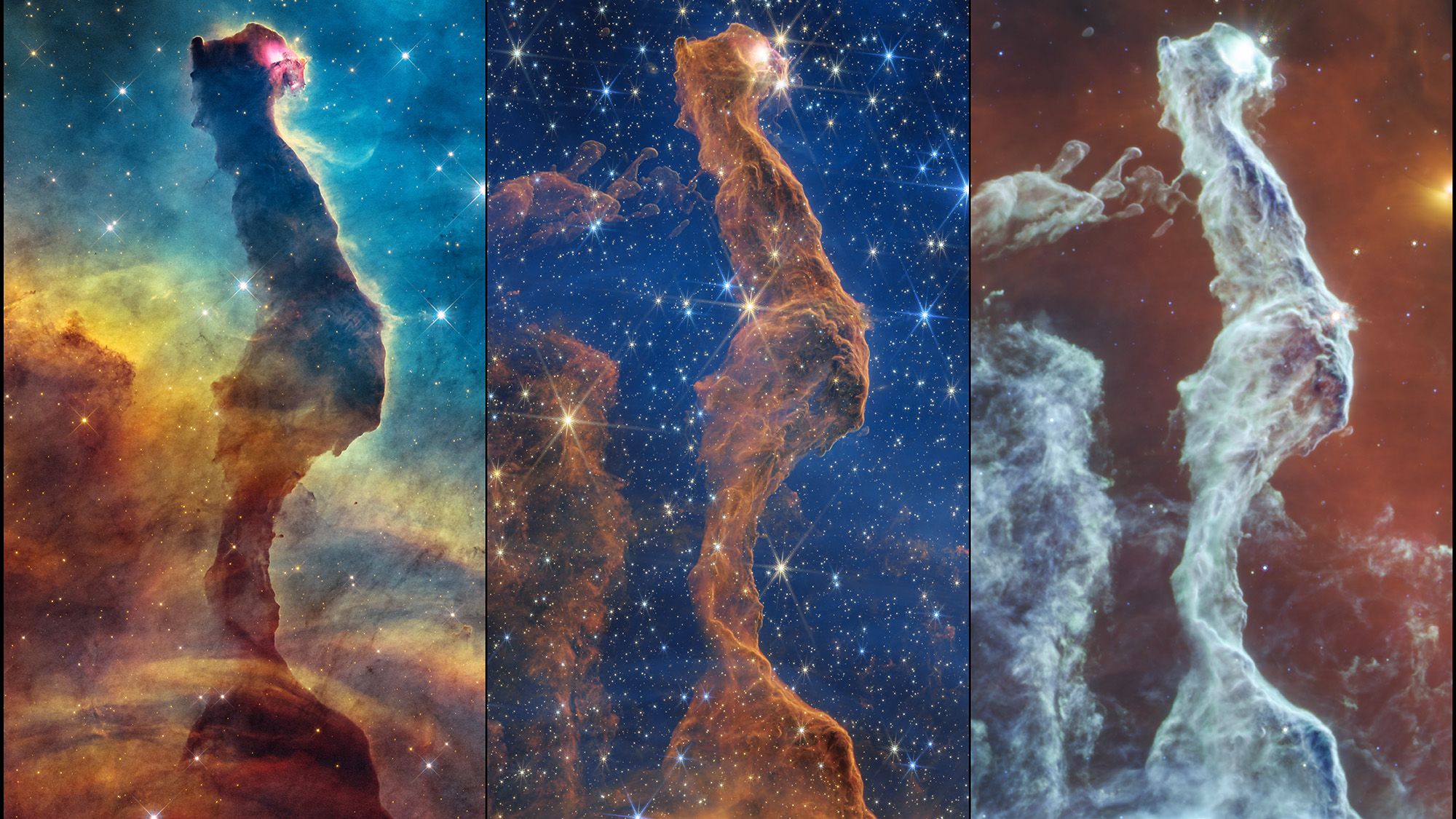
The Cat’s Head Nebula, a cloud of gas and dust about 7,500 light-years from Earth, looks dramatically different when viewed at different wavelengths. To mark Halloween, the European Space Agency (ESA) released three views of the nebula captured by the Hubble Space Telescope and the James Webb Space Telescope (JWST), revealing details that range from glowing optical clouds to a mysterious orange speck.
In space, no one can hear you scream or cry. That was true for Félicette, the Parisian tuxedo cat that completed the world’s first and only feline suborbital flight in 1963, as well as for the giant Cat’s Head Nebula, which has recently been imaged by both Hubble and JWST.
A cosmic cat in the Carina Nebula
The Cat’s Head Nebula is a star-shaped column of gas and dust within the Carina Nebula. From Earth, it vaguely resembles a cat sitting with its back turned to us and its head tilted around to reveal a single red eye. That apparent eye is a young star buried deep inside the dust, although it may be changing the surrounding nebula over time.
These structures form when active young stars emit radiation that erodes nearby material. The Cat’s Head Nebula is one of several such formations in the Carina Nebula. When viewed from another angle, a nearby cloud can resemble a box with its lid open, as seen in this JWST image of the Treasure Chest globule.
Hubble’s optical view
Hubble’s image shows the nebula in visible wavelengths, the same general range of light that can be observed with a strong backyard telescope. The telescope highlights dark columns of dust that have survived the ultraviolet radiation from nearby stars. Along the pillar’s faint right-hand rim, starlight is evaporating the surrounding gas and gradually eroding the structure.
The blue, yellow, orange and red regions around the dust column indicate interactions between starlight and different gas molecules, including oxygen, hydrogen and sulfur. The process is similar to the way molecules in Earth’s atmosphere produce auroras of different colors when excited by solar radiation, although it occurs on a much larger scale.
JWST’s near-infrared view

JWST’s near-infrared camera detects light that is invisible to the human eye. Those wavelengths can pass through the nebula’s wispy outer dust, exposing denser material near the center of the column. As infrared light penetrates the surrounding matter, additional stars and galaxies become visible in the background.
This view also reveals a more complex and turbulent structure. Stellar radiation has carved out the inside and edges of the cat’s head. On the left, an illuminated, disembodied hand-like structure appears to reach toward the nebula as if to pet its cosmic companion.
JWST’s mid-infrared view

The final image, taken with JWST’s mid-infrared instrument, looks toward the nebula’s ghostly center and shows mostly smoky, bluish light. ESA said this glow comes from molecules called polycyclic aromatic hydrocarbons, or PAHs. These colorless molecules contain carbon and hydrogen and are commonly associated with combustion.
Most of the starlight disappears in the mid-infrared view, but a bright spot emerges to the right of the cat’s head. ESA says the orange speck remains a mystery, and its relationship to the rest of the nebula is unknown.
Topics: Space, Space Photo of the Week, James Webb Space Telescope
Source: www.livescience.com