


James Webb Telescope Finds Ancient Galaxy Cluster That Challenges Cosmology
NASA’s James Webb Space Telescope (JWST) has revealed an unusually dense and mature galaxy cluster from the early universe. The discovery of XLSSC 122 suggests that some massive cosmic structures may have formed much earlier—and in a more concentrated way—than current cosmological models predict.
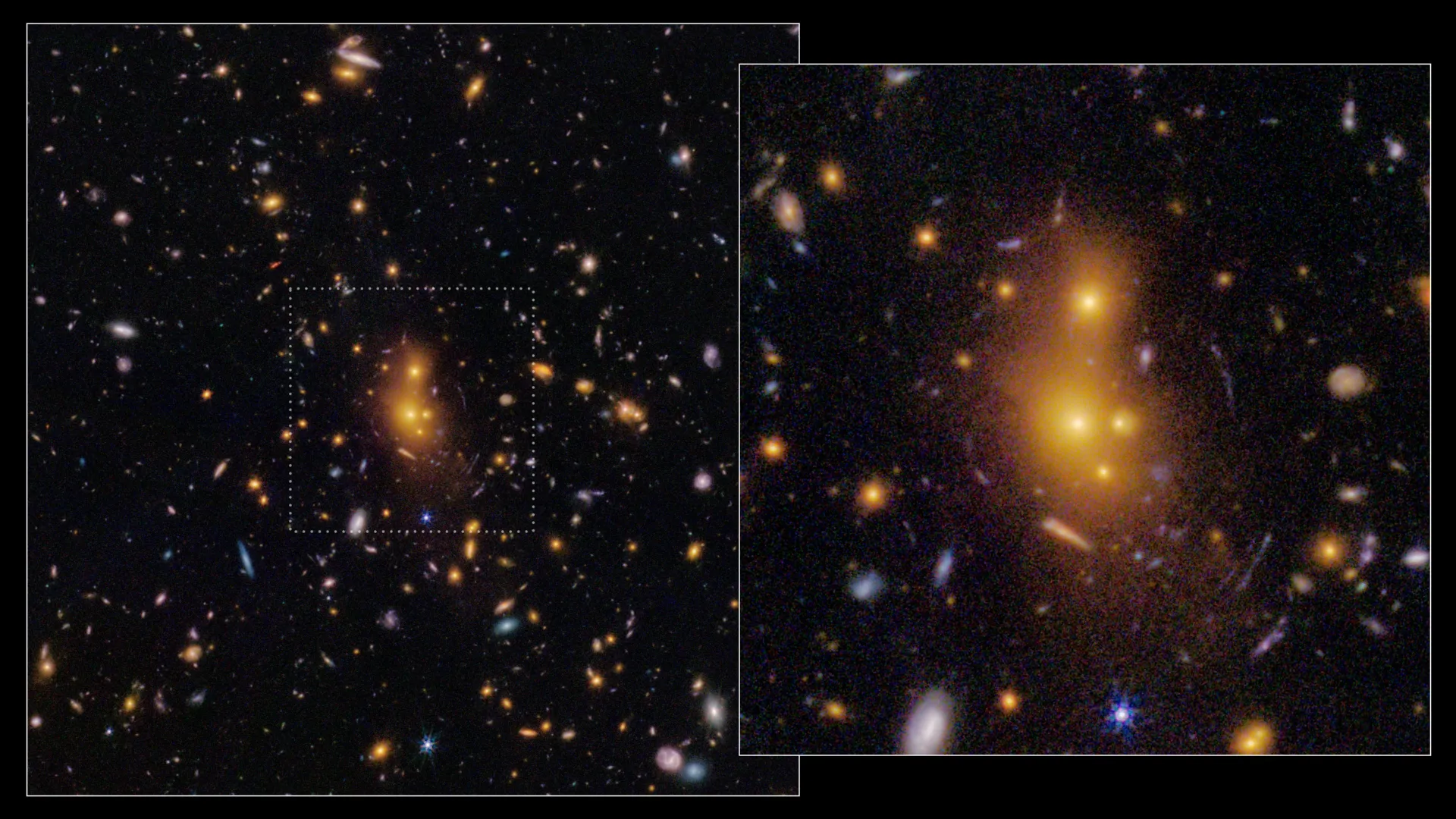
Located about 10.4 billion light-years from Earth, XLSSC 122 is the most distant known galaxy cluster to exhibit strong gravitational lensing. This phenomenon allows astronomers to map the cluster’s mass, including its invisible dark matter.
XLSSC 122 is the focus of three recent studies led by researchers at IPAC, the Science and Data Center for Astrophysics and Planetary Sciences at the California Institute of Technology. The research was presented at a press conference during the 248th Annual Meeting of the American Astronomical Society on June 17, 2026.
The cluster existed during an era when galaxy clusters were still forming through the gradual merger of smaller systems. Yet XLSSC 122 already had the size, organization and central concentration more commonly associated with galaxy clusters in the modern universe.
Ancient galaxy cluster shows powerful gravitational lensing
JWST revealed that XLSSC 122 lies directly in front of one or more even more distant galaxies. The cluster’s powerful gravity bends and distorts light from those background galaxies, creating a striking effect known as strong gravitational lensing.
This alignment gave astronomers an unusually precise way to measure how mass is distributed throughout the cluster.
“When we received the first images from JWST, we said, ‘Wow, look at this! There’s a powerful lensing effect coming out of this cluster!’” said Kyle Finner, a staff scientist at IPAC and lead author of the first paper examining XLSSC 122. “XLSSC 122 has set a record for the most distant galaxy cluster exhibiting strong lensing, a valuable tool for astronomers.”
XLSSC 122 challenges predictions about early cosmic structure
The newly detected gravitational lens gives researchers an opportunity to study the mass distribution of an ancient galaxy cluster in exceptional detail. XLSSC 122 dates back to an era known as “Cosmic Noon,” approximately 10 billion years ago, when the universe was experiencing its most intense period of star formation.
During Cosmic Noon, galaxies were forming stars at rates up to 100 times higher than those seen in the modern universe. Galaxy clusters were also becoming more common as smaller galaxies and groups merged into larger structures.
XLSSC 122, however, appears to have developed in an unexpected way. New measurements show that a significant portion of its mass is concentrated near the cluster’s center. Standard cosmological models generally predict that massive structures should grow more gradually, making such a dense and organized cluster surprising at this early point in cosmic history.
“XLSSC 122 is one of the first galaxy clusters to form in the universe to our knowledge, and its mass concentration does not match the predictions of our cosmological models,” Finner said.
To investigate the mystery further, Finner and his collaborators conducted two additional JWST studies, originally authored by Zachary Schofield and Hyunjin Ju of Yonsei University. Together, the three papers provide a broader view of XLSSC 122 and offer new clues about galaxy cluster formation during Cosmic Noon.
James Webb reveals hidden dark matter in the cluster
Astronomers first identified XLSSC 122 in 2014 through an X-ray survey conducted by the European Space Agency’s XMM-Newton spacecraft. Later observations with the Hubble Space Telescope confirmed its distance of approximately 10.4 billion light-years and showed that the cluster appeared unusually developed for its age.
Hubble did not reveal clear evidence of strong gravitational lensing. That changed when JWST captured a characteristic curved arc of light around the cluster’s center, providing the first definitive sign of strong lensing in XLSSC 122.
“Until JWST, it was not possible to do this level of science in the distant early universe,” Finner said.
The gravitational distortions are caused primarily by something astronomers cannot observe directly: dark matter.
XLSSC 122 contains visible stars and hot, glowing gas, but these familiar forms of matter account for only part of the gravitational lensing effect. Most of the distortion comes from dark matter, an invisible substance that does not emit or reflect light but whose gravitational influence is supported by extensive astronomical evidence.
Scientists estimate that dark matter is about five times more abundant than the ordinary matter that makes up stars, planets and everything around us. Its gravity helps hold galaxies together and shapes the vast cosmic network of galaxy groups, clusters and filaments.
Mapping dark matter billions of years in the past allows scientists to test theories describing how the universe evolved after the Big Bang, approximately 13.8 billion years ago.
“Strong lenses are a way to measure dark matter without actually looking at it,” Finner said. “It gives us a sensitive investigation of cosmological models.”
Weak lensing reveals that the galaxy cluster is still merging
In the second paper, the researchers examined XLSSC 122 using another form of gravitational lensing known as weak lensing.
Strong gravitational lensing produces obvious distortions, such as the pronounced arc captured by JWST. Weak lensing causes much smaller changes in the apparent shapes of distant galaxies. Because these subtle effects are difficult to identify individually, astronomers use statistical methods to detect them across large numbers of background galaxies.
The two techniques provide complementary information. Strong lensing is especially useful for measuring mass concentrated near the center of a galaxy cluster, while weak lensing can reveal how matter is distributed throughout its outer regions.
“The weak gravitational lensing constrains the mass further outward, allowing us to better understand the surrounding cluster region,” Finner said.
When researchers combined the lensing measurements with X-ray and radio observations from other telescopes, they found that XLSSC 122 is still merging. Its galaxies continue to come together as the cluster grows.
The broader analysis also confirmed earlier findings that an unusually large amount of mass is concentrated near the cluster’s core.
Ancient starlight provides another way to map dark matter
The third and latest study revealed another important feature of XLSSC 122: faint light produced by stars that are no longer bound to individual galaxies.
This diffuse glow, known as intracluster light, comes from stars scattered through the space between galaxies. JWST’s observations represent the oldest known detection of intracluster light and provide another way to study how galaxy clusters developed in the distant universe.
The widespread distribution of this light supports the conclusion that XLSSC 122 is undergoing a merger. When galaxies interact and collide, some stars can be pulled away from their original galaxies and spread throughout the cluster. In XLSSC 122, many of these displaced stars do not appear to have settled in the dense central region.
The researchers also found a possible connection between the wandering stars and dark matter. Near the center of the cluster, the shape of the intracluster light closely matches the distribution of dark matter inferred from strong gravitational lensing.
This suggests that the faint glow between galaxies could act as a visible indicator of where invisible dark matter is concentrated. If astronomers find similar relationships in other galaxy clusters—particularly those from the early universe—intracluster light could become a valuable tool for mapping dark matter across cosmic history.
“In this cluster, the light within the cluster essentially follows the dark matter,” Finner said. “That light indicates that the cluster is in a merging state.”
Could more ancient galaxy clusters force a revision of cosmology?
Finner and his colleagues’ next goal is to identify and study dozens more galaxy clusters from similarly early periods in the universe’s history.
Finding distant clusters requires a different strategy from studying them in detail. Although JWST is extremely powerful, its relatively narrow field of view makes it better suited to examining selected targets than surveying large areas of the sky.
Astronomers must first locate promising candidates through extensive X-ray and radio surveys, similar to the observations that initially revealed XLSSC 122.
One promising method relies on the Sunyaev-Zeldovich effect. This occurs when high-energy particles in galaxy clusters scatter radiation from the cosmic microwave background, the faint afterglow of the Big Bang.
The interaction can create a distinctive region that appears as a “hole” in observations of the cosmic microwave background. By searching for these signatures, astronomers can identify galaxy clusters that might otherwise be difficult to detect.
Discovering more objects like XLSSC 122 could have major implications for cosmology. If other ancient galaxy clusters also contain unexpectedly concentrated dark matter and show an unusually advanced level of development, scientists may need to revise some assumptions about how quickly large cosmic structures formed.
For now, XLSSC 122 provides an important test of existing models. Larger samples are needed to determine whether its unusual properties are rare or part of a broader pattern in the early universe.
“The JWST era is still in its early stages, and if we can start getting data on dozens or hundreds of these types of objects at this stage in the universe, then we can really start testing cosmological models,” Finner said.
Source: www.sciencedaily.com