


Why More International Students Are Choosing China for Graduate Study
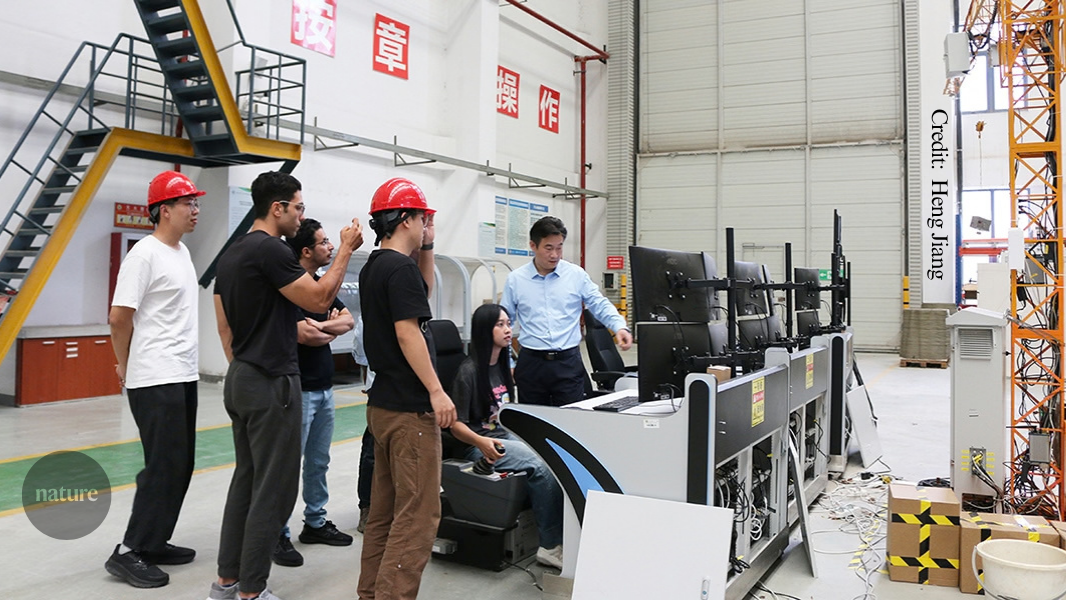
Engineering graduate students from Egypt, Yemen, Indonesia and Niger observe a demonstration of smart construction systems at Southeast University in Nanjing, China.Credit: Heng Jiang
Fatma Satyani, an Indonesian PhD student living in China, wakes up at 7:30 every weekday morning to prepare for the day. Before heading to class at Nanjing Information University in eastern China, she usually eats a traditional Chinese breakfast such as youtiao, or fried dough sticks, and baozi with warm soy milk.
“I love studying here,” says Satyani, who is pursuing a PhD in big data and business intelligence. “The Chinese people are friendly, the food is delicious, and getting around Nanjing is very convenient.”
Satyani is part of a rapidly growing group of students from low- and middle-income countries, particularly in Asia and Africa, who are pursuing graduate education in China as the country invests heavily in development and advanced technologies.
China’s international student population is growing
The number of international students in China has increased since the country lifted its strict coronavirus lockdown rules at the end of 2022. Official statistics reported by China Daily show that 380,000 international students were studying in the country during the 2024–25 academic year—15% more than the previous year.
International students still represented less than 1% of the 48.5 million students enrolled in China’s higher-education system in 2024–25. The proportion is also far below the shares recorded in the United States and the United Kingdom.

Source: HESA; IIE; NCES; Ministry of Education of China; China Daily
In China, 61% of international students come from Asia. Most of the remainder come from Africa and Europe, at 16% each. Government statistics indicate that about 71,750 international students are enrolled in master’s or doctoral programmes.
Although the number of international students is rising, it remains below the roughly 500,000 students who were studying in China in 2018, before the pandemic, according to QS Quacquarelli Symonds, a UK-based higher-education analysis company.

On the move: Why PhD students will study abroad in 2025
Foreign PhD students in China say they are attracted by generous scholarships, opportunities to learn Chinese, connections with Chinese people and the country’s growing capabilities in frontier technologies such as artificial intelligence and data analysis.
China also presents challenges. Mandarin can be difficult to learn, students often have limited options to remain in the country after completing their studies, and Chinese degrees are considered less competitive in some countries.
“In the past, we saw America being the world’s first in science, technology and education. In the future, I think China will be the world’s first in these fields, including attracting and training students and researchers from around the world,” Satyani says.
Learning from China’s technology sector
Satyani completed a two-year master’s degree in business administration and is now in the second year of a doctoral programme. She moved to China in 2023 after Universal University in Batam, Indonesia, suggested that she study there after completing her bachelor’s degree.
“I would like to work as a professor at Universal University in the future, so the university supported me to study abroad in China so that I could take the knowledge I learned in China back to Indonesia and teach it to local students,” Satyani says.
After earning her master’s degree, Satyani decided to pursue a doctorate in China because she wanted to study a subject that would be useful in the future. She sees China as an ideal place to learn how businesses and governments use big data—large datasets that can reveal trends and patterns—and artificial-intelligence tools to improve efficiency.
“In the future country, we have to learn future knowledge,” Satyani says.
Similarly, meteorology doctoral student Aminu Dalhatu Dutti chose Nanjing University of Information Science and Technology because it is a leading institution in meteorology and has advanced computing systems for complex data analysis. Dutti, who is from Nigeria, had heard positive reports about China’s rapid growth and support for international students.

At a cultural-exchange event at Sichuan University in Chengdu, China, Chailina Hanum Siregar introduces Indonesian tea and snacks. She is studying for a PhD in management science.Credit: International Office, School of Business Administration, Sichuan University
Dutti attended an international meteorology conference in China, where he gained knowledge and professional connections that he says will be valuable when he completes his PhD and returns to his position at the Nigeria Meteorological Agency in Abuja.
For students such as Chailina Hanum Siregar, lifestyle and scholarships were important factors. “As a woman, safety is very important to me. I really like how safe the streets of Chengdu are,” she says.
Siregar, who is originally from Jakarta, is a third-year doctoral student studying management science and engineering at Sichuan University in Chengdu. She also applied to universities in the United Kingdom and Australia but did not receive a scholarship offer. She says she did not apply to universities in the United States because of concerns about security there.
Scholarships and China’s soft-power strategy
China launched a national “Study in China” campaign in 2010 to attract international students and “cultivate high-quality international students who understand China and are friendly to China”. In 2016, the country announced that its international higher-education strategy would be incorporated into the Belt and Road Initiative (BRI), a global infrastructure and development strategy involving projects in more than 140 partner countries.
Most of the BRI partner countries are low- and middle-income countries. The Chinese government described education and trade as the “two wings” supporting the Belt and Road.
The students interviewed by the Nature Careers team hold government scholarships. The exact level of support varies, but doctoral scholarships typically include tuition, medical insurance, a monthly stipend and free or subsidized housing.
Tu Mengwei, a sociologist at Swansea University in the United Kingdom, says that China’s generous scholarships are helping to attract international students. Satyani, for example, receives a Chinese government scholarship that provides a monthly stipend of 3,500 yuan—approximately US$520—and free housing.
China is also seeking to internationalize its higher-education system by attracting postdoctoral researchers from abroad, including researchers of Chinese descent. “All of this is part of a larger plan to expand China’s soft power and global influence,” Tu says.
International student demographics are changing
“Since the pandemic, the total number of international students in China has recovered, but the demographics have changed dramatically,” says Wen Wen, a higher-education expert at Tsinghua University in Beijing.
South Korea was the largest source of international students in China in 2018, followed by Thailand, Pakistan, India and the United States. According to QS, the five largest sources in 2024 were Thailand, Pakistan, Vietnam, Russia and Indonesia.
QS consultant Alice Wei says the shift is not surprising. China has long been a popular destination for students from Thailand, Pakistan and Vietnam because of close political ties and frequent trade activity. Rapid economic growth in Southeast Asia has also increased demand for skilled workers, encouraging young people to seek higher education abroad.

Source: Ministry of Education of China; QS Quacquarelli Symonds
Tu says that international students from Pakistan and other Belt and Road countries increased between 2018 and 2023, when she was conducting fieldwork on the international student experience in China.1
The increase was driven not only by China’s policies but also by students’ own plans and ambitions. As China strengthens its transport and infrastructure links with Pakistan, Pakistani students have increasingly recognized that speaking Mandarin or having connections with China could improve their job prospects, Tu says.
China is also building the China–Pakistan Economic Corridor, a US$62 billion Belt and Road flagship project that began in 2015. It aims to develop transport and infrastructure links between Pakistan’s Gwadar port on the Arabian Sea and China’s Xinjiang autonomous region.2
By contrast, the number of Korean and American students in China has declined. Data from South Korea’s Ministry of Education show that the number of South Korean students in China fell by nearly 80% between 2017 and 2023. According to QS, the number of students from the United States dropped from about 24,000 in 2017 to just 400 in 2023.
Researchers attribute the decline mainly to China’s strict pandemic lockdowns, geopolitical tensions and deteriorating public sentiment towards China in those countries.
International students remain separated from Chinese classmates
Most international students in China take courses established by universities that are primarily English-speaking. Few live, study and conduct research alongside Chinese classmates.
Wen says China has a long tradition of keeping international students separate from Chinese students because of immigration and public-security regulations.
Source: www.nature.com