


credit:
NASA’s Goddard Space Flight Center/Conceptual Imagery Lab
NASA’s Nancy Grace Roman Space Telescope is traveling from Earth to Lagrange Point 2, or L2, a region of space located about 1.5 million miles from Earth in the direction away from the Sun. During this approximately three-month journey, the Roman Space Telescope team is conducting a critical phase called commissioning.
During commissioning, engineers and scientists power up the observatory’s systems, calibrate its instruments, and prepare the space telescope for scientific operations. These tests help confirm that Roman is functioning as expected and ready to explore the universe. The mission schedule may change as the team evaluates results and makes necessary adjustments.
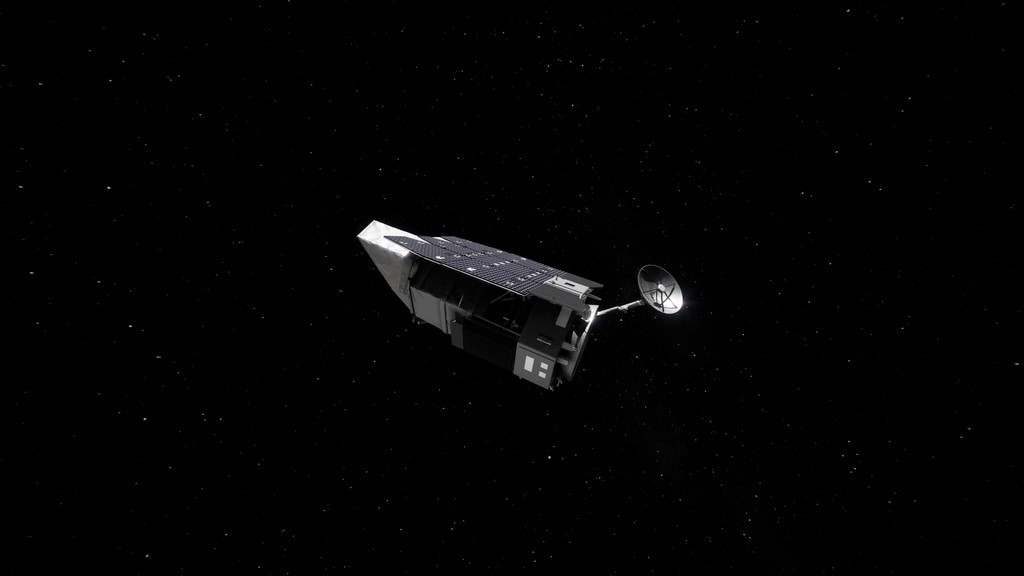
About one hour and 23 minutes after launch, the Roman Space Telescope began unfolding from its compact configuration inside the rocket’s protective fairing. Its solar arrays deployed to generate power, while sunshields and other protective structures extended to help maintain the observatory’s operating temperature.
As deployment continues, the spacecraft’s high-gain antenna will be positioned to support communication with Earth. A visor-like deployable aperture cover will also move into place, permanently exposing and shading Roman’s primary mirror. These steps are essential to preparing the telescope for its mission to study dark energy, dark matter, exoplanets, and the evolving universe.
This visualization shows the Nancy Grace Roman Space Telescope traveling in a stable halo orbit around L2. At this location, the combined gravity of the Sun and Earth, along with Roman’s motion around the Sun, helps keep the observatory aligned with Earth while requiring relatively little fuel for station-keeping.
Orbiting near L2 gives Roman a steady thermal environment and an unobstructed view of large portions of the sky. Because Earth is far away, it blocks very little of the telescope’s view. The distance from the Sun, Earth, and Moon also reduces heat that could interfere with Roman’s infrared observations, allowing the observatory to detect faint cosmic signals.
Learn more about how the Roman Space Telescope’s systems are powered up, tested, calibrated, and prepared for groundbreaking science.
keep exploring
Discover more topics from NASA
Source: science.nasa.gov