


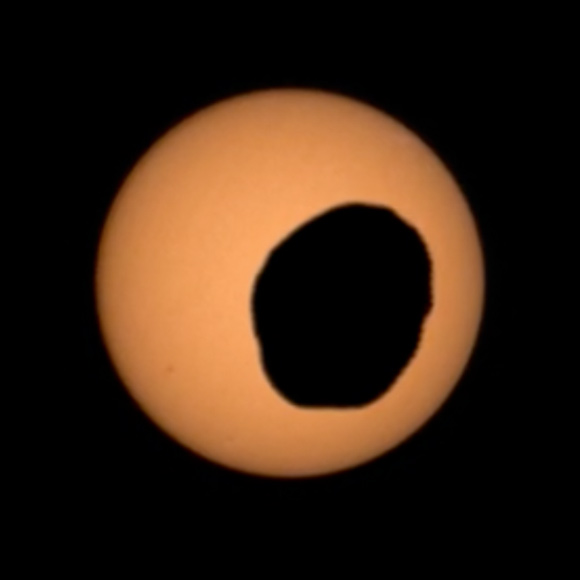
NASA’s Perseverance rover captured a stunning view of Phobos, Mars’ larger moon, passing in front of the Sun in a rare solar transit observed from Jezero Crater.
Mars’ moon Phobos crosses the Sun in an image captured by Perseverance’s Mastcam-Z camera on August 12, 2026. Image credit: NASA / JPL-Caltech / ASU / MSSS / SSI.
Phobos is the larger and innermost of Mars’ two moons. American astronomer Asaph Hall discovered the irregular satellite on August 17, 1877.
The small, heavily cratered moon measures approximately 26 x 22 x 18 km (16.2 x 13.7 x 11.2 miles) and has a distinctive, rugged, potato-like shape.
Phobos is the closest orbiting natural satellite to its planet in the Solar System. It travels approximately 6,000 km (3,700 miles) above the Martian surface and completes one orbit around Mars in just 7 hours and 39 minutes.
Because Phobos orbits so close to Mars, the planet’s curvature would prevent observers near the Martian polar regions from seeing the moon.
Phobos’ orbital period is about three times shorter than Mars’ rotation period. As a result, observers on the Martian surface would see the moon rise in the west and set in the east—an unusual motion for a natural satellite.
Unlike Earth’s Moon, Phobos is too small and too close to Mars to completely cover the Sun. Solar eclipses caused by Phobos are therefore partial solar transits, during which the moon’s dark, potato-shaped silhouette moves across the solar disk.
“Perseverance used the Mastcam-Z camera to capture the silhouette of Phobos as it crossed in front of the Sun on August 12, 2026, the 1,948th Martian day, or sol, since the start of the mission,” members of the Perseverance team said in a statement.
“This animation is colored to simulate what it would look like if a human observer viewed the solar transit through eclipse safety glasses from the surface of Mars.”
This is not the first Phobos solar transit observed by Perseverance. Since landing in Jezero Crater in February 2021, the Mars rover has recorded several passages of the moon across the Sun.
“By comparing observations from different solar transits, scientists can refine their understanding of Phobos’ orbit and investigate how the small Martian moon is changing,” the researchers said.
In the distant future, Phobos’ orbit is expected to gradually decay, eventually sending the moon toward the surface of Mars.
Source: www.sci.news