


Glucosamine May Worsen Alzheimer’s Disease Outcomes, Study Finds
Glucosamine, a widely used over-the-counter supplement for joint pain, may worsen outcomes for people with Alzheimer’s disease and related dementias, according to a new study by neuroscientists at the University of Florida.
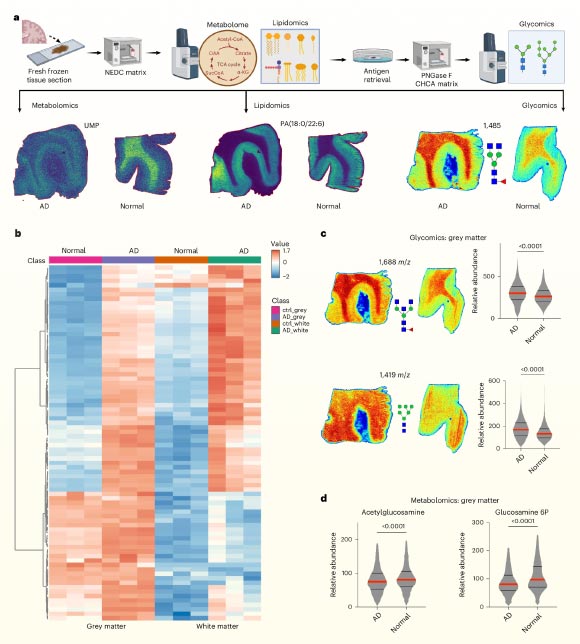
Spatial multi-omics analysis reveals hyperglycosylation in the human Alzheimer’s disease brain. Image credit: Hawkinson et al., doi: 10.1038/s42255-026-01538-4.
“About 7 million people in the United States have Alzheimer’s disease, and millions more have related dementias such as Lewy body dementia and frontotemporal dementia,” said co-senior author Dr. Ramon Sun, director of the Center for Advanced Spatial Biomolecular Research and associate director of innovation at the University of Florida’s McKnight Institute for Brain Research.
“Many of these people are actively taking over-the-counter supplements that can worsen the progression of the disease.”
Alzheimer’s brains show abnormal sugar-chain activity
Because glucosamine is widely available and commonly used by older adults for joint health, Dr. Sun and his colleagues investigated whether it might affect Alzheimer’s disease and related dementias.
The researchers found that brains affected by Alzheimer’s disease contain abnormally high levels of N-glycans, which are sugar chains attached to proteins. They refer to this condition as hyperglycosylation.
The increase was found in brain tissue from deceased Alzheimer’s patients and was more pronounced in the brain’s gray matter during later stages of the disease. It also appeared in two mouse models of Alzheimer’s disease.
“Proteins are the molecular machines of the cell, and many of them require a sugar tag attached to them in the right way to fold correctly and move to the right place to do their job,” said co-senior author Dr. Matt Gentry, chair of the Department of Chemistry and Molecular Biology at the University of Florida.
“What we found in Alzheimer’s disease is that this sugar-tagging system appears to be overactive.”
“Alzheimer’s brains add too many of these sugar structures, and this appears to contribute to the progression of Alzheimer’s disease rather than preventing it.”
Glucosamine worsened memory in mice
Experiments in mice suggested that the increase resulted from greater production of sugar chains rather than a failure to break them down.
The researchers found that targeting PGM3, a component of the sugar-chain building pathway, could improve outcomes in the animal models. A drug called NGI-1 helped mice with Alzheimer’s disease perform better on social memory tests.
By contrast, when mice were given glucosamine, which supplies material for the sugar-chain building pathway, the amount of sugar chains in the brain increased and memory worsened.
Neither approach changed the amyloid plaques that are a hallmark of Alzheimer’s disease.
Human health-record data show higher risks among glucosamine users
The scientists also analyzed electronic health records from the University of Florida Health System.
Among patients with Alzheimer’s disease-related dementia, those with documented glucosamine use for at least one year had an approximately 25% higher risk of death than non-users.
Among patients with mild cognitive impairment, glucosamine users were approximately 25% more likely to progress to dementia. However, survival rates were not significantly different from those of non-users.
Approximately 8% of the patients in the records were documented glucosamine users.
Study does not prove glucosamine causes harm
The authors cautioned that the human data are observational and do not prove that glucosamine causes harm in people. Glucosamine did not increase glycan levels or impair memory in the brains of healthy mice.
“Our findings suggest that metabolic changes significantly contribute to the progression of Alzheimer’s disease, and furthermore, addressing metabolic abnormalities may be an important complement to approaches focused on Alzheimer’s disease plaques and Alzheimer’s disease-related fibrotic changes,” said Dr. Sun.
The findings were published in the journal Nature Metabolism.
_____
TR Hawkinson et al. 2026. Hyperglycosylation is a metabolic driver of Alzheimer’s disease. Nature Metabolism 8, 1410–1425; doi: 10.1038/s42255-026-01538-4.
Source: www.sci.news