


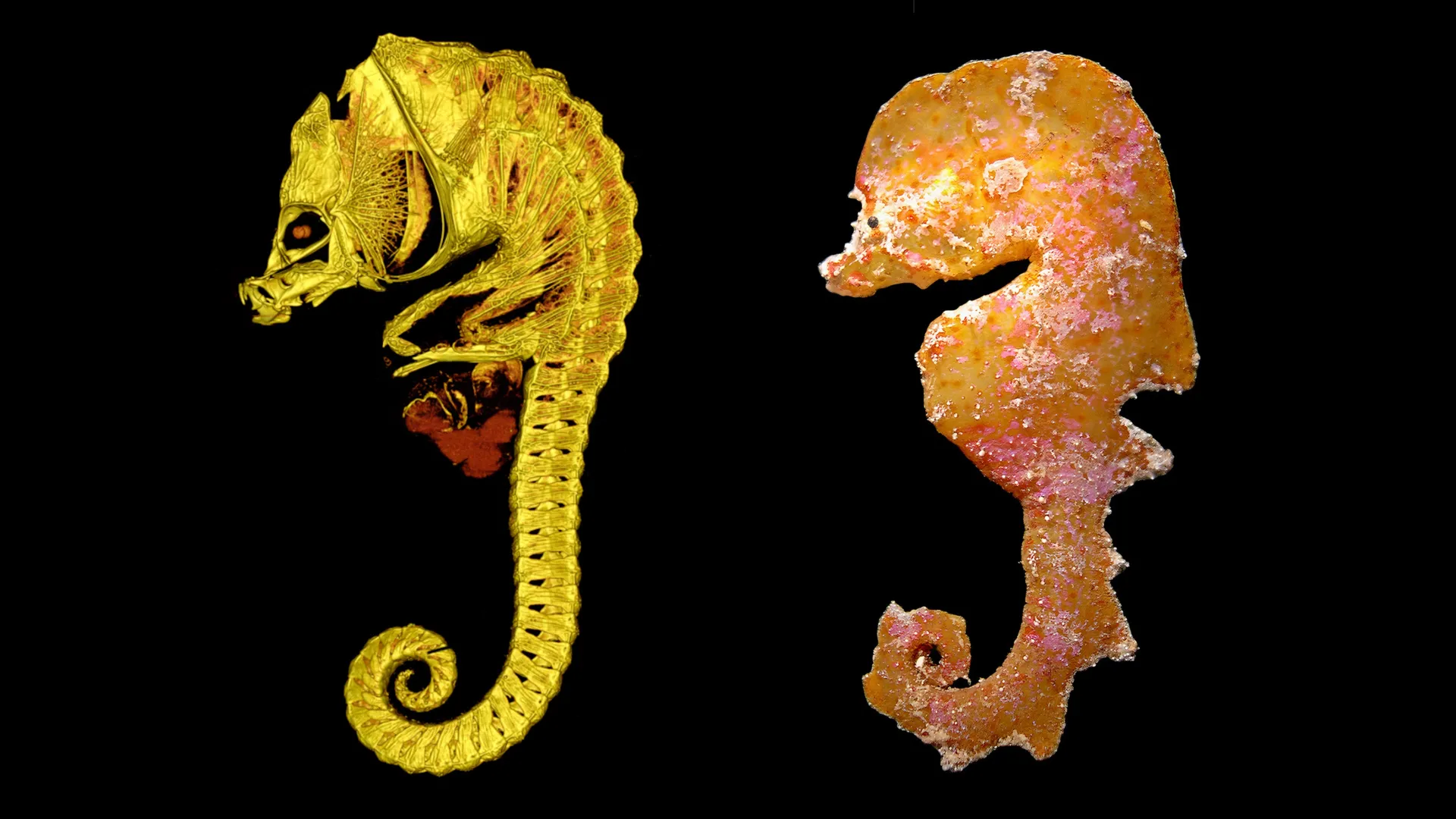
At first glance, the Helmethead Seamuppet looks like a seahorse, with a horse-shaped head, a curled prehensile tail and a fully enclosed pouch in which the male carries young. But a new study identifies this thumb-sized fish as a distinct genus that evolved similar features independently. Known only from seven preserved specimens collected from deep waters off southern Australia, the fish had remained misidentified in museum collections for decades.
A fish hidden in museum collections
The study, published in Journal of Lost Species, describes Australichthys aegis, a newly recognized fish from deep coral reefs off southern Australia. Its common name, the Helmethead Seamuppet, refers to the dome-shaped, helmet-like structure on its head.
Its scientific name follows the same idea: in Greek mythology, the aegis was a protective shield. The species belongs to a small group called the Sea Muppets, alongside the Bullneck Seamuppet (A. minotaur) and the Paradoxical Seamuppet (A. paradoxus).
All three species occupy distinct branches of the family tree. Although seahorse-like features have evolved repeatedly, these fish are only distantly related to true seahorses. The evidence for their distinct identity remained misfiled in a museum drawer for decades.
Bycatch from deep water
These fish cannot be found by scuba diving. All known specimens were caught accidentally in trawls or dredges operating approximately 50 to 125 metres below the seabed.
A single specimen of A. aegis was collected in 2006 near the Gambier Islands, at the mouth of Spencer Gulf in South Australia. The dredger was sampling small shelled animals called brachiopods during a natural-history expedition. Because the expedition was targeting invertebrates, the fish was mistakenly placed in the South Australian Museum’s invertebrate collection, where it remained unrecognized for many years.
The other specimens were also caught by chance, preserved and largely forgotten. They are held in collections including the Australian Museum, Museum Victoria and CSIRO.
The entire genus is known from just seven specimens, collected over about 65 years and scattered across more than 2,500 kilometres of coastline. No specimens have been collected for nearly 20 years.
An irreplaceable specimen
Because the specimens are irreplaceable, the researchers could not dissect them. Instead, they used micro-CT scans, a form of X-ray imaging related to the technology used in hospitals but detailed enough to reveal the fish’s small bones.
The scans allowed the researchers to build three-dimensional models of each skeleton and compare the bones individually with those of a true seahorse (Hippocampus).
Earlier classifications had been based on the fish’s outward appearance, but the skeleton did not support a close relationship with seahorses. Seahorses have distinctive internal structures, including a hard cage of fused bony plates supporting the abdomen and a bony head structure called a coronet.
The scans showed that Australichthys has neither feature. Instead, the fish has a different arrangement of bones supporting the abdomen, one not found in seahorses.
DNA could be obtained from only one specimen. The A. aegis specimen had been preserved in ethanol rather than formalin, and it was the only member of the genus preserved in a way that left its genetic material intact.
Genetic sequencing placed the fish well outside the seahorse lineage, on a branch alongside its closest relative. The genetic evidence confirmed what the bones had already shown.
All three species had previously been classified in the genus Hippocampus because of their appearance. The anatomical and genetic evidence showed that they were not seahorses and required their own genus. The name Australichthys combines the Latin word for “south” with the Greek word for “fish.”
A shared way of life
When separate evolutionary lineages develop similar features, biologists call the process convergent evolution. It usually reflects a shared way of life rather than close shared ancestry.
The seahorse body plan—including the curved head, strong tail and brood pouch—has evolved at least twice within a single fish family, Cucinaceae, which includes seahorses, pipefish, pipehorses and seadragons.
Understanding how this happened could help explain why evolution repeatedly arrives at similar solutions.
These fish were found in the Great Southern Reef, a system of connected kelp forests and reefs surrounding southern Australia. Many of its species are found nowhere else, while its deeper zones remain largely unexplored.
An entire genus of vertebrates was accidentally hidden there until CT scanning helped resolve its identity.
No one has seen these fish alive. They have appeared only in passing nets and dredges, qualifying them as a lost species: animals known from a small number of preserved specimens but never observed alive.
Calling them lost does not predict that they are extinct. Instead, it identifies them as a priority for targeted research rather than animals left to be rediscovered by chance. They may still live in parts of the ocean that people rarely visit.
Source: www.sciencedaily.com