


New research reveals that the extinct thylacine, also known as the Tasmanian tiger or marsupial wolf, had a uniquely adapted skull unlike any living predator. In a new study published in Nature Communications, researchers from Flinders University, the University of Melbourne and the Australian Museum found that the thylacine did not simply evolve a wolf-like skull. Instead, its skull combined features associated with foxes, jackals, marsupials and several extinct predators.
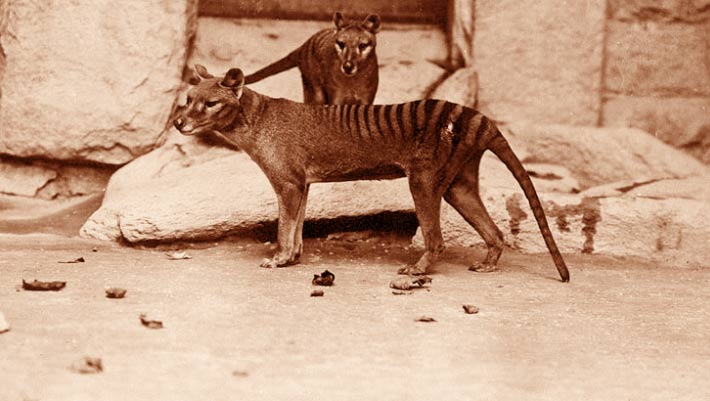
A pair of thylacines, or Tasmanian tigers, photographed around 1905. Image credit: Smithsonian Institution/EJ Keller, National Zoo.
The thylacine (Thylacinus cynocephalus) was a carnivorous marsupial and Tasmania’s apex terrestrial predator. Although it resembled a medium-sized dog or wolf, it was more closely related to kangaroos and other marsupials than to placental carnivores.
Known for its distinctive dark stripes across the lower back, elongated snout and unusual reproductive anatomy, the thylacine appeared to combine features from several different animals. Its scientific name, Thylacinus cynocephalus, means “dog-headed pouched animal.”
Fossil evidence indicates that thylacines were present in Australia millions of years ago. By the 20th century, however, they had disappeared from mainland Australia and survived only in Tasmania, the island state south of the Australian mainland.
The species declined because of several factors, including hunting, habitat loss and competition with introduced species. A government bounty system operating from 1830 to 1914 led to the killing of thousands of thylacines. The last confirmed thylacine died at Beaumaris Zoo in Hobart, Tasmania, in 1936.
The thylacine’s resemblance to gray wolves contributed to the widespread belief that it was a serious threat to livestock. According to the researchers, this perception helped accelerate the extinction of an already rare animal, despite limited evidence that thylacines had a major effect on Tasmania’s livestock industry.
“The thylacine’s resemblance to the gray wolf contributed to the belief that it was a livestock predator,” said Flinders University researcher Vera Weisbecker and her colleagues.
“This association partly caused the rapid extinction of an already rare species by British colonists within 130 years, although there was little evidence that it had a significant impact on the livestock economy.”
The extinction of the thylacine marked the disappearance of a lineage of large carnivorous marsupials that had survived for more than 30 million years. Because there are no living close relatives, scientists have had to reconstruct the species’ ecology and evolution using fossils, museum specimens, historical observations and comparisons with other mammals.
For the new study, Professor Weisbecker and her co-authors conducted a detailed three-dimensional analysis of the thylacine skull. They compared it with the skulls of 60 carnivorous mammals, including wolves, foxes, big cats and extinct marsupial predators.
The analysis showed that the front of the thylacine’s snout resembled that of canids that hunt relatively small prey, such as foxes and jackals. However, the rear portion of the skull more closely resembled that of its marsupial relatives.
The researchers also found that the thylacine’s skull was remarkably large for its body mass of approximately 17 kilograms. Its skull was comparable in size to those of predators weighing two to four times more, including gray wolves and leopards.
Despite its size, the thylacine skull was not built like that of a typical large predator. Its snout was unusually tall, narrow and curved, with a broad, pinched region near the canine teeth known as a “terminal rosette.” Similar features are found in only a small number of extinct, long-snouted predators, including the Eocene mammal Andrewsarchus.
The researchers also identified an unusually large infraorbital foramen, an opening in the skull associated with the facial nerves. Although its precise function in the thylacine remains uncertain, the feature may have supported enhanced facial sensitivity and helped the animal position accurate bites.
Together, these anatomical characteristics suggest that the thylacine used a rapid, high-impact snap bite to capture relatively small and agile prey. This feeding strategy does not closely match that of any living mammal and may be more comparable to the hunting adaptations of extinct predators with long, slender jaws.
“Our latest findings about the thylacine’s feeding adaptations challenge the myths that contributed to its extinction,” Professor Weisbecker said.
The thylacine has often been compared with Northern Hemisphere predators such as wolves, jackals and foxes because of its body shape and elongated head. However, these similarities are an example of convergent evolution: unrelated animals independently evolve comparable traits in response to similar ecological pressures.
“The thylacine may have weighed only about half as much as an average gray wolf, but its oversized skull was approximately the same size as a wolf’s skull,” said Australian Museum researcher Dr Douglas Rovinsky.
“However, although the thylacine skull was large, it was not shaped like the skull of a typical large predator. Its snout was long, thin and relatively delicate rather than robust like that of a gray wolf.”
“Instead, the thylacine’s snout more closely resembled that of a fox or jackal, even though those animals can be considerably smaller than a thylacine.”
_____
V. Weisbecker et al. 2026. The skull morphology of the extinct Tasmanian tiger suggests a unique way of chewing. Nature Communications 17, 8729; doi: 10.1038/s41467-026-76614-0
Source: www.sci.news