


Astronomers have made a groundbreaking discovery using spectral data from the Mid-Infrared Instrument (MIRI) onboard the NASA/ESA/CSA James Webb Space Telescope, detecting methane in interstellar object 3I/ATLAS for the first time ever.
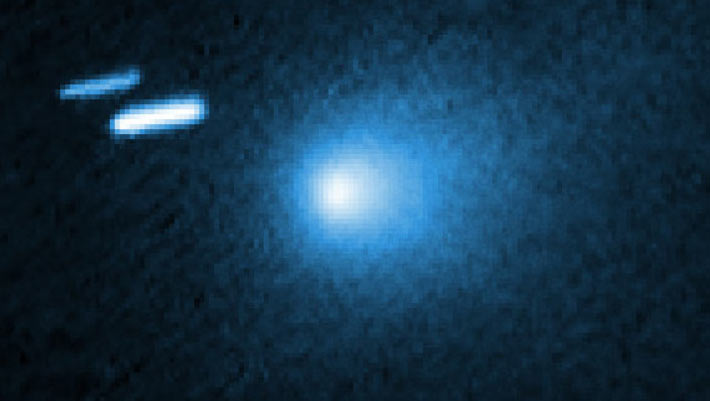
Hubble captured this image of 3I/ATLAS on July 21, 2025, when the comet was 446 million kilometers (277 million miles) from Earth. Image credits: NASA/ESA/David Jewitt, UCLA/Joseph DePasquale, STScI.
According to astronomer Matthew Belyakov from the California Institute of Technology, “Interstellar objects (ISOs) like 3I/ATLAS are planetesimals formed around other stars and ejected from their original systems through mechanical interactions.”
“During its brief journey through our solar system, 3I/ATLAS offers a unique insight into a population of small extrasolar objects, providing a valuable opportunity to analyze similarities and differences in planetesimal formation processes across the galaxy.”
3I/ATLAS is the third confirmed interstellar object, following 1I/’Oumuamua and 2I/Borisov, featuring an estimated core diameter of 2.6 km (1.6 miles).
Unlike 1I/’Oumuamua, which appeared inactive, 3I/ATLAS has shown signs of being in a comatose state for an extended period.
The astronomers stated, “Coordinated efforts are ongoing to characterize the chemical composition of the 3I/ATLAS coma.”
“Ground spectroscopy in visible wavelengths revealed gaseous cyanide and atomic nickel, while radio observations using ALMA uncovered methanol and hydrogen cyanide in its molecular inventory.”
“Additional near-infrared observations via Webb and SPHEREx detected fluorescence signatures from water, carbon dioxide, and carbon monoxide.”
“Post-perihelion measurements by SPHEREx displayed a marked increase in carbon monoxide production along with new emission features at 3.2-3.4 μm, likely resulting from organic materials.”
Evidence suggesting 3I/ATLAS’s activity is evolving includes its bluish visible color and noticeable asymmetry in water production trends before and after perihelion.
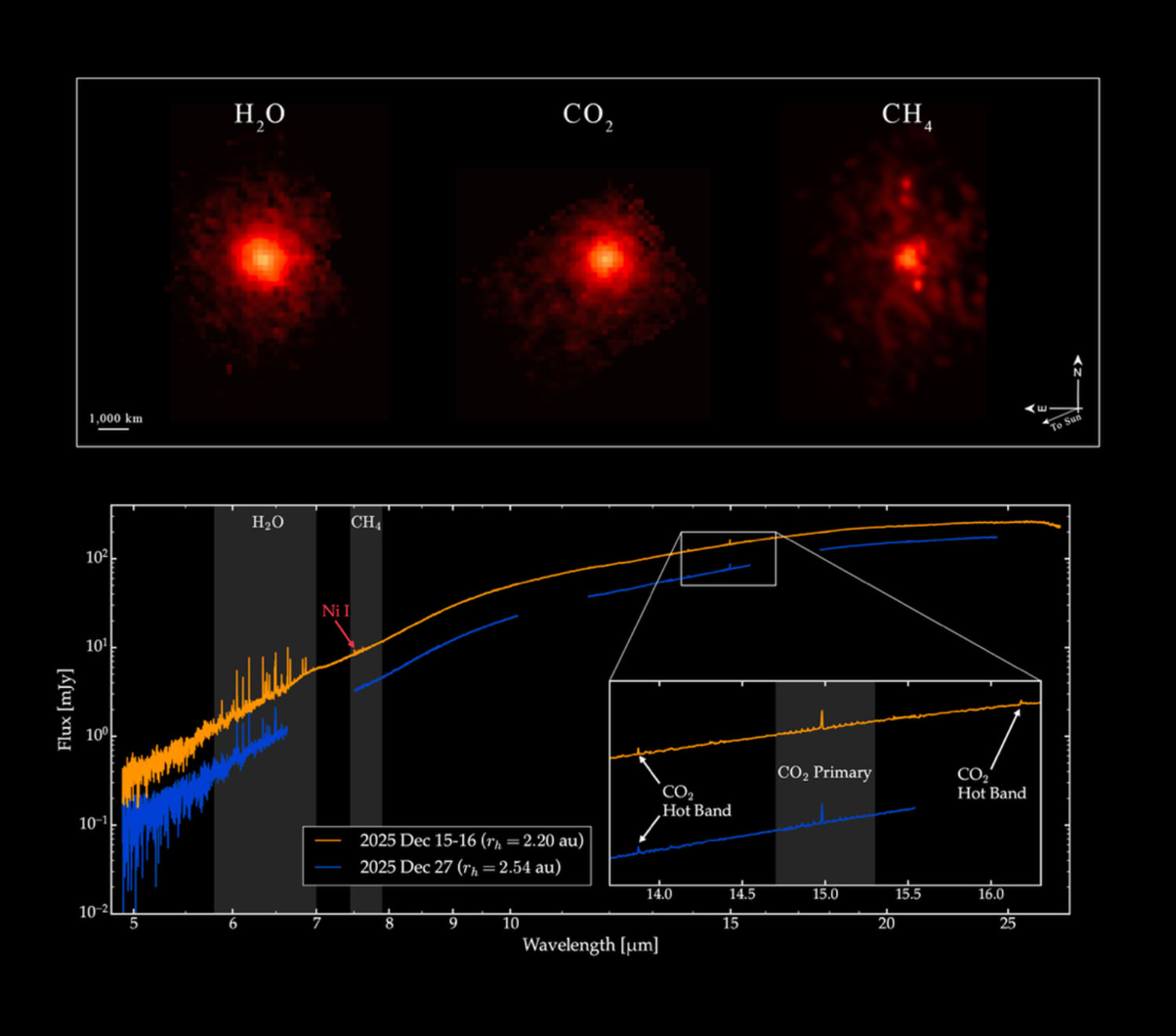
3I/ATLAS observed by Webb’s MIRI instrument, with contour lines indicating gaseous emissions from the comet. Water vapor spreads significantly beyond its core, while carbon dioxide and methane are tightly concentrated near the comet’s core. Image credits: NASA/ESA/CSA/STScI/M. Belyakov, Caltech/I. Wong, STScI/A. Pagan, STScI.
The latest observations were conducted using MIRI on two different days as 3I/ATLAS orbited the Sun, starting from December 15-16, 2025, at around 329 million km (205 million miles) from the Sun, followed by a second observation on December 27 at approximately 379 million km (236 million miles).
“Methane is highly volatile, meaning it easily transitions from solid ice to gas,” the researchers noted.
“The late emergence of methane in Comet 3I/ATLAS suggests it is buried beneath the comet’s surface, insulated from sublimation, until heat from its solar approach penetrates the icy subsurface.”
“The relative amount of methane to water found is surprisingly high and lacks comparable examples in our solar system.”
3I/ATLAS has long been recognized as a rare carbon-rich object, and the Webb observations confirm its uniqueness.
This comet consistently emits more carbon dioxide than water, diverging from typical comets in our solar system.
The presence of methane and carbon dioxide indicates a different formation history compared to traditional solar system origins.
“Webb also observed a rapid decline in gas production as 3I/ATLAS moved away from the Sun, with water showing the most significant decrease,” scientists explained.
“This behavior aligns with expectations for such objects, as reduced solar heat causes the comet’s surface to cool, leading to decreased ice evaporation.”
For further details, check out a paper that will be published on April 8, 2026, in the Astrophysics Journal Letter.
_____
Matthew Belyakov et al. 2026. “Volatile inventory of 3I/ATLAS as seen by JWST/MIRI.” APJL 1001, L11; doi: 10.3847/2041-8213/ae5700
Source: www.sci.news