


Close Menu
HitechubHitechub
    What's Hot
    Technology

    A bricklayer robot has set a new record

    Space

    5 Fascinating Facts About Space

    Technology

    Driverless taxi in Japan

    Important Pages:
    • About Us
    • Privacy Policy
    • Terms & Conditions
    Facebook X (Twitter) Instagram Pinterest
    Facebook X (Twitter) Instagram
    HitechubHitechub
    Thursday, June 4
    • Technology
      1. AI
      2. Gadgets
      3. View All

      This is the most popular CEO in the world

      Sectors in which “Chat-GPT” is most often used

      AI Pioneer Expresses Concern About Potential for AI to Surpass Humanity

      Artificial intelligence has begun to “swallow” professions

      What’s new in Android 14

      Europeans have about 700 million old mobile phones in their drawers

      Here’s how you can tell if your phone is being tapped

      “Sneaker X” – computer case in the shape of a sneaker

      Russian Gamers Unite to Prevent Nuclear War: Join the Fight Online

      Challenges of Space Travel: Why Journeying to Space is So Difficult

      NASA Astronaut Casts Historic Vote from Space

      Discover the Future of Comfort: What If You Could Wear a Chair?

    • Science
      1. Space
      2. Wheels
      3. View All

      Galaxies in the universe are growing more slowly than they should

      “Espace” presented the new lander “Apex 1.0”

      The largest asteroid sample ever collected has arrived on Earth

      (VIDEO) Incredible flight of the Parker Solar Probe

      Toyota wants to make a new generation battery with a range of up to 1,200 km

      Meet Toyota’s lunar “baby” that could make exploring the Moon easier

      Microlino – Is this the perfect city car?

      Alfa Romeo 4C gets an electric successor

      Discover the Giant Scorpion That Dominated Ancient Britain in the Devonian Period

      Pigeons Utilize Superparamagnetic Immune Cells in Their Livers to Detect Earth’s Magnetic Field

      Webb Telescope Discovers Methane in Interstellar Comet 3I/ATLAS

      Silent Spring: How Rachel Carson’s 1962 Science Book Transformed the World

    HitechubHitechub
    Home » When Food is Scarce: This Single-Celled Organism Becomes a Giant Man-Eater for Survival
    Science

    When Food is Scarce: This Single-Celled Organism Becomes a Giant Man-Eater for Survival

    Share Facebook Twitter Pinterest WhatsApp
    Share
    Facebook Twitter LinkedIn Pinterest WhatsApp

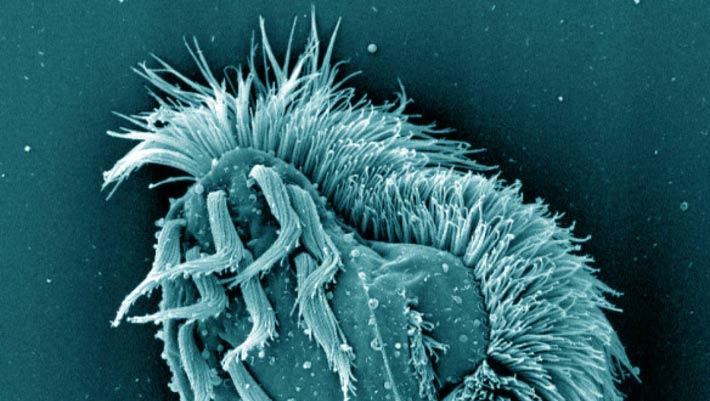
    Euprothes Gigatrochus, a newly identified species of ciliate organisms, has been discovered within a seawater filtration system on the Caribbean island of Curaçao. This remarkable find hints at the potential for these organisms to evolve into cannibalistic “supergiants,” deepening our understanding of microscopic life complexity.


    Euprothes Gigatrochus. Image credit: Ben Larson and Samuel Lord.

    “Ciliates in the genus Euprotes have fascinated researchers since the advent of microscopy due to their widespread presence and distinctive features,” stated lead author Dr. Ben Larson from Rensselaer Polytechnic Institute.

    Euprotes species inhabit diverse aquatic ecosystems, and their behavior, reproductive patterns, symbiotic interactions, geographical distribution, and environmental adaptations have been the focus of extensive research.

    These ciliates have a complex, organized body structure similar to animals, with cilia arranged into specialized membranous cells for feeding, swimming, and locomotion.

    Euprothes Gigatrochus was collected from a seawater filtration system in Curaçao and represents a new addition to this fascinating genus.

    Interestingly, within clonal populations where all cells share identical DNA, certain cells can develop into supergiants—over twice the length of typical cells, possessing a broader body and enlarged mouths.

    Rather than filtering and consuming bacteria like their normal counterparts, these supergiant cells become formidable predators, capturing smaller cloned relatives at a startling rate of approximately one every ten minutes.

    “This single-cell behavior aligns with traits typically associated with larger animal development,” Dr. Larson observed.

    “This research broadens our understanding of single-celled organisms and offers a novel framework to explore cellular form and function control.”

    Moreover, the behavioral shifts observed extend beyond feeding.

    Normal cells exhibit graceful swimming and walking behaviors, while supergiants modify their movement to a circular walking pattern, ideal for hunting surface-dwelling prey, and awkwardly roll when not on a surface.

    “Supermacrogenesis involves trade-offs. While these cells excel in hunting, their swimming capabilities decline, shifting their dietary focus from bacteria to a new prey type,” Dr. Larson explained.

    To uncover the molecular underpinnings of this transformation, the study sequenced transcriptomes from Euprothes Gigatrochus, including normal cells, supergiants, and those reverting from the supergiant state.

    The findings revealed that supergiants represent transcriptionally distinct developmental stages, showcasing significant differences in gene expression involving cell cycle regulation, protein synthesis, and membrane organization.

    Cells transitioning back from the supergiant phase exhibited unique molecular signatures that temporarily inhibit pathways responsible for transformation.

    Populations starting from recently reverted cells generated new supergiants more slowly and less frequently than those initiated from normal cells, irrespective of external factors.

    The emergence of supergiant cells typically coincides with a shift from rapid growth to stationary phases, particularly in environments with limited small prey, and they persist only as long as large prey (normal cells) are available.

    Supergiants constitute no more than 5% of the population, suggesting a bet-hedging strategy that allows a small fraction of cells to exploit alternative resources.

    This groundbreaking discovery establishes a new paradigm for studying the developmental biology of unicellular organisms, which uniquely manage both cellular and organismal functions within a single membrane.

    “Much of our current developmental knowledge stems from multicellular organisms,” Dr. Larson highlighted.

    “Similar developmental processes are observable in single-celled organisms, paving the way for studying fundamental biological questions across different life forms.”

    The findings from this study will be published in Proceedings of the National Academy of Sciences.

    _____

    Ben T. Larson and others. 2026. Controlled development of cannibalistic supergiant cells in ciliates: Euprothes Gigatrochus. PNAS 123 (20): e2606891123; doi: 10.1073/pnas.2606891123

    Source: www.sci.news

    Share. Facebook Twitter Pinterest LinkedIn WhatsApp
    Previous ArticleUnlocking Multitasking: How Science Reveals Your Brain’s Potential with Practice
    Next Article New Axolotl Fossil Discovered in Mexico: A Significant Paleontological Find

    Related Posts

    Science

    Discover the Giant Scorpion That Dominated Ancient Britain in the Devonian Period

    Science

    Pigeons Utilize Superparamagnetic Immune Cells in Their Livers to Detect Earth’s Magnetic Field

    Science

    Webb Telescope Discovers Methane in Interstellar Comet 3I/ATLAS

    Science

    Silent Spring: How Rachel Carson’s 1962 Science Book Transformed the World

    Science

    New Axolotl Fossil Discovered in Mexico: A Significant Paleontological Find

    Science

    Unlocking Multitasking: How Science Reveals Your Brain’s Potential with Practice

    Science

    Revealing the Truth: Stonehenge’s Altar Stones Likely Not Transported by Glaciers

    Science

    Experts Recommend Ditching AI Prompts to Reduce Energy Consumption

    Add A Comment
    Leave A Reply Cancel Reply

    Stay In Touch
    • Facebook
    • Twitter
    • Instagram
    • Pinterest
    Top Picks
    Science

    How Plants Altered Magma Chemistry: Insights from Sciworthy

    Approximately 400 million years ago, vascular land plants with advanced venous systems for transporting water…

    Microlino – Is this the perfect city car?

    Discover the Future of Comfort: What If You Could Wear a Chair?

    (VIDEO) Incredible flight of the Parker Solar Probe

    When Food is Scarce: This Single-Celled Organism Becomes a Giant Man-Eater for Survival

    Most Popular
    Technology

    Empowering Girls: Launching Africa’s First Private Space Satellite

    Wheels

    What will the first “Xiaomi” on four wheels be called?

    Categories
    • AI (13)
    • Gadgets (10)
    • Science (47)
    • Space (9)
    • Technology (37)
    • Wheels (9)
    Our Picks
    Science

    Discover the Giant Scorpion That Dominated Ancient Britain in the Devonian Period

    Science

    How Land Plants Transform River Ecosystems – Cyworthy

    © 2026 Hitechub.
    • Home
    • About Us
    • Privacy Policy
    • Terms & Conditions

    Type above and press Enter to search. Press Esc to cancel.

    We are using cookies to give you the best experience on our website.

    You can find out more about which cookies we are using or switch them off in .

    Ad Blocker Enabled!
    Ad Blocker Enabled!
    Our website is made possible by displaying online advertisements to our visitors. Please support us by disabling your Ad Blocker.
    Hitechub
    Powered by  GDPR Cookie Compliance
    Privacy Overview

    This website uses cookies so that we can provide you with the best user experience possible. Cookie information is stored in your browser and performs functions such as recognising you when you return to our website and helping our team to understand which sections of the website you find most interesting and useful.

    Strictly Necessary Cookies

    Strictly Necessary Cookie should be enabled at all times so that we can save your preferences for cookie settings.