


Researchers have analyzed nickel isotopes from 66-million-year-old debris left by the Chicxulub impact, concluding that the asteroid responsible for Earth’s last mass extinction was likely part of a rare class of protometeorite known as Ornan type carbonaceous chondrite (CO chondrite).
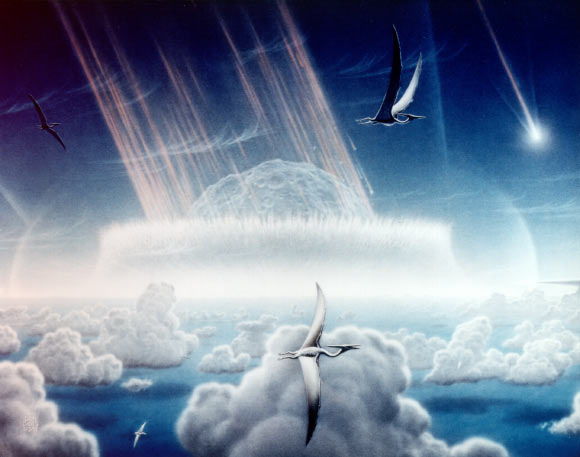
The illustration captures the moment an asteroid impacted the shallow tropical waters of the sulfur-rich Yucatan Peninsula, present-day southeastern Mexico. This cataclysmic event, which occurred approximately 65 million years ago, is believed to have triggered the extinction of dinosaurs and numerous other species. The scene also features a pterodactyl soaring above the tropical clouds. Image credit: Donald E. Davis / NASA.
Carbonaceous chondrites constitute only about 5% of all meteorites found on Earth, and CO chondrites represent a small fraction of that category.
These meteorites are among the most primitive and unaltered materials within our solar system.
“CO chondrites differ significantly from typical meteorites displayed in museums,” stated Professor Philip Crais, a researcher at Free University and the University of British Columbia.
“CO chondrites contain considerably fewer volatile components such as carbon, zinc, water, and especially sulfur compared to any other meteorite types documented on Earth.”
“Our hypothesis regarding the extinction’s cause remains unchanged, but it diminishes the likelihood that sulfur from the impact was the primary factor.”
“The key factor will be microscopic debris released into the atmosphere.”
In their investigation, Professor Claeys and his team conducted high-precision nickel isotope measurements on samples collected over many years from distinct clay layers formed globally due to the Chicxulub impact.
“This research is quite challenging. The entire meteorite vaporized upon impact, so only a tiny fraction of the projectile is preserved in the planet’s KT clay layer,” explained Professor Crais.
Many questions linger about the origin of the Chicxulub impactor.
Potential sources include remote debris-rich areas in the outer solar system and regions of the asteroid belt near Jupiter.
“The Chicxulub impactor approached from approximately 10 to 15 kilometers away,” stated Professor Claeys.
“It struck the Earth at an estimated speed of 64,000 km/h, creating a massive crater.”
“The impact location is now buried beneath Mexico’s Yucatan Peninsula.”
“This rare impact from such a significant distance underscores the unfortunate fate of the dinosaurs.”
Findings from this study have been published in today’s issue of Scientific Progress.
_____
Georgy V. Mahatadze et al. (2026). The origin of the Cretaceous-Paleogene impactor is revealed by nickel isotopes. Scientific Progress 12(29); doi: 10.1126/sciadv.aef4858
Source: www.sci.news