


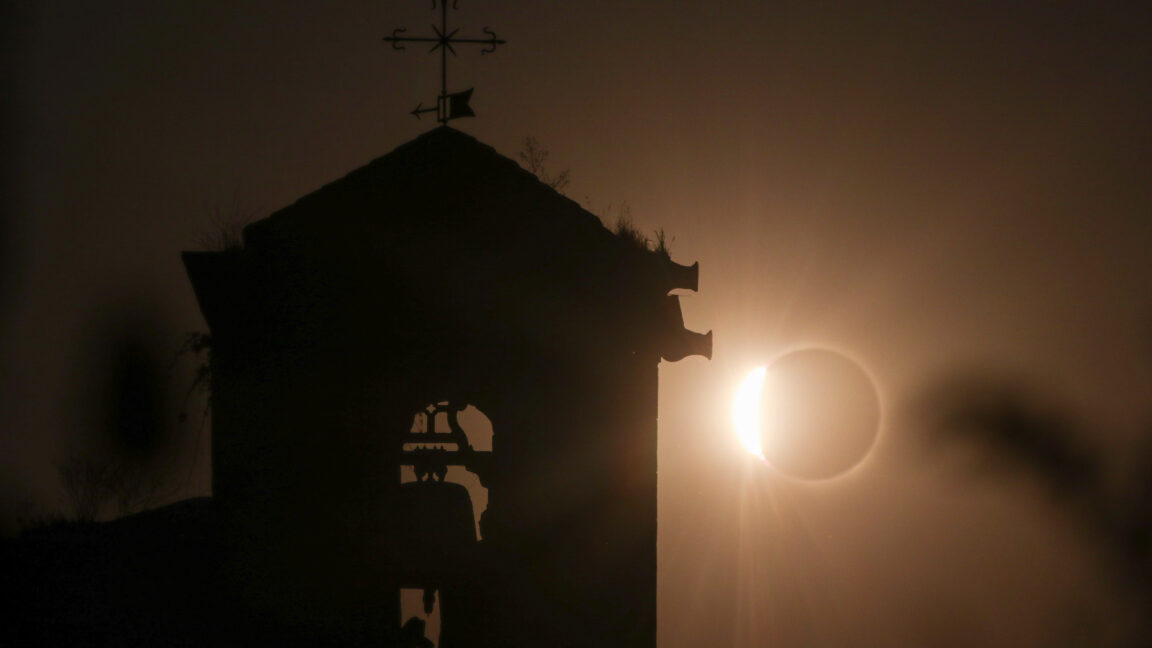
Watching a solar eclipse in advance can be just as memorable as witnessing the main event. A friend and I traveled to rural Duratón, Spain, approximately 60 miles (100 kilometers) north of Madrid. From the grounds of a centuries-old Romanesque church, we hoped to watch the eclipse transform an idyllic Spanish landscape for roughly 90 seconds.
We arrived 24 hours before the solar eclipse to scout the location and see how the event might unfold. The old Catholic church in Duratón offered ample parking and was far enough from the region’s larger towns to avoid the biggest crowds. However, as the eclipse approached the following day, more than 100 locals, tourists, and photographers gathered on the church grounds with cameras, telescopes, music, and their favorite beverages.
The solar corona above the Church of the Assumption in Duratón, Spain.
Credit: Stephen Clark/Ars Technica
The setting felt both ancient and modern, natural and human. The church stands beside a Visigoth cemetery containing anthropomorphic graves carved into the rock. About 1,000 feet away, archaeological research is underway at the Roman city of Confloenta. As I waited for the eclipse, I wondered how the people who lived here centuries ago might have reacted when the sun suddenly disappeared.
Then the eclipse began. Wearing certified eclipse glasses, I watched the moon gradually move across the sun until daylight faded roughly an hour before sunset. The church bell rang, the crowd cheered, and the sun’s turbulent outer atmosphere appeared as a ghostly white halo above Duratón’s centuries-old place of worship.
After several minutes, the sun resumed its journey across the sky, exactly as modern science had predicted. There were no omens or reasons for fear—only an extraordinarily beautiful experience. Watching a total solar eclipse in Duratón, Spain, against this historic landscape is a memory I will carry for the rest of my life.
Source: arstechnica.com