


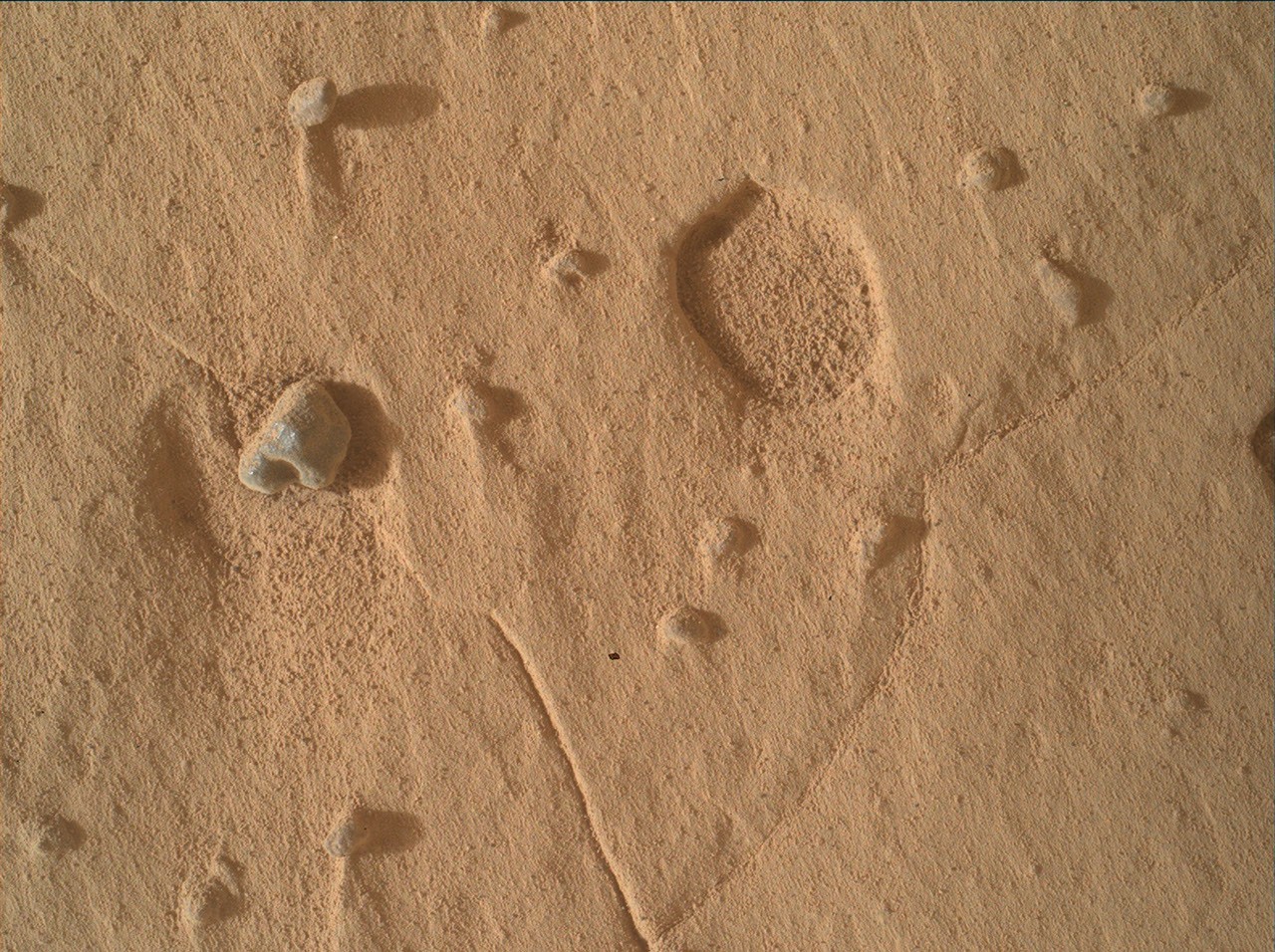
Curiosity Rover Discovers Unusual Shallow Holes on Mars
Written by Michelle Minitti, MAHLI Deputy Principal Investigator
Earth planning date: Friday, August 21, 2026
Mars continues to surprise scientists, even after NASA’s Curiosity rover has spent 14 years exploring the Red Planet. This week, both of Curiosity’s workspaces revealed an unusual geological feature: wide, shallow holes scattered across the bedrock.
Small cavities are not uncommon on Mars. They can form when resistant nodules or pebbles weather out of the surrounding rock. However, the newly discovered holes were significantly wider and shallower than similar features observed in the past. Scientists also found no obvious remnants of an object that may have occupied the cavities.
Curiosity’s MAHLI camera and Mastcam instrument closely examined these unusual Martian rock formations. The rover captured a stereo mosaic and a tightly overlapping image set that can be used to create a digital elevation model of the structures. These observations will help scientists better understand the geological processes that shaped this section of the Mount Sharp stratigraphy.
Analyzing Mars Bedrock and Floating Rocks
The surrounding bedrock was equally intriguing. Mastcam documented the area while ChemCam analyzed a complex sequence of layers whose textures and structures changed over short vertical distances. These variations may record changes in the environmental or depositional conditions that existed when the rocks formed.
ChemCam, MAHLI, and APXS also examined a gray, coarse-grained, resistant layer that differs from the surrounding host rock. Its distinct appearance may indicate different chemical or mineralogical properties. ChemCam additionally studied one of the gray, loose stones scattered across the rover’s workspace to investigate how these floating rocks formed and where they originated.
Farther away, the Cordillera buttes remained a major focus of the Curiosity science team. Mastcam acquired extensive mosaics covering their visible surfaces, while ChemCam’s Remote Micro-Imager collected detailed mosaics of specific rock layers and horizons.
In Valle Grande to the south, Curiosity also targeted the Tolhuaca and Potosi buttes. ChemCam searched for possible cross-layers and assessed the mineral composition of the dark material covering Potosi.
Monitoring Martian Weather and Sandstorms
Members of the environmental science team were also active this week. They planned an increased number of observations with the Rover Environmental Monitoring Station (REMS), Mastcam, and Navcam to track possible regional sandstorms. By the end of the week, however, the storm appeared to be weakening.
Despite losing one planned planning day because of a downlink issue, the Curiosity team successfully completed all of these observations and continued investigating the unusual geology of Mount Sharp.
Source: science.nasa.gov