


Nature Briefing: Two Cell Types Build the Brain, Europe’s Space Ambitions and a New Wild Cat
Hello Nature readers. Would you like to receive this briefing free in your inbox every day? Sign up here.
Two types of progenitor cells may build the brain
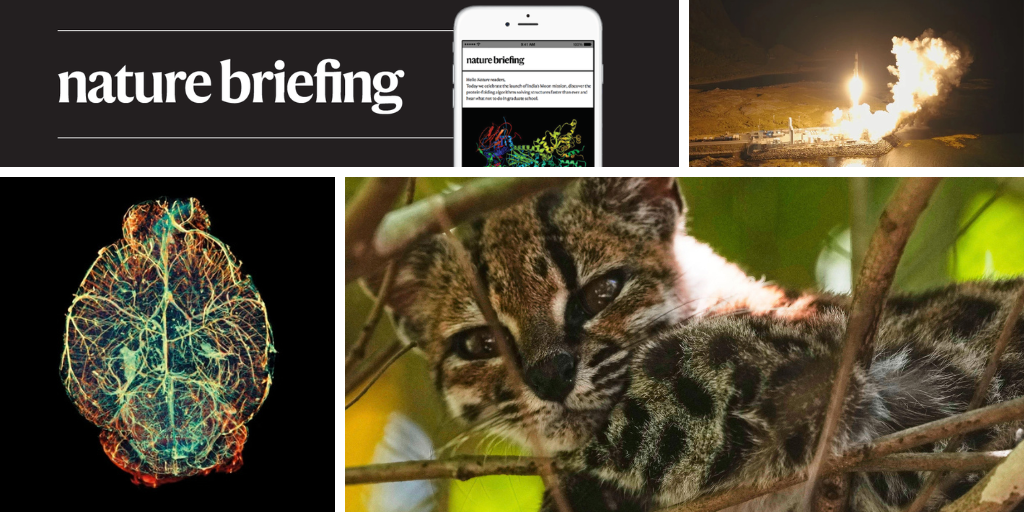
The mouse brain has meandering blood vessels, shown here in artificial color.
Credit: Simon Walker-Samuel, UCL CABI/Science Photo Library
New research suggests that two types of progenitor cells are needed to build the brain, challenging the decades-old theory that a single type of starting cell gives rise to complex organs.
The study found that one type of progenitor cell forms the hindbrain, while another generates the forebrain and midbrain. Although some researchers remain unconvinced, other aspects of the work have received widespread praise.
The authors also developed an efficient method for inducing stem cells to become hindbrain motor neurons. This could help researchers study diseases that affect these cells, including amyotrophic lateral sclerosis (ALS).
Nature | 5-minute read
Reference: Nature Neuroscience paper
Europe seeks greater independence in space
Europe is taking steps to develop its own sovereign space capabilities and reduce its dependence on infrastructure from the United States.
Europe currently relies on organizations such as NASA and companies such as SpaceX to launch some astronauts and satellites. At a summit in Paris earlier this month, leaders including French President Emmanuel Macron and European Commission President Ursula von der Leyen expressed a desire to strengthen Europe’s autonomy in space.
Countries including Germany are also increasing spending on space-defence technology.
Nature | 5-minute read
A new wild cat species discovered after more than a century
Leopardus tyrcayo is smaller than a domestic cat and covered in leopard-like spots. It is the first new species of cat to be scientifically described in more than 100 years.
Genetic analysis suggests that the group of South American spotted cats to which Leopardus tyrcayo belongs was once thought to be a single species but may actually contain nearly five species. That discovery could have important conservation implications.
“If you think it’s a single thing from southern Brazil to Costa Rica, you know it’s not endangered,” says geneticist and study co-author Eduardo Eizirik. “But if you find out it’s not a single thing, but actually five things, you need to evaluate each one separately.”
National Geographic | 10-minute read
Reference: Current Biology paper

The proposed scientific name for the cat is derived from its common name among people who live with it in Bolivia’s Yungas Forest.
Juan Carita/Associated Press, Alamy
Features and analysis
How AI is changing scientific discovery
Artificial-intelligence systems such as Google’s Co-Scientist can generate hypotheses, design experiments and analyze data. These tools are changing how researchers work and could influence how scientists are evaluated.
The goal is to free researchers from “the mundane aspects of discovery,” says geneticist Le Cong, co-founder of biomedical AI start-up Phylo. However, automating those tasks could deprive students and early-career researchers of opportunities to develop their skills. Scientists may also need an unusually broad range of knowledge to judge whether AI-generated ideas are sound.
Nature | 11-minute read
What does AI’s mathematics claim mean for fluid mechanics?
OpenAI claimed last week that its system had solved a high-profile physics puzzle by showing that the Navier–Stokes equations do not always work for incompressible fluids. The claim raised questions about AI’s impact on mathematics, including who receives credit for discoveries.
For a guide to the underlying science, brush up on turbulence and fluid flow with this overview.
Nature | 6-minute read
The hidden mental-health costs of climate change
“People often experience climate change not as a single disaster, but as a gradual erosion of health, livelihoods, social cohesion and dignity,” writes clinical psychologist and public-health researcher Manasi Kumar.
“Mental health is at the heart of these losses, yet remains largely invisible in the systems designed to address them.” When people struggle to adapt and communities are torn apart, Kumar argues, the damage must be measured and institutions must be held accountable for addressing these harms.
Nature | 7-minute read
Can you find the penguin?
On Friday, Leif Penguson was exploring the natural limestone arches of Le Lavant des Arcs, near Notre-Dame-de-Londres, France. Did you find the penguin? When you are ready, see the answer.
Source: www.nature.com