


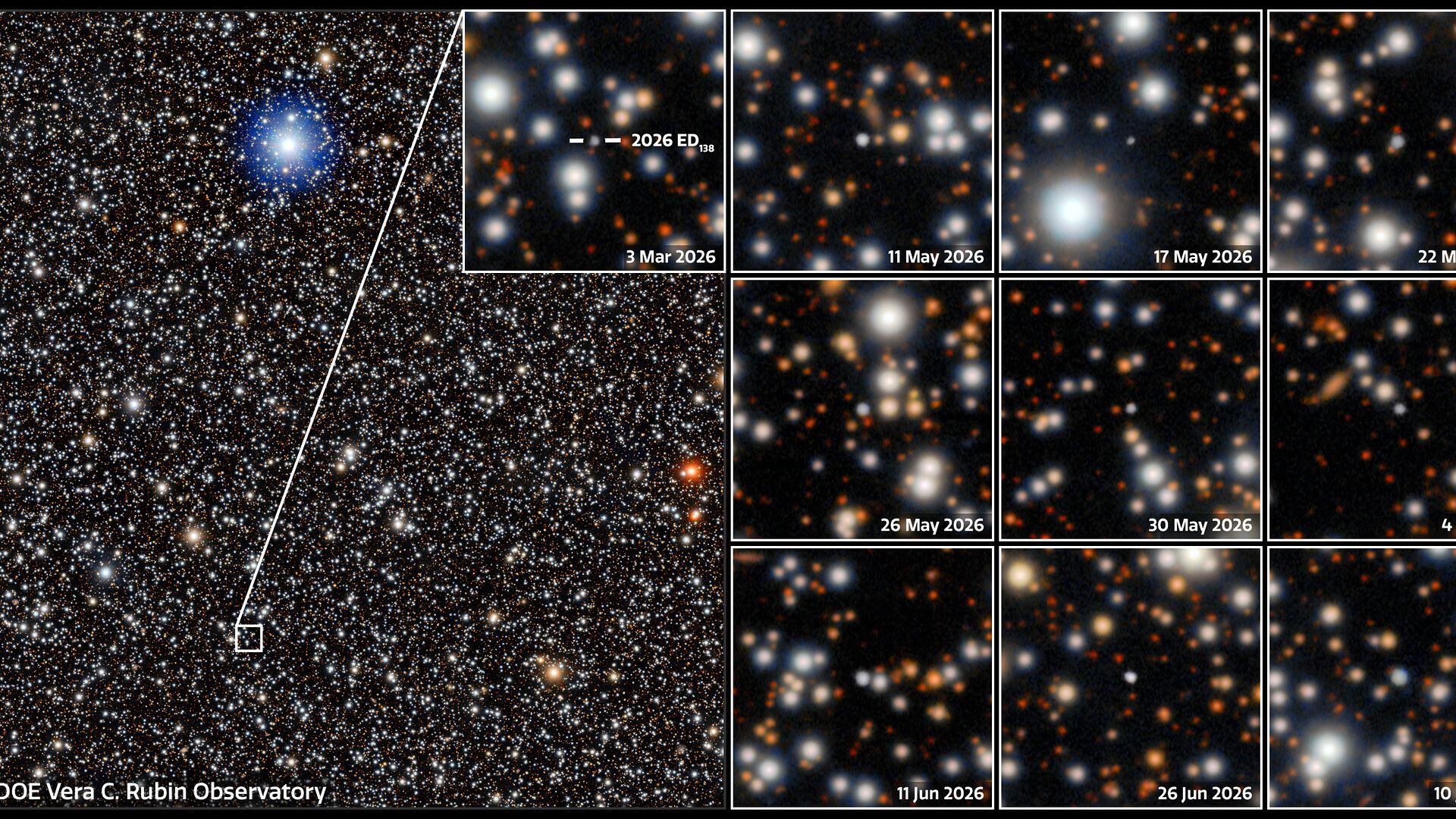
The Vera C. Rubin Observatory has identified what appears to be a new dwarf-planet candidate beyond Neptune. Designated 2026 ED138, the object may be one of the largest and brightest bodies ever found in the Kuiper Belt. If future observations confirm that it is round enough to qualify as a dwarf planet, it would join the five officially recognized dwarf planets and become the sixth.
A hidden world beyond Neptune
“My first reaction was excited disbelief,” astrophysicist Matthew Holman of the Smithsonian Astrophysical Observatory said in a statement. Holman is a member of the Rubin team that developed the code used to help identify dwarf-planet candidates.
“Objects like this are so rare that I immediately started checking to see if I or my code had done anything wrong,” he said.
2026 ED138 orbits the sun at a distance of approximately 46 times the distance between Earth and the sun. Its orbit is tilted 25 degrees relative to the plane of the solar system, an angle that researchers say helps hide it in the bright background of the Milky Way.
Many telescopes struggle to detect objects beyond the millions of stars in the galaxy’s central bulge. The Rubin Observatory, however, will photograph the entire southern sky every few nights using the largest digital camera ever created. The observatory is designed to issue millions of alerts each night for objects whose brightness or position has changed, making it well suited to finding moving bodies in the solar system as well as temporary events such as supernova explosions.
The observatory’s 10-year mission to scan the sky has only just begun. ED138 stood out in the data collected in July.
Holman is developing software algorithms to process the enormous volume of data gathered by Rubin. The code, developed with colleagues including Kevin Napier, compares billions of observations to determine which detections belong to the same moving object. When the team ran Rubin’s data through the software, it revealed an unusually large object.
By combining Rubin observations with archival images from the Dark Energy Camera on the Victor M. Blanco 4-meter Telescope at Cerro Tololo Inter-American Observatory in Chile, the researchers were able to trace ED138’s orbit over the past decade.
What makes ED138 unusual?
The Kuiper Belt is a largely unexplored region beyond Neptune, extending approximately 30 to 50 times the distance between Earth and the sun. It contains mostly small, icy bodies made of frozen methane, ammonia, water and rock, including Pluto and most of the known dwarf planets. Thousands of Kuiper Belt objects have been discovered, and scientists view them as potential frozen time capsules that preserve clues about the early formation of the solar system.
Image credit: NSF–DOE Vera C. Rubin Observatory/NOIRLab/SLAC/AURA/R. Proctor
Dwarf planets are larger than asteroids but smaller than planets. They are massive enough for their own gravity to pull them into a roughly round shape, but they have not cleared their orbital neighborhoods in the way planets have.
The International Astronomical Union has officially recognized five dwarf planets: Ceres, Pluto, Eris, Haumea and Makemake. Astronomers who study dwarf planets often recognize at least nine likely examples, along with several additional candidates whose properties remain uncertain.
Depending on the criteria used, the solar system’s Kuiper Belt could contain anywhere from a few to hundreds of dwarf planets. Identifying them is difficult because their distant orbits make them faint and their apparent motion across the sky very slow. The strongest candidates generally have high albedo, or surface reflectance, and diameters greater than approximately 370 to 500 miles (600 to 800 kilometers).
ED138 is notable for its brightness, albedo and estimated size. Researchers estimate that it is between 370 and 930 miles (600 and 1,500 kilometers) in diameter. Pluto, the largest dwarf planet recognized by the IAU, has a diameter of 1,477 miles (2,377 kilometers), while Ceres, the smallest officially recognized dwarf planet, measures 595 miles (958 kilometers) across.
Further observations will help researchers refine ED138’s diameter and density and determine whether the object is sufficiently round to qualify as a dwarf planet.
“If confirmed as a dwarf planet, ED138 would join a very small group of planets,” Holman said. “Rubin will photograph the entire southern sky repeatedly over a 10-year period, so others hiding in places where previous surveys skipped are now within reach.”
Source: www.livescience.com