


NASA’s Hubble Space Telescope has helped reveal why nearby dwarf galaxies contain far less oxygen than simulations predict. In a study of 37 dwarf galaxies published Monday in The Astrophysical Journal, researchers found that supernova-driven galactic winds remove oxygen from low-mass galaxies more efficiently than current models suggest.
Dwarf galaxies contain thousands to hundreds of millions of stars. Because oxygen is a tracer for a broader range of heavy elements, the finding suggests that these small galaxies retain only a fraction of the oxygen their stars produce.
“Oxygen is produced by stars in galaxies, and we know that oxygen must have been in galaxies at some point in the past, so it must have been expelled,” said study co-author Grace Telford, an assistant professor in the University of Utah’s Department of Physics and Astronomy. “And that requires the energy from massive stars and supernova explosions to expel material from the host galaxy and into intergalactic space.”
Tracking oxygen beyond dwarf galaxies
The research was conducted through the Wind Oxygen Loss of Galaxies (GLOW) project, funded by NASA and the National Science Foundation. The team tracked oxygen in stars, interstellar gas and intergalactic space to understand how the element is distributed and how it leaves galaxies.
Oxygen is the most abundant element after hydrogen and helium. It is relatively easy to detect and measure, its production is well understood, and it provides a reliable indicator of how chemical elements are distributed within galaxies.
“So we chose oxygen for practical reasons,” said Kristen Wingfield McQuinn, GLOW principal investigator and science operations center mission director for NASA’s newly launched panoramic Nancy Grace Roman Space Telescope at the Space Telescope Science Institute in Baltimore, Maryland. McQuinn is also an associate professor at Rutgers University in New Brunswick, New Jersey.
“Oxygen is one of the main elements formed by stars, and being able to track how much oxygen is produced and how much is distributed inside and outside galaxies will help us understand the evolution of galaxies,” McQuinn said. “It also helps us understand where and how many galaxies enrich the space between galaxies, known as the intergalactic medium.”
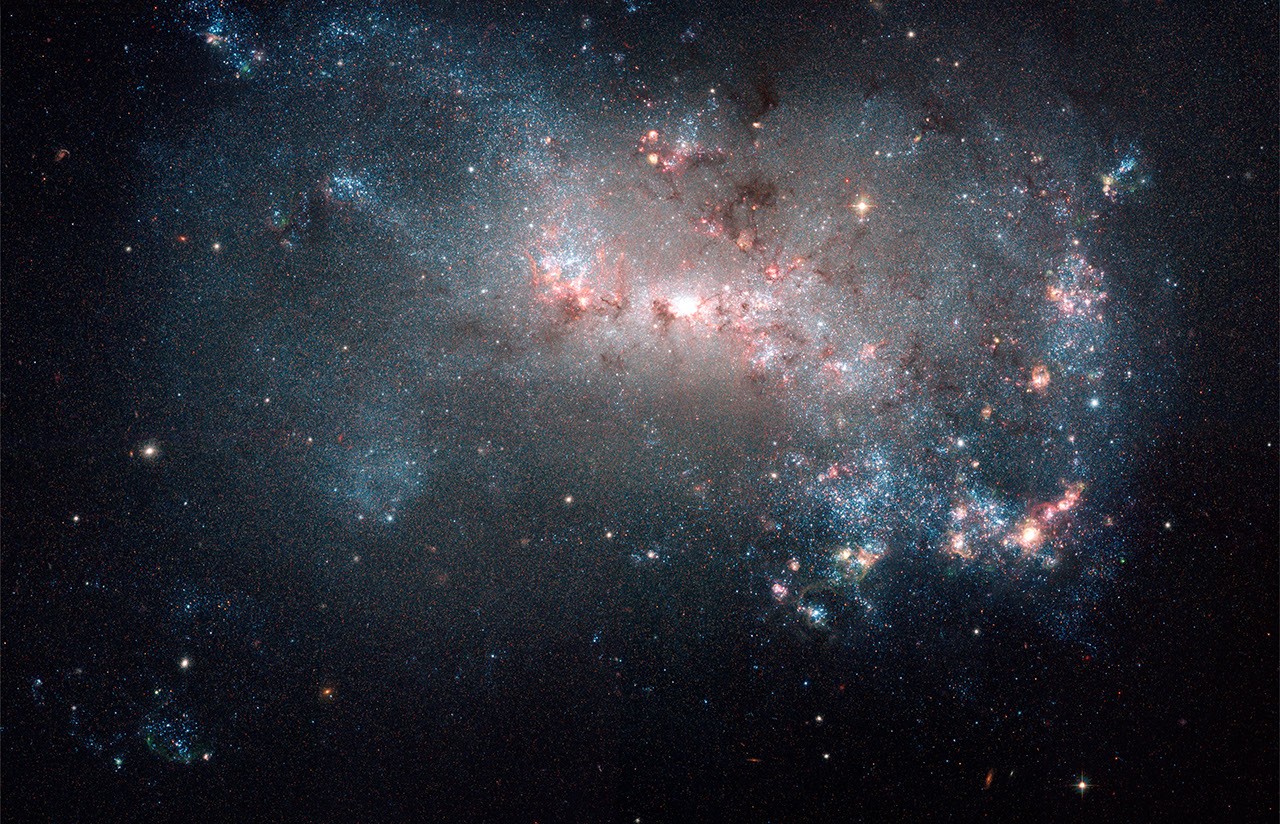
This is an image of NGC 4449, one of the dwarf galaxies in NASA’s Hubble Space Telescope’s Wind Oxygen Loss Galaxies (GLOW) study. The researchers found that dwarf galaxies can retain only a fraction of the oxygen produced by their stars.
Images: NASA, ESA, Hubble Heritage – ESA/Hubble Collaboration, Alessandra Aloisi (STScI, ESA)
The study combined archival optical images from Hubble with observations from NASA’s retired Spitzer Space Telescope, the ground-based Very Large Array and the Australian Telescope Compact Array. Hubble’s observations allowed the researchers to resolve individual stars in all 37 galaxies, determine their formation histories and compositions, and track the oxygen produced by their stellar populations.
The galaxies were selected because their masses fall within the range where simulations and theory predict that supernova explosions should increase the amount of oxygen expelled from galaxies. The team aimed to determine how oxygen is divided among stars, gas and dust, and where the missing oxygen might have gone.
Where does the expelled oxygen go?
Astronomers already suspected that galaxies lose most of their oxygen and other heavy elements, but the destination of those elements remained an open question. Previous research published in 2014 examined star-forming galaxies similar to the Milky Way and found that they had lost most of their oxygen. Some of that oxygen was detected in a diffuse halo of gas surrounding the galaxy outside its disk, known as the circumgalactic medium.
The GLOW team extended that work to low-mass galaxies spanning a broad range of masses and environments. Earlier studies measured oxygen in the circumgalactic medium of dwarf galaxies, but it remains unclear whether most of the missing oxygen is located there or has been expelled entirely from the galaxies’ surroundings.
Future observations
McQuinn also hopes to study low-mass galaxies in nearby space. She has an approved program using the Roman Space Telescope to search for faint, small star systems across large areas of the sky. After identifying these galaxies, she plans to use Hubble and NASA’s James Webb Space Telescope to examine their stars in greater detail, reconstruct their histories and determine how star formation changed over cosmic time.
Telford’s future research will use Hubble to study the individual massive stars that produce oxygen and eject it from their host galaxies. She is observing some nearby GLOW targets in detail to characterize how massive stars differ in these small galaxies.
The Hubble Space Telescope has operated for more than 30 years and continues to contribute discoveries that shape scientists’ understanding of the universe. Hubble is an international collaboration between NASA and the European Space Agency. NASA’s Goddard Space Flight Center in Greenbelt, Maryland, manages telescope and mission operations, with Lockheed Martin Space in Denver supporting those operations at Goddard. The Space Telescope Science Institute in Baltimore, operated by the Association of Universities for Astronomical Research, conducts Hubble science operations for NASA.
Source: science.nasa.gov