


Close Menu
HitechubHitechub
    What's Hot
    Science

    Mathematician’s Advice: Aim High, But Don’t Shoot for the Moon

    Wheels

    Meet Toyota’s lunar “baby” that could make exploring the Moon easier

    AI

    AI created opening credits for the series “Friends”

    Important Pages:
    • About Us
    • Privacy Policy
    • Terms & Conditions
    Facebook X (Twitter) Instagram Pinterest
    Facebook X (Twitter) Instagram
    HitechubHitechub
    Wednesday, June 10
    • Technology
      1. AI
      2. Gadgets
      3. View All

      This is the most popular CEO in the world

      Sectors in which “Chat-GPT” is most often used

      AI Pioneer Expresses Concern About Potential for AI to Surpass Humanity

      Artificial intelligence has begun to “swallow” professions

      What’s new in Android 14

      Europeans have about 700 million old mobile phones in their drawers

      Here’s how you can tell if your phone is being tapped

      “Sneaker X” – computer case in the shape of a sneaker

      Russian Gamers Unite to Prevent Nuclear War: Join the Fight Online

      Challenges of Space Travel: Why Journeying to Space is So Difficult

      NASA Astronaut Casts Historic Vote from Space

      Discover the Future of Comfort: What If You Could Wear a Chair?

    • Science
      1. Space
      2. Wheels
      3. View All

      Galaxies in the universe are growing more slowly than they should

      “Espace” presented the new lander “Apex 1.0”

      The largest asteroid sample ever collected has arrived on Earth

      (VIDEO) Incredible flight of the Parker Solar Probe

      Toyota wants to make a new generation battery with a range of up to 1,200 km

      Meet Toyota’s lunar “baby” that could make exploring the Moon easier

      Microlino – Is this the perfect city car?

      Alfa Romeo 4C gets an electric successor

      NASA Responds to Criticism Over All-Male Astronaut Crew for Artemis III Mission

      Rare Camera Trap Footage Reveals Wolves Hunting European Bison

      Uncovering Surprising Foods That Cause Weight Gain: What You Didn’t Expect

      Moon Meteorite Holds Key Evidence of Massive Asteroid Impact

    HitechubHitechub
    Home » Astronomers Detect Alien Radio Signals from Interstellar Object 3I/ATLAS
    Science

    Astronomers Detect Alien Radio Signals from Interstellar Object 3I/ATLAS

    Share Facebook Twitter Pinterest WhatsApp
    Share
    Facebook Twitter LinkedIn Pinterest WhatsApp

    Explore the SETI Institute’s Allen Telescope Array, a sophisticated 42-element radio interferometer located at the Hat Creek Radio Astronomy Observatory in California. Astronomers used 3I/ATLAS to search for artificial radio transmissions, but only detected human-made interference.


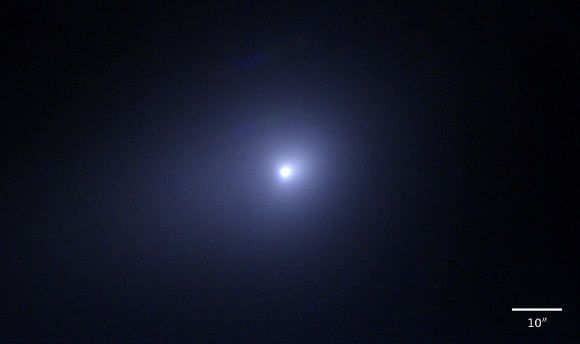
    This image from the Subaru Telescope showcases the interstellar comet 3I/ATLAS. Image credit: National Astronomical Observatory of Japan

    3I/ATLAS is recognized as the third confirmed interstellar object to enter our solar system, following 1I/’Oumuamua and 2I/Borisov.

    While evidence suggests that 3I/ATLAS is a natural object, it also serves as a promising target for technosignature searches, as man-made objects could provide the earliest indications of extraterrestrial life.

    “On July 1, 2025, the interstellar object, initially designated as C/2025 N1 (ATLAS) and now popularly known as 3I/ATLAS, was discovered by the Asteroid-Earth Impact Final Alert System (ATLAS) in Rio Hurtado, Chile,” said SETI Institute astronomer Dr. Sofia Sheikh and her team.

    “Numerous telescopes worldwide are tracking the orbit of 3I/ATLAS, revealing notable cometary activity during these observations.”

    “If it is indeed a comet, as anticipated based on initial findings, it should be rich in volatiles and develop a prominent tail now that it has passed perihelion.”

    “Early observations indicated the object appeared red and exhibited a coma due to its luminescence as it approached the Sun.”

    “Although it reached perihelion on October 29, 2025, observations from Earth were significantly hindered from September to early November due to its close proximity to the Sun.”

    “There remains a wealth of information to glean about this interstellar object, making continued observation during its approach a scientific advantage.”
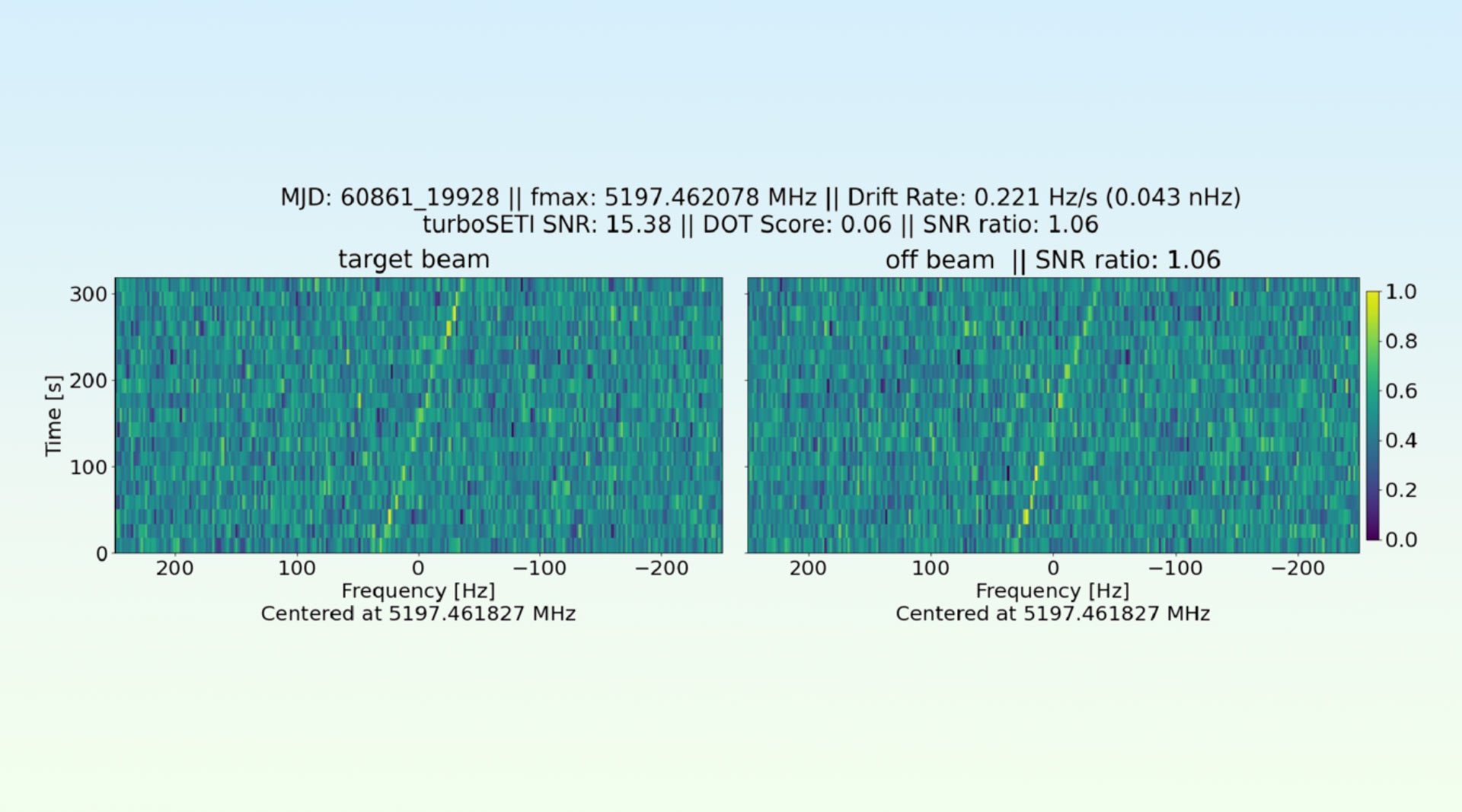

    Output waterfall plot from a 3I/ATLAS observation showing no signals above the SNR threshold

    Output waterfall plot from a 3I/ATLAS observation showing 0 signals above the SNR ratio threshold. The signal seems narrowband and may indicate local interference. Image credit: Sheikh et al., doi: 10.3847/1538-3881/ae6651.

    During this observational campaign, astronomers monitored 3I/ATLAS for more than seven hours using the Allen Telescope Array, spanning frequencies from 1 to 9 GHz.

    They detected approximately 74 million narrowband signals; however, after filtering out human interference and matching object motions, only about 200 signals warranted further review.

    The findings highlight that detected signals are likely attributable to terrestrial technology or satellites.

    Although no definitive technosignatures were identified, this study reinforces the notion that 3I/ATLAS is a natural phenomenon.

    Additionally, this observation provides constraints on the potential power of radio transmissions emanating from or near 3I/ATLAS, revealing signals weaker than approximately 10 to 110 W—equivalent to that of household appliances—across the detected frequencies.

    “The 3I/ATLAS results exemplify the potential for detecting signals with current technology,” stated Dr. Valeria García López, an astronomer at Furman University and director of the Breakthrough Listening Initiative.

    “This emphasizes the importance of continuing our search for technosignatures, even in objects where signals may not be anticipated.”

    The team’s research will be featured in Astronomy Magazine.

    _____

    Sophia Z. Sheikh et al. 2026. Retrieval of radiotechnical signatures from interstellar object 3I/ATLAS using the Allen Telescope Array. A.J. 172, 1; doi: 10.3847/1538-3881/ae6651

    Source: www.sci.news

    Share. Facebook Twitter Pinterest LinkedIn WhatsApp
    Previous ArticleExperience Incredible Speeds as You Move Through Space
    Next Article The World’s Oldest Cheese: Fascinating Facts About This Unusual Delicacy

    Related Posts

    Science

    NASA Responds to Criticism Over All-Male Astronaut Crew for Artemis III Mission

    Science

    Rare Camera Trap Footage Reveals Wolves Hunting European Bison

    Science

    Uncovering Surprising Foods That Cause Weight Gain: What You Didn’t Expect

    Science

    Moon Meteorite Holds Key Evidence of Massive Asteroid Impact

    Science

    Discover How Millions of Planets Could Form Around Supermassive Black Holes

    Science

    Unlocking Sloth’s Slow Lifestyle: The Ancient ‘Jumping Gene’ Explained

    Science

    Rapid Melting of Glaciers on the Roof of the World: Causes and Impacts

    Science

    Near Miss with Waymo: Why I’m Still Optimistic About Self-Driving Cars

    Add A Comment
    Leave A Reply Cancel Reply

    Stay In Touch
    • Facebook
    • Twitter
    • Instagram
    • Pinterest
    Top Picks
    Science

    Astronomers Discover Clearest Evidence of an Exoplanet’s Magnetic Field Yet

    Astronomers have unveiled groundbreaking evidence that magnetic fields influence the weather on exoplanets, particularly by…

    Deep neural networks do not see the world as we see it

    Pigeons Utilize Superparamagnetic Immune Cells in Their Livers to Detect Earth’s Magnetic Field

    Achure’s Expert Toolmakers: Selecting Stones with Unmatched Precision

    Rising Frequency and Intensity of Severe Turbulence: What’s Behind the Unpredictable Sky Conditions?

    Most Popular
    Science

    Unveiling the Truth: Why Your Memories May Not Be Accurate

    Technology

    The most powerful supercomputer in Europe

    Categories
    • AI (13)
    • Gadgets (10)
    • Science (176)
    • Space (9)
    • Technology (37)
    • Wheels (9)
    Our Picks
    Technology

    Test flight of an air taxi in Jerusalem

    AI

    10 Effective Strategies for Teaching Artificial Intelligence

    © 2026 Hitechub.
    • Home
    • About Us
    • Privacy Policy
    • Terms & Conditions

    Type above and press Enter to search. Press Esc to cancel.

    We are using cookies to give you the best experience on our website.

    You can find out more about which cookies we are using or switch them off in .

    Ad Blocker Enabled!
    Ad Blocker Enabled!
    Our website is made possible by displaying online advertisements to our visitors. Please support us by disabling your Ad Blocker.
    Hitechub
    Powered by  GDPR Cookie Compliance
    Privacy Overview

    This website uses cookies so that we can provide you with the best user experience possible. Cookie information is stored in your browser and performs functions such as recognising you when you return to our website and helping our team to understand which sections of the website you find most interesting and useful.

    Strictly Necessary Cookies

    Strictly Necessary Cookie should be enabled at all times so that we can save your preferences for cookie settings.