


Whisker-Sensing Drone Uses Tactile Antennas to Detect Obstacles
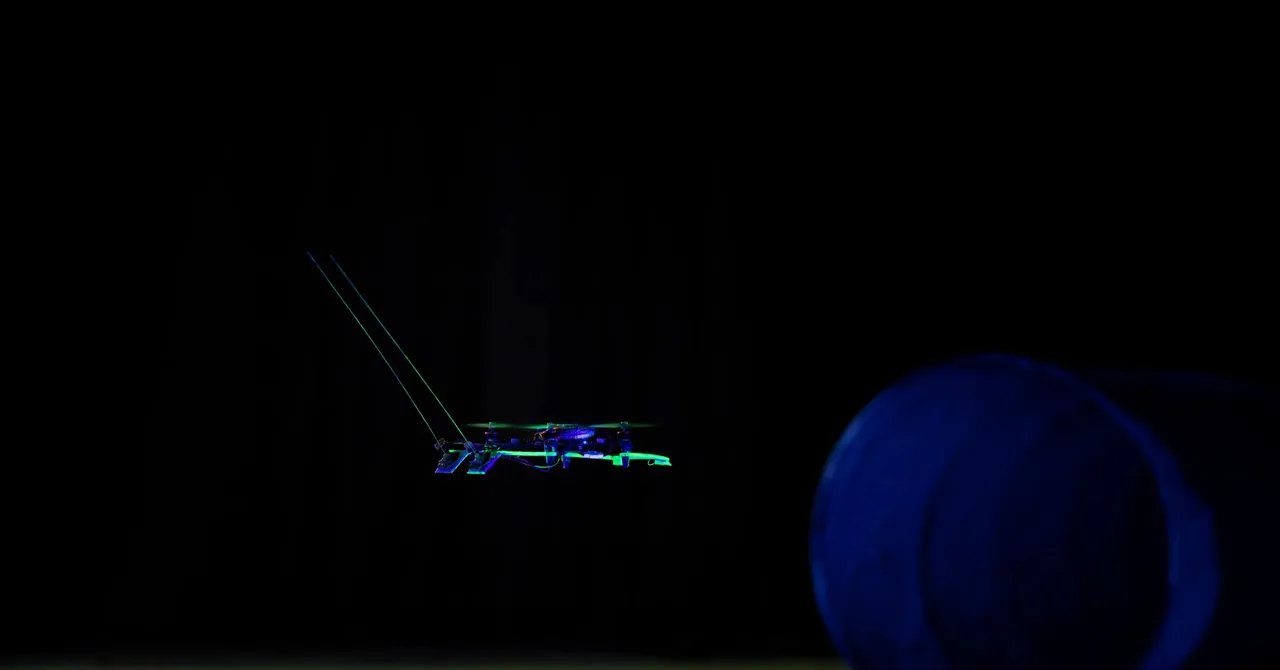
Researchers led by Hamaza developed a palm-sized drone equipped with artificial whiskers that help it estimate the distance and location of nearby obstacles. The whiskers are made from delicate nickel-titanium wires measuring 0.4 millimeters in diameter—about the thickness of four sheets of paper.
Each whisker is about 8 inches long, making the antenna longer than the drone itself. The researchers attached two whiskers to the drone, along with three small pressure sensors at their base. By measuring how the wires bend, the drone can detect nearby obstacles and estimate its position relative to them.
All calculations needed for this navigation system are handled by the drone’s onboard microcontroller, without relying on an external computer.
Finding the Right Whisker Angle
Although the concept may seem simple, determining the best angle for attaching the whiskers proved challenging. Animals that navigate with whiskers generally do not fly, and even long, lightweight wires can affect a drone’s stability.
When the drone moved along a wall, resistance against the whiskers could cause it to spin and crash. To identify a stable configuration, the researchers tested six different attachment angles at three different speeds and compared a total of 72 flights.
The drone flew without major problems when the whiskers were installed at 30, 45 and 60 degrees. The researchers selected a 45-degree angle because it produced the least wobbling in the drone’s direction. They also considered that a 60-degree angle reduced the drone’s forward sensing range.
Reducing False Obstacle Detections
The researchers also faced challenges when processing data from the whisker sensors. The system had to distinguish genuine contact with an obstacle from disturbances caused by the drone itself, including vibrations from its propellers.
Even after filtering out this noise, approximately 38% of the drone’s detections were false positives. The researchers attributed the problem to sensor drift, in which sensor readings gradually change over time.
To address the issue, the team developed a correction algorithm that continuously estimates drift trends. It uses sensor readings collected while the drone is flying without touching anything. When combined with additional filters, the correction method reportedly reduced false positives to 0%.
Source: www.wired.com