


Hello Nature readers. Would you like to receive this science briefing free in your inbox every day? Sign up here.
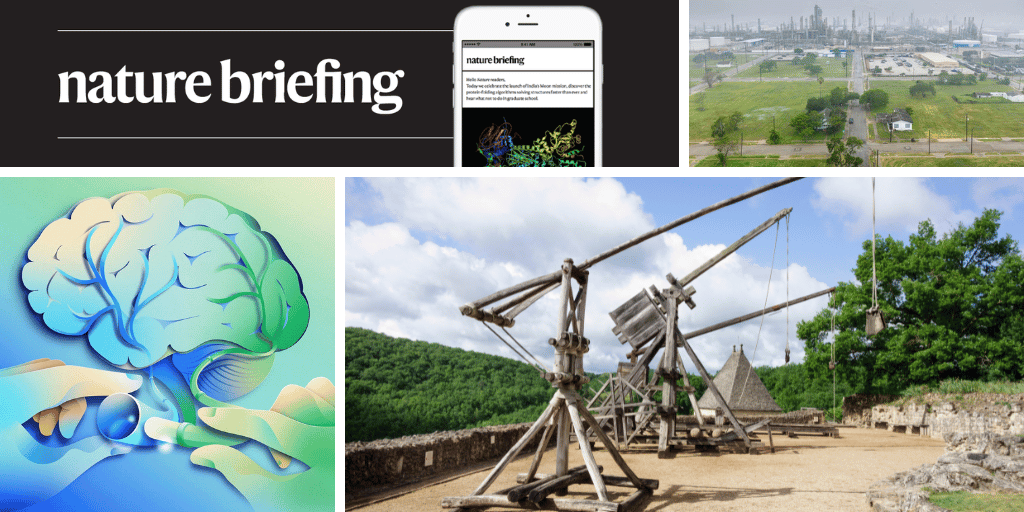
British troops used trebuchets during the 1304 siege of Stirling Castle. Researchers believe one projectile killed Skeleton 150. (Frank Buck/Alamy)
Around 700 years ago, a trebuchet projectile appears to have caused catastrophic injuries to a person whose remains were found beneath the chapel at Stirling Castle in Scotland. The skeleton, known as Skeleton 150, had fractures in more than 160 locations, indicating a brief episode of extreme force and high-speed impact.
Archaeologists identify the first confirmed evidence of a death caused by a trebuchet projectile. Forensic osteologist Lucas Waltenberger said the pattern and location of the fractures are inconsistent with more common explanations, such as falling from a castle wall or being trampled by a horse. The findings were presented at the European Congress of the Society of Paleopathology in Berlin last week.
Reference: Abstracts from the European Conference of the Paleopathology Society
The US National Institutes of Health (NIH) has reportedly begun rejecting research grant applications whose “primary role” is to provide information to policymakers and lawmakers, according to internal documents reviewed by Nature. The change could make it more difficult for government agencies to fund studies examining how policies, including firearms regulation and environmental protection, affect human health.
The documents state that NIH-funded research must support decision-making by stakeholder groups relevant to the agency’s mission, including patients, healthcare providers and scientists. Policymakers are not specifically included in that list.
Nature | 6-minute read
The growing international trade in mummified human remains could create health risks for buyers, sellers and postal workers, researchers warn. Archaeologists reviewed more than 100 social-media and auction-house listings offering mummified bodies for sale. Many of the remains showed signs of biological deterioration, while the listings provided little guidance about safe transport or storage.
Dormant microorganisms, including fungal spores, could be present in the remains. If disturbed, the researchers say, these organisms could become airborne and potentially cause serious infections.
Reference: International Cultural Heritage Journal paper
Featured science stories and expert insights
An experimental surgery for Alzheimer’s disease is attracting interest in China, despite limited evidence that it improves patients’ long-term health. The procedure connects lymphatic vessels in the neck to nearby veins, theoretically creating a new route for removing toxic proteins associated with Alzheimer’s disease from the brain.
The technique is being tested in controlled clinical studies around the world. Researchers remain divided, with some expressing cautious enthusiasm and others questioning whether any benefits will be meaningful or lasting. Microsurgeon JP Hong said that even a one-year improvement for a patient would be “an absolute miracle.”
Nature | 13-minute read

Graphic: Richard Tibbits/Nature
A group of climate scientists, psychiatrists and public-health researchers argue that environmental treaties should be treated as tools for protecting mental health and psychosocial well-being, not only as measures for preventing ecological damage.
Exposure to pollution and the depletion of natural resources can increase the risk of mental-health problems. However, the mental-health effects of environmental policies are rarely measured or reported. The researchers recommend that policymakers examine existing environmental agreements to identify where mental-health goals could be incorporated and determine what resources would be required.
Nature | 12-minute read
Urbanization is forcing some wild species to adapt rapidly. Some animals are evolving new physical traits and behaviors to survive in cities. For example, lizards living in Puerto Rico’s urban areas appear to have developed longer limbs and toes that provide a stronger grip.
Researchers also point to changes in other species, including signs of domestication in some urban animals, such as shorter snouts. They caution, however, that not every species can adapt at the same speed. Animals capable of changing their behavior may be better equipped to cope with rapidly changing urban environments.
Today, we’re thinking about how much time commuters could save if a train could accelerate from zero to nearly 800 kilometres per hour in just 5.3 seconds. China’s experimental train has reportedly achieved that feat, breaking its own short-range acceleration record.
Because I follow the steadier pace of the London Underground, I have more time to read your feedback on this newsletter. If you have any comments, please email [email protected].
Thank you for reading,
Jacob Smith, Associate Editor, Nature Briefing
• Nature Briefing: Careers — insights, advice and award-winning journalism to help you optimize your working life.
• Nature Briefing: Microbiology — the microorganisms that dominate life on Earth and their roles in health, the environment and our food systems.
• Nature Briefing: The Anthropocene — coverage of climate change, biodiversity, sustainability and geoengineering.
• Nature Briefing: AI and Robotics — thoughtful reporting on artificial intelligence and robotics, written by humans.
• Nature Briefing: Cancer — a weekly newsletter created for cancer researchers and professionals.
• Nature Briefing: Translational Research — the latest developments in biotechnology, drug discovery and pharmaceuticals.
Source: www.nature.com