


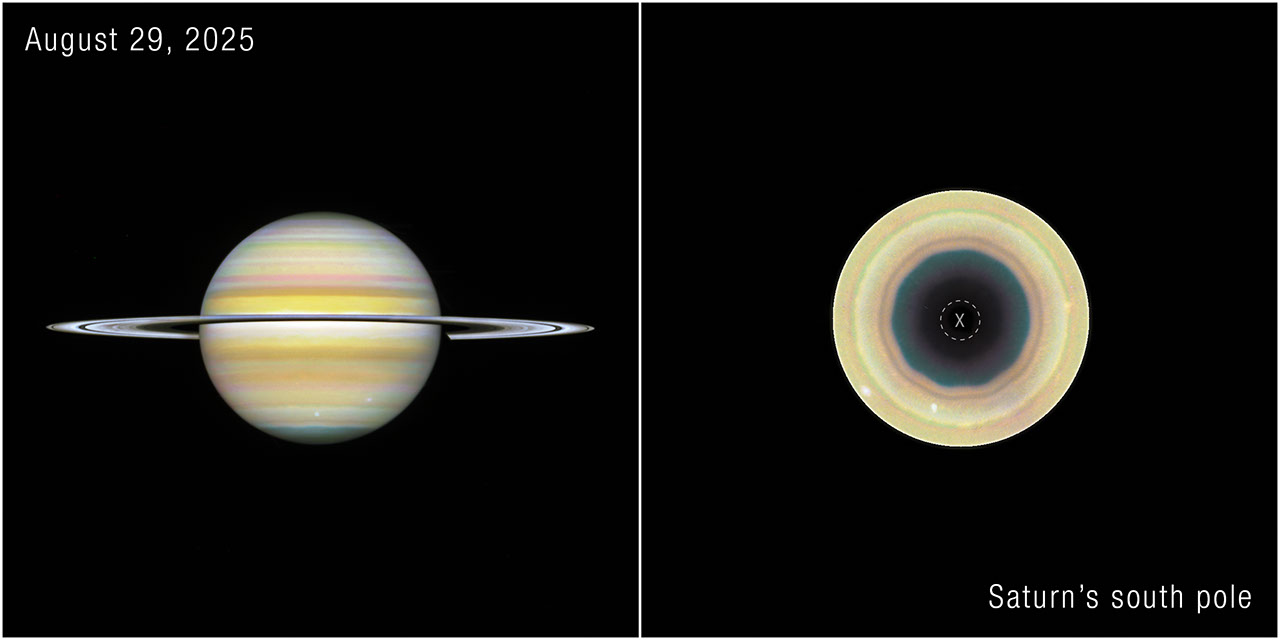
NASA’s Hubble Space Telescope captured Saturn and its south pole, where astronomers discovered a 10-sided atmospheric wave. The observations indicate that Saturn’s southern decagon extends through several layers of the planet’s atmosphere.
Images: NASA, ESA, STScI, Agustín Sánchez La Vega (UPV), Amy Simon (NASA-GSFC), Michael Wong (University of California, Berkeley). Image processing: Alyssa Pagan
Hubble Telescope Reveals a New 10-Sided Atmospheric Pattern at Saturn’s South Pole
NASA’s Hubble Space Telescope has detected a massive, evolving 10-sided atmospheric wave around Saturn’s south pole. The newly identified feature, known as a decagon, is the first large and regularly shaped lateral jet pattern observed in Saturn’s southern hemisphere.
The discovery resembles Saturn’s famous northern hexagon, but the two formations are not identical. Scientists believe the southern decagon may represent a recently developing atmospheric phenomenon on the gas giant. The findings were published in the journal Science Advances. Read the research.
Hubble Tracks the Formation of Saturn’s South Pole Decagon
By analyzing several years of Hubble observations beginning in 2023, researchers identified subtle signs of a wave that gradually developed into a more distinct decagonal pattern. The images were collected through Hubble’s Outer Planet Atmospheres Legacy, or OPAL, program, which monitors the atmospheres of the solar system’s outer planets over time.
“We’ve never seen anything like this in Saturn’s southern hemisphere,” said study co-author Amy Simon, OPAL principal investigator at NASA’s Goddard Space Flight Center in Greenbelt, Maryland. “The northern hexagon has been visible whenever we have observed it for more than 40 years. This feature is different. It appears to be intensifying, giving us a rare opportunity to watch a major atmospheric pattern develop.”
Saturn’s changing seasons gradually brought its south pole into view from Earth, allowing astronomers to study the region in greater detail. Researchers also combined Hubble observations with images from ground-based observatories to confirm the feature.
Lead author Agustín Sánchez-La Vega, a researcher at the University of the Basque Country in Spain, and amateur astronomers Trevor Barry and Jean-Paul Auger first noticed a faint, wavy band near Saturn’s south pole in 2024 observations. Additional ground-based images captured in 2025 provided stronger evidence of the developing decagonal structure. The researchers used observations collected through the Planetary Virtual Observatory Laboratory, which receives planetary images from observers around the world.
Why Hubble’s Saturn Observations Matter
Hubble’s location above Earth’s atmosphere provides exceptionally sharp images of Saturn throughout the planet’s rotation. This clarity allowed astronomers to examine the south pole without the distortion caused by atmospheric turbulence on Earth.
“Given the symmetry of Saturn’s north-south jet-stream system, we have been searching for a southern counterpart to the north-pole hexagon in Hubble images since 1990,” Sánchez-La Vega said. “Images from NASA’s Cassini spacecraft, which orbited Saturn from 2004 to 2017, showed no hint of a long-lived structure in this region. Hubble’s observations confirm that the feature was already present by 2023.”
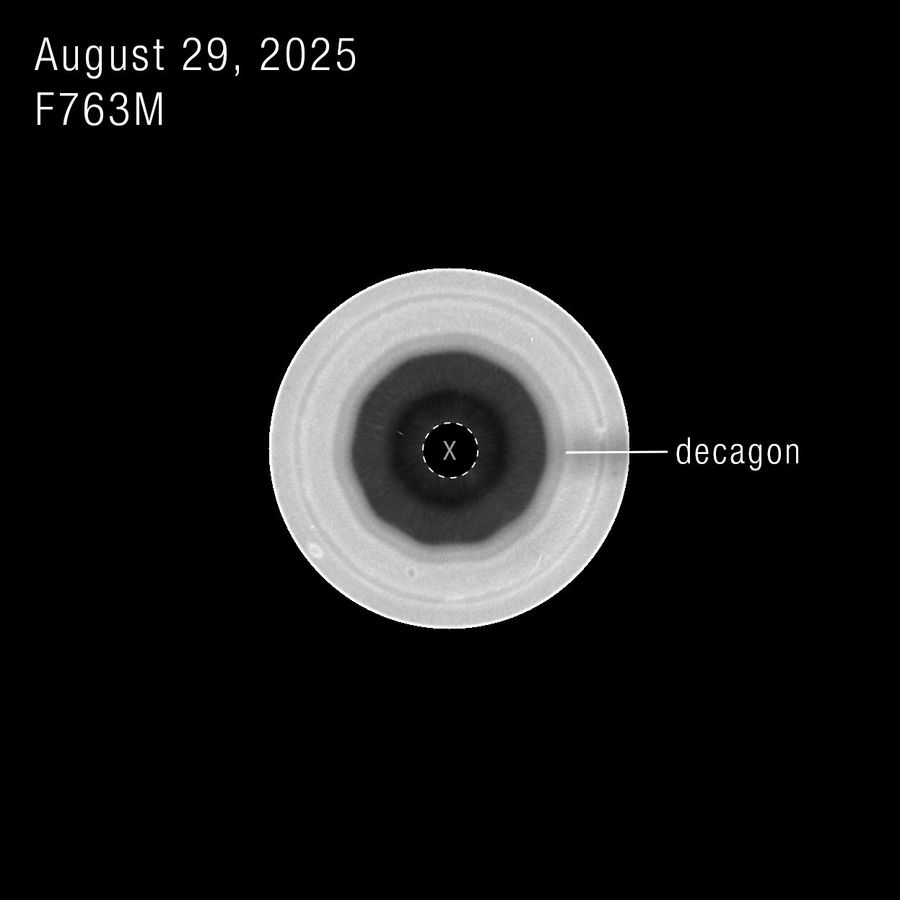
A single filter from NASA’s Hubble Space Telescope clearly reveals the 10-sided atmospheric wave, or decagon, surrounding Saturn’s south pole. An “X” marks the area where no data was recorded.
Images: NASA, ESA, STScI, Agustín Sánchez La Vega (UPV), Amy Simon (NASA-GSFC), Michael Wong (University of California, Berkeley). Image processing: Alyssa Pagan
A Vertical Atmospheric Structure
The Saturn south pole decagon lies within one of the planet’s powerful jet streams and appears across multiple atmospheric layers. This suggests that it is a deep, vertical structure rather than a feature limited to the upper cloud tops.
Hubble’s observations at different wavelengths show that the apparent location of the decagon shifts slightly. Because each wavelength reveals a different altitude, these changes provide clues about the structure and movement of Saturn’s atmosphere.
“The most interesting aspect is that this feature appears to have formed relatively recently,” Simon said. “The key question is why it is developing now when we have never seen it before.”
What Scientists Hope to Learn About Saturn’s Decagon
Additional observations from Hubble and NASA’s James Webb Space Telescope, along with advanced computer models, will help researchers determine how the decagon formed, how long it will persist, and how it compares with Saturn’s long-lived northern hexagon.
Because Hubble has observed the planets for decades, astronomers can study how atmospheric features change over time. The OPAL program provides more than a single snapshot: it helps scientists monitor seasonal changes, track short-lived storms, and identify atmospheric patterns that develop gradually.
“When we began the OPAL program, we expected fascinating surprises, but we did not know what those surprises would be,” said study co-author Michael Wong of the University of California, Berkeley. “Many OPAL discoveries are based on years of observations rather than a single image. Long-term monitoring makes it possible to identify new planetary phenomena.”
Researchers will continue observing Saturn to determine whether the southern decagon settles into a stable, long-lasting pattern like the northern hexagon or continues to change. Future observations could reveal what generates these waves, how they reflect the atmospheric dynamics of gas giants, and whether similar features exist on planets beyond our solar system.
The Hubble Space Telescope has operated for more than 30 years and continues to produce discoveries that expand our understanding of the universe. Hubble is an international partnership between NASA and the European Space Agency. NASA’s Goddard Space Flight Center in Greenbelt, Maryland, manages telescope and mission operations, with support from Lockheed Martin Space. The Space Telescope Science Institute in Baltimore, operated by the Association of Universities for Research in Astronomy, conducts Hubble science operations for NASA.
Source: science.nasa.gov