


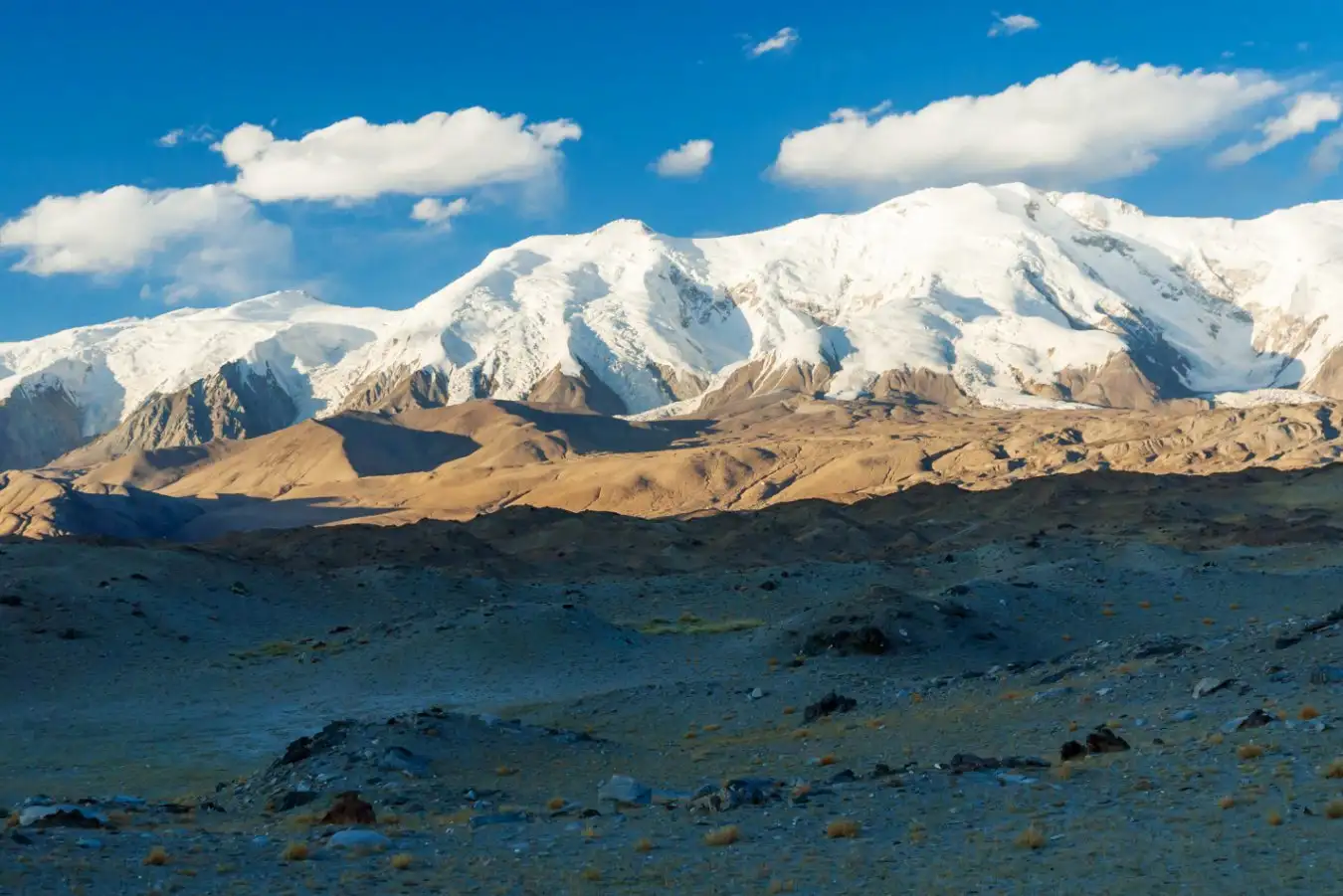
Kongur Shan Mountains, Pamir Plateau, China
Credit: Mark Andrews/Alamy
Recent studies reveal alarming ice loss in Asia’s Pamir Mountains, indicating that one of the last glacier-stable regions worldwide shows signs of decline due to climate change.
For decades, global temperature increases have led to glacier retreats, but the so-called “roof of the world” in Central Asia had been an anomaly. From the 1970s to the early 2000s, glaciers in the Western Kunlun, Karakoram, and Eastern Pamir mountains remained stable or showed minimal growth.
Fan You from the Chinese Academy of Sciences has been monitoring the three-kilometer-long Kangxiyan Glacier in China’s Xinjiang Uighur Autonomous Region, which peaks at 5,350 meters.
Prior to 2022, the glacier exhibited slight fluctuations in ice mass, with moderate annual losses and some years even recording slight gains.
However, a significant change occurred post-2022, with ice loss surging dramatically. In 2025, researchers measured unprecedented glacier melt, with the entire glacier surface losing 1.5 meters of equivalent water—more than quadrupling the average losses observed from 2011 to 2024.
The record melt observed at Kangxiyan is also evident in other glaciers across the Pamir Plateau, primarily due to extreme heat conditions. Unlike previous years, where high temperatures were concentrated in a brief period, 2025’s elevated temperatures persisted throughout the entire snowmelt season.
This suggests a shift in the dynamics of the Pamir-Karakorum glaciers, aligning them with global melting trends. Researchers warn that extreme weather events are likely to further accelerate glacier loss in this region.
According to Sean Eaves from Victoria University in Wellington, New Zealand, these findings align with predictions that human-induced climate change significantly increases the frequency of extreme warming, which impacts glacier integrity. However, we must exercise caution before declaring that such trends will continue undeniably.
The ice mass of Kangxihe Glacier was initially measured only in 2011, making 2025 a critical date for understanding the historical context of glacier changes.
Topics:
Source: www.newscientist.com