


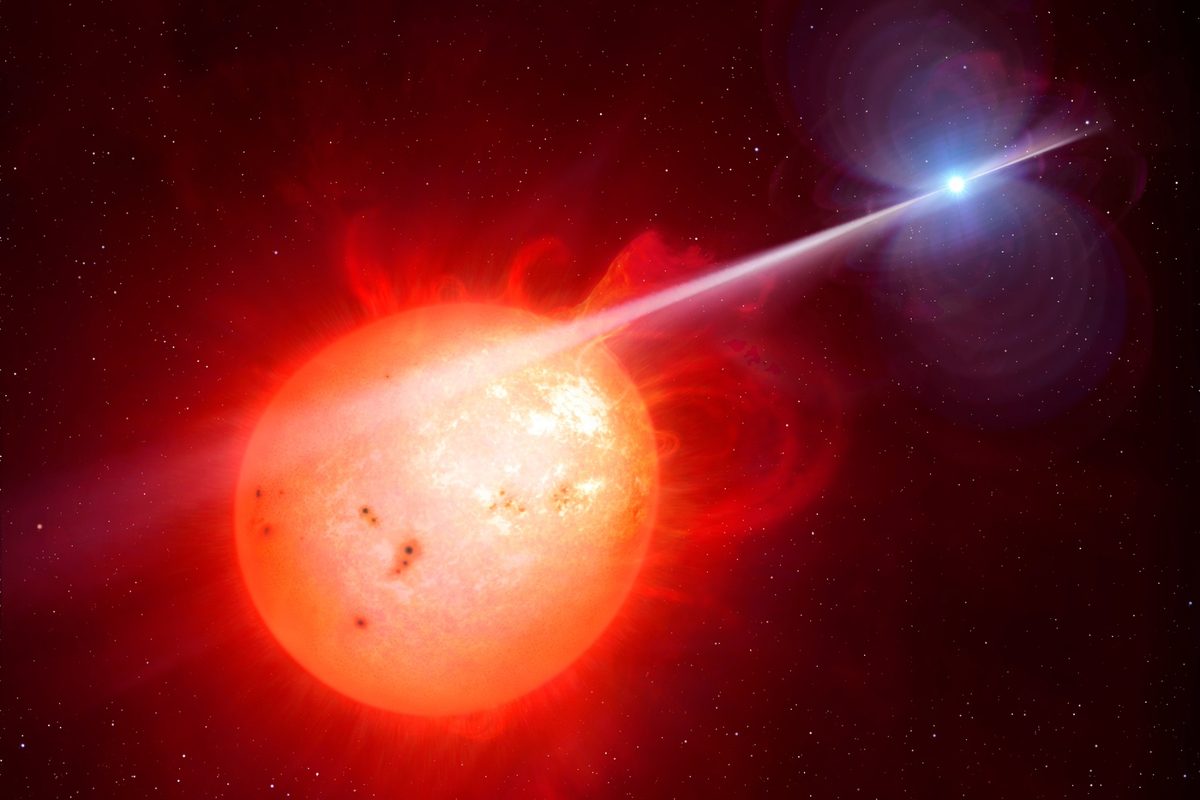
In recent years, astronomers have been intrigued by a series of mysterious radio signals originating from the Milky Way. Approximately 12 long-period radio transients (LPT) have been detected from various locations within the galaxy.
Currently, researchers at the University of Sydney, Australia, report in Nature Astronomy, led by Covey Rose, that one of these signals may be linked to an anomalous star system they have dubbed the “Star Rosetta Stone.” This discovery may help scientists unlock the mysteries behind these enigmatic signals.
The newly discovered system, known as ASKAP J1745-5051, consists of a white dwarf—a dense stellar remnant comparable to Earth in size but possessing a mass similar to that of the Sun—and a significantly larger yet lower-mass red dwarf star, which has about one-tenth the mass of the Sun. The two stars are in close proximity, completing an orbit in just over an hour.
The interaction between the stars’ magnetic fields leads to radio bursts at specific points in their orbits, producing signals at regular intervals.
According to Rose, “This system serves as a key to deciphering these signals. It may aid us in determining whether other long-period transients are closer to pulsars or white dwarfs functioning as stellar Rosetta Stones,” referencing the archeological artifact that facilitated the translation of ancient hieroglyphics.
In addition to radio emissions, material from the less massive star is drawn towards the white dwarf, heating it and generating X-rays.
This groundbreaking discovery offers a unique opportunity to investigate not only the magnetic interactions between stars but also extreme plasma physics under conditions unattainable on Earth.
Rose emphasized, “These systems are natural laboratories, allowing us to test our understanding of matter’s behavior under intense magnetic fields and gravitational forces.”
Dr. Darren Baskill, an expert in cataclysmic systems from the School of Physics and Astronomy at the University of Sussex, commended the research. “They provided excellent observations and explanations for the causes behind these long-period radio transients,” he stated.
However, he cautioned, “While the source of these radio waves now seems to be clarified, many more questions persist regarding the physics of cataclysmic stars.”
Read more:
Source: www.sciencefocus.com