


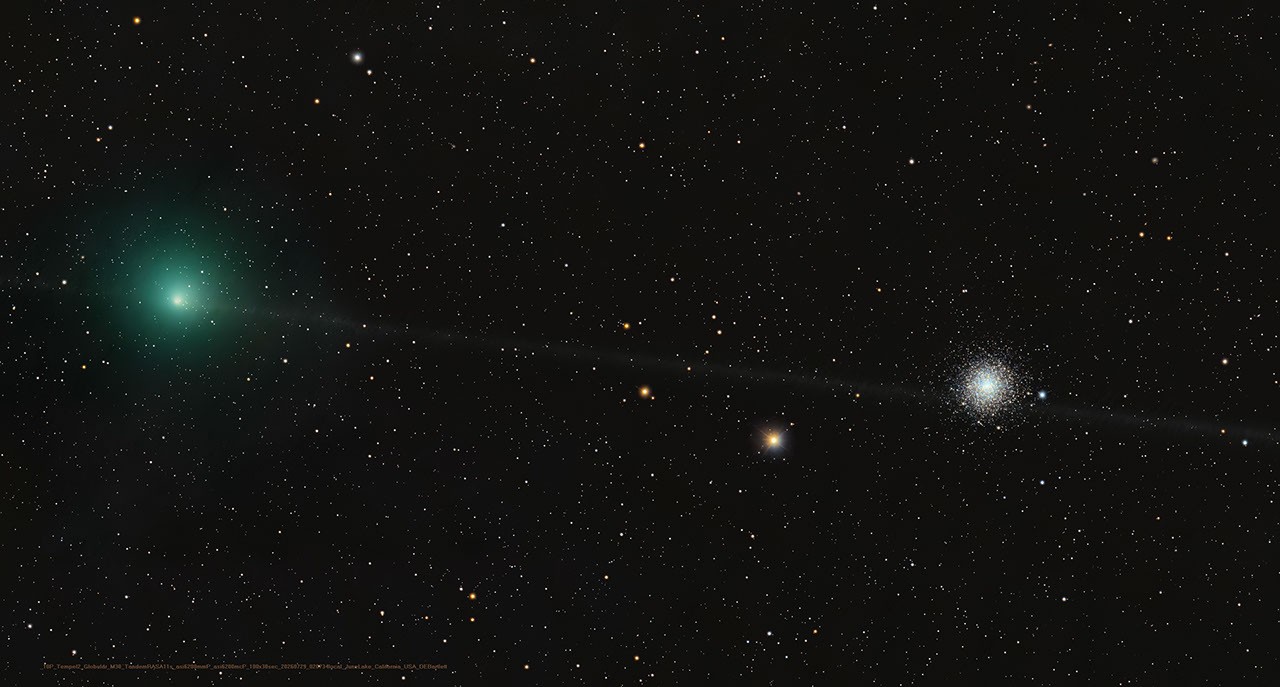
Explanation: Which of these objects is not a comet? The answer is the object on the right: a globular star cluster. On the left, the diffuse green coma of periodic comet 10P/Tempel 2 appears in the frame. The globular cluster is Messier 30, also called M30—the 30th object in astronomer Charles Messier’s catalog of celestial objects that could be mistaken for comets. In the 18th century, Messier compiled his famous Catalogue of Nebulae and Star Clusters to identify faint objects that remained fixed against the background stars instead of moving across the sky like comets. Although his telescope would have shown comet 10P/Tempel 2 and the distant star cluster as similarly faint, fuzzy objects, the famous comet hunter would have reached the same conclusion. Captured on July 29, this modern telescopic image shows periodic comet Tempel 2 passing close to Messier 30 in the night sky. The comet’s faint, narrow orbital dust trail appears to pass through the globular star cluster, but the two objects are separated by an extraordinary distance: Tempel 2 was only 3.5 light-minutes from Earth, while Messier 30 lies approximately 28,000 light-years away.
Tomorrow’s picture: Contemplating the Sun
Source: science.nasa.gov