


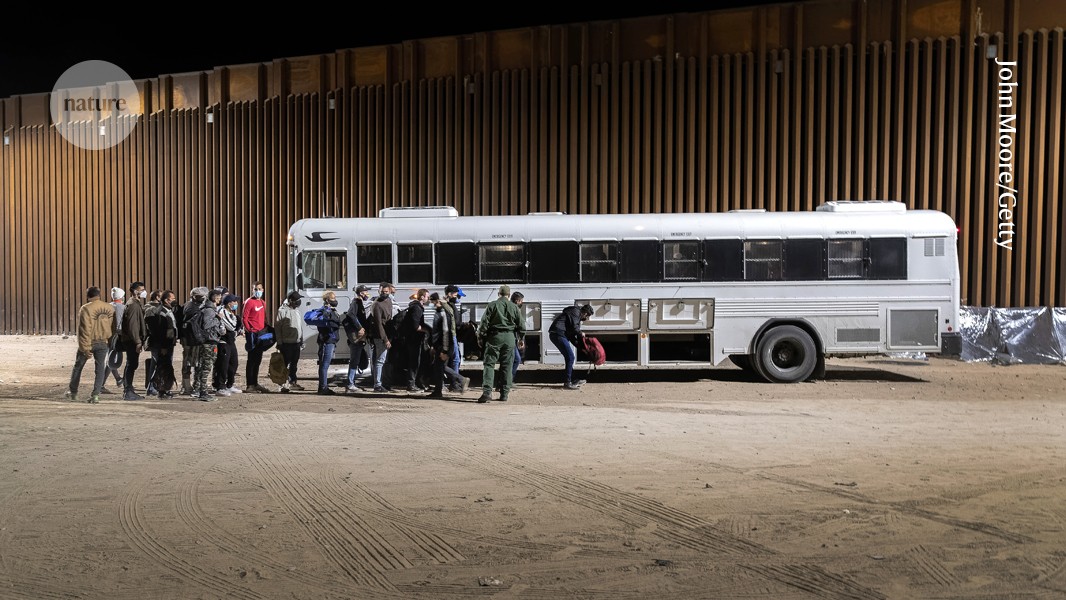
An increase in the undocumented population has been associated with lower rates of property crime and assault in some neighborhoods, although robberies have increased in certain areas.Credit: John Moore/Getty
An analysis of 11,500 neighborhoods across more than 100 US cities found no evidence that growing undocumented populations lead to higher overall crime rates. In many neighborhoods where the undocumented population increased, property crime and violent crime declined.
In a paper published in Urban Issues Journal on August 101, researchers compared estimates of undocumented residents with crime statistics collected between 2010 and 2018.
“Our study is the first to analyze these figures across regions using such a diverse national sample,” says study co-author and criminologist Caris Kubrin at the University of California, Irvine. “This is important because neighborhoods are the places closest to people. That is where perceptions are formed.”
Previous studies have “used samples of people and places within specific jurisdictions,” says Alexis Piquero, a criminologist at the University of Miami in Coral Gables, Florida. By comparison, he says, this study is “much broader in scope.”
The findings support earlier research from the United States and other countries showing no consistent connection between immigration and violent crime. “This is very consistent with what we’ve seen in the UK study,” says Ben Brindle, a senior researcher with the Migration Observatory at the University of Oxford.
Undocumented immigrants and neighborhood crime
Undocumented immigrants include people who entered a country without authorization or remained after their visa expired. Public perceptions are often shaped by the assumption that undocumented immigrants are more likely to commit crimes than documented immigrants or citizens.
However, Piquero notes that “it’s very difficult to measure the number of undocumented immigrants in any country, because they’re here illegally. So researchers have developed estimates.”
For this study, Kubrin and her colleagues received access to non-public demographic data on 46 million people through the Federal Statistical Research Data Center.
To estimate the undocumented population, the researchers excluded people identified as US citizens or born in the United States, as well as those recorded as having public health insurance, higher education, or a spouse who was an American citizen. These characteristics are more commonly associated with authorized visa holders or permanent residents.
The analysis found that undocumented residents accounted for an average of 5.6% of neighborhood populations in 2010. By 2018, that figure had fallen to 4.8%, according to estimates from the Department of Homeland Security.

Since 2000, human migration has increased rapidly. These maps reveal where people are going
The researchers then used crime data from the National Incident-Based Crime Survey to examine how neighborhood crime patterns correlated with the estimated share of undocumented immigrants. They analyzed property crimes, including robbery and automobile theft, along with violent crimes such as murder and aggravated assault.
Overall, neighborhoods with larger increases in undocumented immigration did not experience a general rise in crime. However, the statistical analysis identified associations between increases in the undocumented population, property crime, and aggravated assault in some locations.
Robbery rates also tended to rise in areas where the undocumented population increased. “Crime rates may be higher in some areas because immigrants are victims rather than criminals,” Kubrin says. Undocumented immigrants are more likely than other residents to be paid in cash and less likely to have bank accounts, factors that may increase their vulnerability to robbery.
Source: www.nature.com