


Could Switching Breathing Gases Help Prevent Decompression Sickness?
Deep-sea divers carefully control their ascent to avoid decompression sickness, also known as “the bends.” This potentially serious condition occurs when dissolved gases form bubbles in the blood and tissues as pressure decreases during a rapid ascent.
Now, a new study involving pigs in custom diving suits suggests that changing the gas divers breathe underwater could reduce the risk of severe decompression sickness. The findings may eventually help commercial and military divers stay underwater longer, dive deeper and return to the surface more quickly.
The research was published August 10 in Proceedings of the National Academy of Sciences.
Study co-author Dr. Richard Moon, an anesthesiologist and professor of medicine at Duke University, has treated many people with decompression sickness. Moon has also experienced a mild case himself, which caused joint pain.
Severe decompression sickness can be life-threatening. Gas bubbles may block blood flow and damage the heart, brain and other organs.
from the latest videoslive science
Why divers develop decompression sickness
The risk begins with the gases divers breathe underwater. At depth, surrounding pressure increases, causing gases such as nitrogen and helium to dissolve into the body’s tissues.
When a diver ascends, the pressure drops. If the ascent is too fast, dissolved gas can come out of solution and form bubbles, much like bubbles released when a carbonated drink is opened. These bubbles can cause joint pain, neurological symptoms, breathing problems and other complications.
Breathing compressed air at great depth can also cause nitrogen narcosis, sometimes called “the rapture of the deep.” The condition can impair judgment and create an intoxicated feeling because of the effects of nitrogen under high pressure.
How nitrox and heliox reduce diving risks
Many divers use nitrox, a breathing mixture containing more oxygen and less nitrogen than ordinary air. Reducing nitrogen exposure can lower the risk of nitrogen narcosis and decompression sickness when the gas is used within appropriate depth and time limits.
Commercial and technical divers may use heliox, a mixture of helium and oxygen. Helium is less likely than nitrogen to cause narcosis, making heliox useful for deep diving. However, heliox is expensive and does not eliminate the risk of decompression sickness.
High oxygen concentrations can also become toxic at depth. For that reason, divers must carefully manage gas mixtures, pressure, depth and exposure time.
“The risk of injury while diving increases almost exponentially with increasing depth,” said Dr. Kay Tetzlaff, a clinician-researcher at the University of Tübingen who was not involved in the study.
Divers prepare scuba tanks filled with heliox, a mixture of helium and oxygen.
(Image credit: Vladimir_Timofeev, via Getty Images)
Why researchers tested carbon tetrafluoride
Moon and his colleagues have spent decades studying ways to make deep-sea diving safer. Their approach is based on a process called isobaric counterdiffusion, in which one inert gas leaves body tissues as another enters.
The researchers initially considered neon because its larger molecules might move through tissues more slowly than helium or nitrogen. However, the cost of neon increased sharply, partly because of disruptions to global supplies. The team instead investigated carbon tetrafluoride, or CF4.
Carbon tetrafluoride is an inert gas, meaning it does not readily react chemically with body tissues. It is also less soluble than helium, which could allow helium to leave the body faster than CF4 enters tissues.
Pig study shows fewer signs of decompression sickness
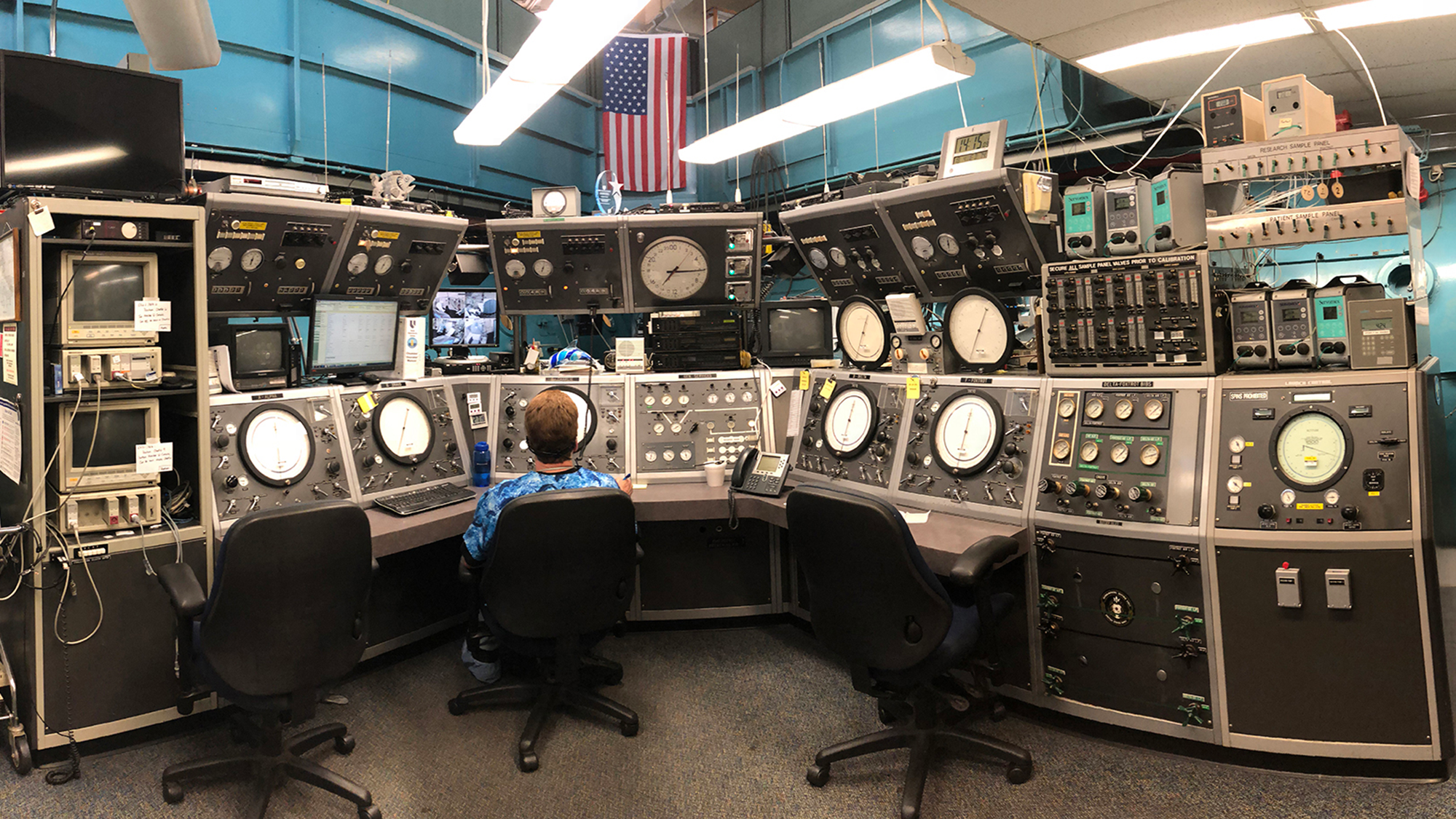
The experiment took place at Duke University’s hyperbaric facility, where researchers used a large pressure chamber to simulate conditions roughly 61 meters, or 200 feet, below sea level.
The team studied 40 sedated pigs, which are considered useful models for examining certain effects of diving because their cardiovascular and respiratory systems share important similarities with those of humans. The animals wore custom-made diving suits equipped with hoods and heaters.
Each pig underwent a one-hour simulated dive. Half breathed heliox for the entire experiment. The remaining pigs breathed heliox initially and switched to a mixture of oxygen and CF4 during the final 10 minutes underwater.
During the gas switch, helium began leaving the animals’ tissues while the less-soluble CF4 entered more slowly. As a result, the pigs in the experimental group had less inert gas remaining in their tissues when they returned to the surface.
All of the animals underwent decompression at the same rate and were monitored for three hours afterward. Pigs that breathed only heliox showed more signs of decompression sickness, including difficulty walking and a higher incidence of gas bubbles, or embolisms, in the heart.
More than 80% of the pigs that breathed heliox died within three hours of the simulated dive and decompression. None of the pigs that switched to the CF4-based mixture died during the monitoring period.
Could the gas mixture be used by human divers?
The findings are promising, but they do not immediately support changing human diving standards. The study was conducted in pigs under controlled laboratory conditions, and additional research is needed to evaluate the safety, effectiveness and long-term effects of breathing carbon tetrafluoride.
Cost is another obstacle. CF4 is expensive, making it unlikely to become a practical option for most recreational divers. The gas may be more relevant to commercial, scientific or military diving, where the ability to work safely at extreme depths could justify the expense.
“Due to the cost, it will be limited to commercial and military diving,” Moon said.
Even if the technology is used by only a small number of divers, Tetzlaff said the research could still have an important impact.
“Being able to dive safer is worth the effort, right?” he said. “Even if it only applies to a few people.”
This article is for informational purposes only and does not provide medical or diving advice.
Lance, R. M., Murkowski, M. S., Mahon, R. T., Everitt, J. I., Natoli, M. J., Wright, M. C., Howle, L. E., Bartlett, N. C., Patel, A., Morales, G., and Moon, R. E. (2026). Isobaric backdiffusion of carbon tetrafluoride breathing gas to prevent severe decompression sickness. Proceedings of the National Academy of Sciences, 123(33), e2600125123.
Source: www.livescience.com