


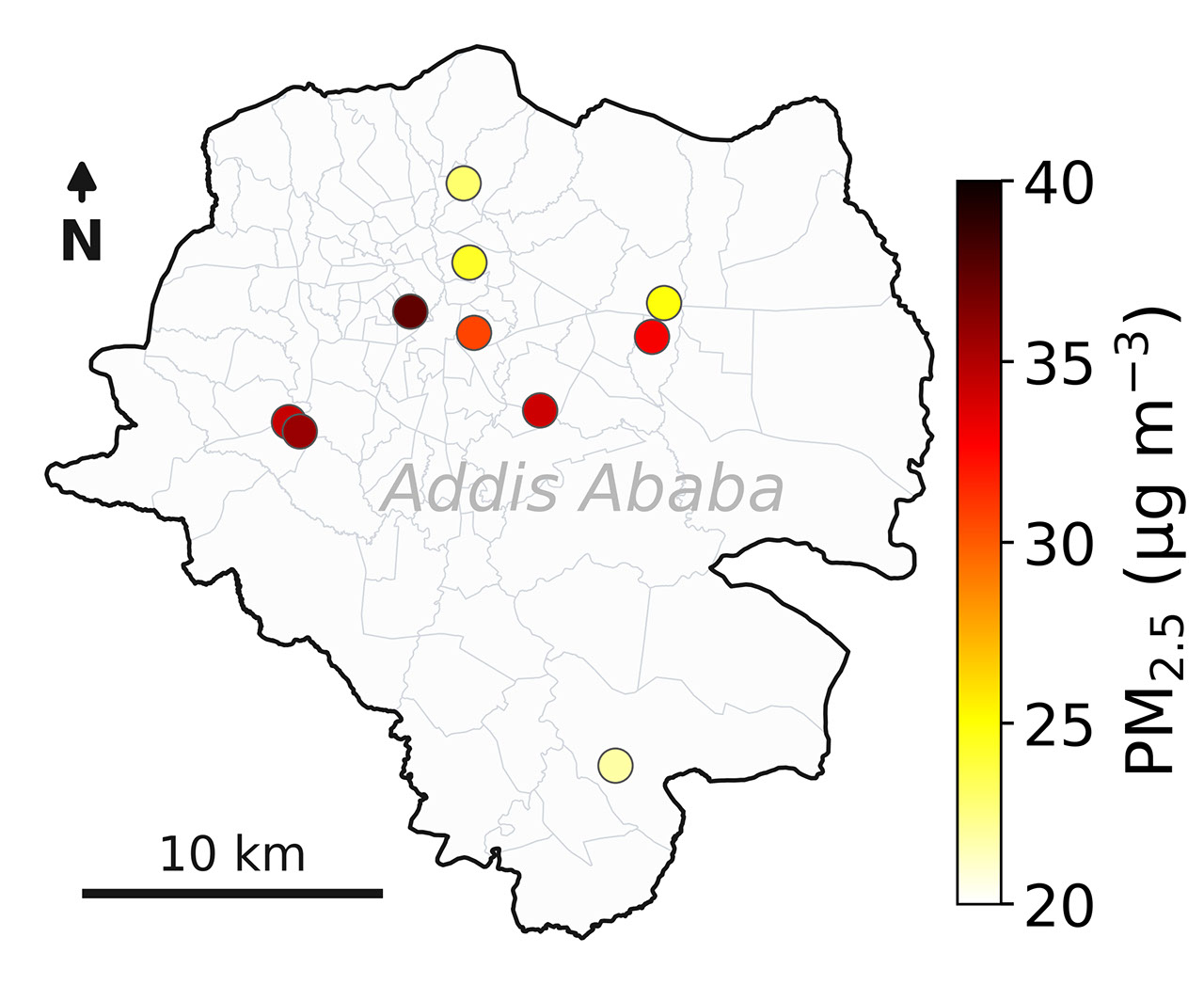
A new map of Addis Ababa, Ethiopia, highlights how NASA’s Multi-Angle Imager for Aerosols (MAIA) mission is delivering one of the most detailed studies of urban air pollution to date. Over a three-year period, MAIA sensors measured fine particulate matter, known as PM2.5—airborne particles with diameters of 2.5 micrometers or smaller.
Black carbon, commonly called soot, is a major component of PM2.5 pollution in Addis Ababa. Research has linked exposure to black carbon and other fine particles with low birth weight, impaired brain development, respiratory illness, and premature death. Mapping these pollutants can help researchers better understand the health risks associated with air pollution in Ethiopia’s capital.
The color scale on the right shows differences in PM2.5 concentrations across monitoring stations, ranging from 20 to 40 micrograms per cubic meter. Dark red areas represent the highest pollution levels and the poorest air quality.
In Ethiopia, black carbon is commonly released by diesel vehicles, fires, and other combustion sources. Detailed observations from MAIA sensors show how air pollution in Addis Ababa changes throughout the day and across seasons. Pollution levels can increase during rush hour traffic and holiday celebrations, providing valuable insight into the city’s most significant emission sources.
The findings from Addis Ababa may also help cities worldwide develop more effective air-quality strategies, including communities in the United States. MAIA’s global air-pollution research covers 12 regions, including areas surrounding Los Angeles, Atlanta, and Boston.
The MAIA mission combines an operational ground-based sensor network with a space-based observatory. Its advanced camera is being developed at NASA’s Jet Propulsion Laboratory and is scheduled for launch by the Italian Space Agency (ASI) on an ASI satellite by the end of 2027. By analyzing how light reflects from different aerosol particles, the instrument will help identify PM2.5 types and map particle concentrations across the regions it studies.
Source: science.nasa.gov