


ATLAS Finds Evidence of a Rare Higgs Boson Decay Into a Virtual Photon and a Real Photon
Physicists from the ATLAS Collaboration at CERN’s Large Hadron Collider (LHC) have found evidence that the Higgs boson decays into a virtual photon and a real photon. The virtual photon then produces a pair of leptons. Known as H→γ*γ→ℓℓγ, this rare process occurs only about once in every 10,000 Higgs boson decays, making it one of the most elusive particle behaviors ever studied.
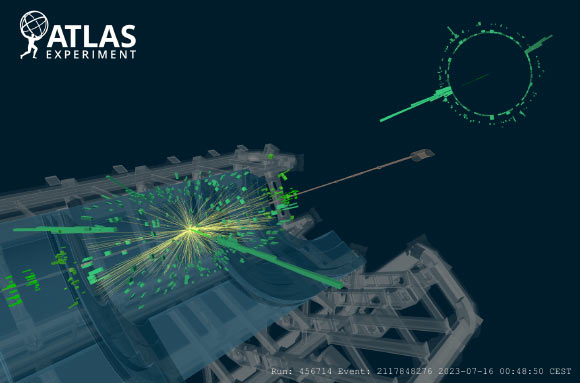
A display of an event recorded by the ATLAS detector in 2022 in which a candidate Higgs boson decays into a photon-lepton pair following a proton-proton collision. Image credit: ATLAS Collaboration / CERN.
A Rare Higgs Boson Decay
“Every decay mode of the Higgs boson provides a different window into the fundamental laws of nature,” ATLAS physicists said in a statement.
“Rare decays are of particular interest because they provide a unique opportunity to test the Standard Model in areas where subtle effects of new physics may become visible.”
“Recent studies of rare Higgs boson decays, including decays into photon, Z-particle and muon pairs, are beginning to unlock this potential and warrant further exploration.”
“One particularly elusive decay is the Higgs boson decay into a virtual photon and a photon.”
Unlike ordinary photons, which are stable and massless, virtual photons exist only temporarily and do not behave like real photons. In this process, the virtual photon immediately produces a pair of leptons.
Because the decay produces a lepton pair rather than a second real photon, it provides a way to examine subtle properties of the Higgs boson, including tests of so-called CP symmetry.
How ATLAS Searched for the Signal
To collect enough data on this rare process, ATLAS researchers combined results from two Large Hadron Collider runs: the three-year Run 3 dataset collected from 2022 to 2024 and the complete Run 2 dataset collected between 2015 and 2018.
The researchers examined collision events containing a photon and two low-mass leptons. The leptons were emitted so close together that their signals nearly overlapped, making them especially difficult to identify when they were electrons rather than muons.
Although the ATLAS detector can readily identify nearby muons, detecting two nearby electrons is significantly more challenging.
To address this problem, the scientists developed a machine-learning tool based on boosted decision trees to identify so-called merged electrons. They also used specialized calibration and detection systems.
Evidence, Not Yet a Discovery
Combining the two datasets roughly doubled the amount of information available for analysis. The resulting signal appeared as a small excess in the data near the Higgs boson’s known mass of 125 GeV and closely matched theoretical predictions.
The statistical significance of the result reached 3.4 standard deviations. That level is sufficient to qualify as evidence, but it falls short of the traditional 5-sigma threshold that physicists use to claim a discovery.
“This result demonstrates the amazing power of the ATLAS experiment and the power of innovative analytical techniques that allow physicists to explore some of the rarest decays of the Higgs boson,” the physicists said.
“As the era of the High-Luminosity LHC approaches, researchers will be able to explore these elusive processes with unprecedented precision, providing new opportunities to test the Standard Model and look for signs of new physics.”
The results will be published in High Energy Physics Journal.
_____
ATLAS Collaboration. 2026. Measurement of Higgs boson decay into photons in low-mass dilepton systems and pp collisions at √s = 13 and 13.6 TeV using the ATLAS detector. High Energy Physics Journal, in press. arXiv:2608.03369.
Source: www.sci.news