


Close Menu
HitechubHitechub
    What's Hot
    Science

    Eyelash Trimming for Men: The Rising Trend That’s Confusing Ophthalmologists

    Technology

    How fast commercial airplanes really are?

    AI

    10 Effective Strategies for Teaching Artificial Intelligence

    Important Pages:
    • About Us
    • Privacy Policy
    • Terms & Conditions
    Facebook X (Twitter) Instagram Pinterest
    Facebook X (Twitter) Instagram
    HitechubHitechub
    Thursday, June 4
    • Technology
      1. AI
      2. Gadgets
      3. View All

      This is the most popular CEO in the world

      Sectors in which “Chat-GPT” is most often used

      AI Pioneer Expresses Concern About Potential for AI to Surpass Humanity

      Artificial intelligence has begun to “swallow” professions

      What’s new in Android 14

      Europeans have about 700 million old mobile phones in their drawers

      Here’s how you can tell if your phone is being tapped

      “Sneaker X” – computer case in the shape of a sneaker

      Russian Gamers Unite to Prevent Nuclear War: Join the Fight Online

      Challenges of Space Travel: Why Journeying to Space is So Difficult

      NASA Astronaut Casts Historic Vote from Space

      Discover the Future of Comfort: What If You Could Wear a Chair?

    • Science
      1. Space
      2. Wheels
      3. View All

      Galaxies in the universe are growing more slowly than they should

      “Espace” presented the new lander “Apex 1.0”

      The largest asteroid sample ever collected has arrived on Earth

      (VIDEO) Incredible flight of the Parker Solar Probe

      Toyota wants to make a new generation battery with a range of up to 1,200 km

      Meet Toyota’s lunar “baby” that could make exploring the Moon easier

      Microlino – Is this the perfect city car?

      Alfa Romeo 4C gets an electric successor

      Pigeons Utilize Superparamagnetic Immune Cells in Their Livers to Detect Earth’s Magnetic Field

      Webb Telescope Discovers Methane in Interstellar Comet 3I/ATLAS

      Silent Spring: How Rachel Carson’s 1962 Science Book Transformed the World

      New Axolotl Fossil Discovered in Mexico: A Significant Paleontological Find

    HitechubHitechub
    Home » Webb Telescope Discovers Methane in Interstellar Comet 3I/ATLAS
    Science

    Webb Telescope Discovers Methane in Interstellar Comet 3I/ATLAS

    Share Facebook Twitter Pinterest WhatsApp
    Share
    Facebook Twitter LinkedIn Pinterest WhatsApp

    Astronomers have made a groundbreaking discovery using spectral data from the Mid-Infrared Instrument (MIRI) onboard the NASA/ESA/CSA James Webb Space Telescope, detecting methane in interstellar object 3I/ATLAS for the first time ever.


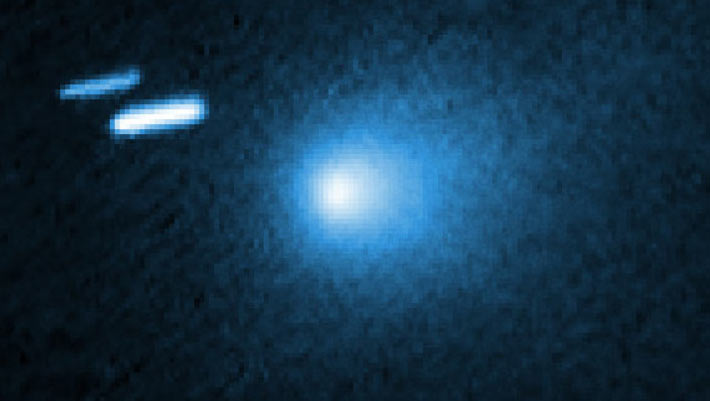
    Hubble captured this image of 3I/ATLAS on July 21, 2025, when the comet was 446 million kilometers (277 million miles) from Earth. Image credits: NASA/ESA/David Jewitt, UCLA/Joseph DePasquale, STScI.

    According to astronomer Matthew Belyakov from the California Institute of Technology, “Interstellar objects (ISOs) like 3I/ATLAS are planetesimals formed around other stars and ejected from their original systems through mechanical interactions.”

    “During its brief journey through our solar system, 3I/ATLAS offers a unique insight into a population of small extrasolar objects, providing a valuable opportunity to analyze similarities and differences in planetesimal formation processes across the galaxy.”

    3I/ATLAS is the third confirmed interstellar object, following 1I/’Oumuamua and 2I/Borisov, featuring an estimated core diameter of 2.6 km (1.6 miles).

    Unlike 1I/’Oumuamua, which appeared inactive, 3I/ATLAS has shown signs of being in a comatose state for an extended period.

    The astronomers stated, “Coordinated efforts are ongoing to characterize the chemical composition of the 3I/ATLAS coma.”

    “Ground spectroscopy in visible wavelengths revealed gaseous cyanide and atomic nickel, while radio observations using ALMA uncovered methanol and hydrogen cyanide in its molecular inventory.”

    “Additional near-infrared observations via Webb and SPHEREx detected fluorescence signatures from water, carbon dioxide, and carbon monoxide.”

    “Post-perihelion measurements by SPHEREx displayed a marked increase in carbon monoxide production along with new emission features at 3.2-3.4 μm, likely resulting from organic materials.”

    Evidence suggesting 3I/ATLAS’s activity is evolving includes its bluish visible color and noticeable asymmetry in water production trends before and after perihelion.
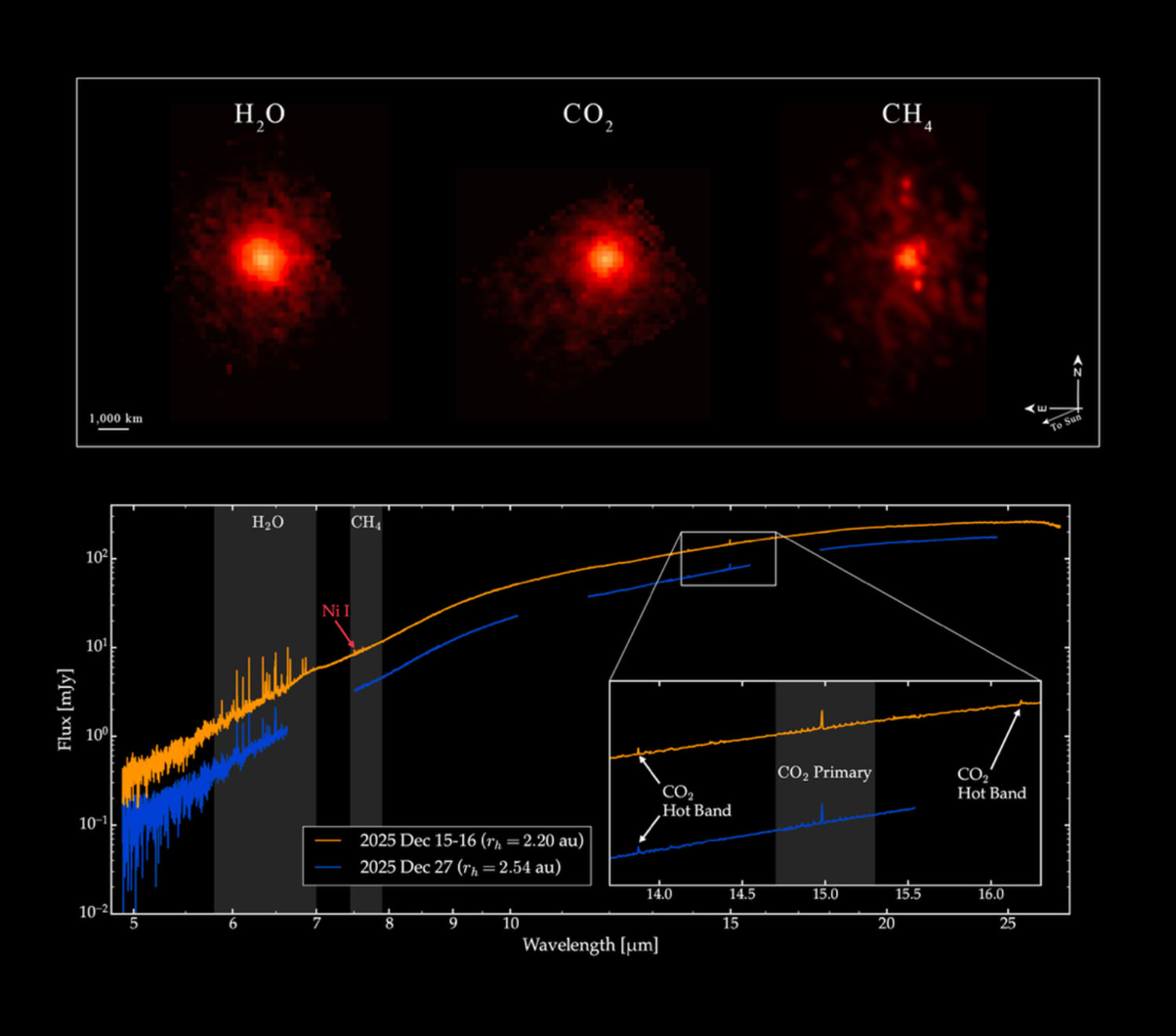

    3I/ATLAS observed by Webb's MIRI instrument, highlighting gas concentrations around the comet. Image credits: NASA/ESA/CSA/STScI/M. Belyakov, Caltech/I. Wong, STScI/A. Pagan, STScI.

    3I/ATLAS observed by Webb’s MIRI instrument, with contour lines indicating gaseous emissions from the comet. Water vapor spreads significantly beyond its core, while carbon dioxide and methane are tightly concentrated near the comet’s core. Image credits: NASA/ESA/CSA/STScI/M. Belyakov, Caltech/I. Wong, STScI/A. Pagan, STScI.

    The latest observations were conducted using MIRI on two different days as 3I/ATLAS orbited the Sun, starting from December 15-16, 2025, at around 329 million km (205 million miles) from the Sun, followed by a second observation on December 27 at approximately 379 million km (236 million miles).

    “Methane is highly volatile, meaning it easily transitions from solid ice to gas,” the researchers noted.

    “The late emergence of methane in Comet 3I/ATLAS suggests it is buried beneath the comet’s surface, insulated from sublimation, until heat from its solar approach penetrates the icy subsurface.”

    “The relative amount of methane to water found is surprisingly high and lacks comparable examples in our solar system.”

    3I/ATLAS has long been recognized as a rare carbon-rich object, and the Webb observations confirm its uniqueness.

    This comet consistently emits more carbon dioxide than water, diverging from typical comets in our solar system.

    The presence of methane and carbon dioxide indicates a different formation history compared to traditional solar system origins.

    “Webb also observed a rapid decline in gas production as 3I/ATLAS moved away from the Sun, with water showing the most significant decrease,” scientists explained.

    “This behavior aligns with expectations for such objects, as reduced solar heat causes the comet’s surface to cool, leading to decreased ice evaporation.”

    For further details, check out a paper that will be published on April 8, 2026, in the Astrophysics Journal Letter.

    _____

    Matthew Belyakov et al. 2026. “Volatile inventory of 3I/ATLAS as seen by JWST/MIRI.” APJL 1001, L11; doi: 10.3847/2041-8213/ae5700

    Source: www.sci.news

    Share. Facebook Twitter Pinterest LinkedIn WhatsApp
    Previous ArticleSilent Spring: How Rachel Carson’s 1962 Science Book Transformed the World
    Next Article Pigeons Utilize Superparamagnetic Immune Cells in Their Livers to Detect Earth’s Magnetic Field

    Related Posts

    Science

    Pigeons Utilize Superparamagnetic Immune Cells in Their Livers to Detect Earth’s Magnetic Field

    Science

    Silent Spring: How Rachel Carson’s 1962 Science Book Transformed the World

    Science

    New Axolotl Fossil Discovered in Mexico: A Significant Paleontological Find

    Science

    When Food is Scarce: This Single-Celled Organism Becomes a Giant Man-Eater for Survival

    Science

    Unlocking Multitasking: How Science Reveals Your Brain’s Potential with Practice

    Science

    Revealing the Truth: Stonehenge’s Altar Stones Likely Not Transported by Glaciers

    Science

    Experts Recommend Ditching AI Prompts to Reduce Energy Consumption

    Science

    Unlocking Stonehenge: A New Breakthrough in Solving Its Greatest Mystery

    Add A Comment
    Leave A Reply Cancel Reply

    Stay In Touch
    • Facebook
    • Twitter
    • Instagram
    • Pinterest
    Top Picks
    Technology

    What will you do if the world remains without internet?

    It’s an interesting question what would happen if the internet disappeared, that is, if the whole world lost its connection to the network for some reason.

    Where is the anti-universe where time flows backwards?

    Unlocking Multitasking: How Science Reveals Your Brain’s Potential with Practice

    Can ChatGPT diagnose patients just like doctors?

    Essential Guide for Parents: What to Know About Kids’ VR Gear Choices

    Most Popular
    Technology

    Driverless taxi in Japan

    Technology

    The most powerful X-ray laser in the world has been activated

    Categories
    • AI (13)
    • Gadgets (10)
    • Science (46)
    • Space (9)
    • Technology (37)
    • Wheels (9)
    Our Picks
    AI

    AI Pioneer Expresses Concern About Potential for AI to Surpass Humanity

    Wheels

    BMW XM surprises in a moose avoidance test

    © 2026 Hitechub.
    • Home
    • About Us
    • Privacy Policy
    • Terms & Conditions

    Type above and press Enter to search. Press Esc to cancel.

    We are using cookies to give you the best experience on our website.

    You can find out more about which cookies we are using or switch them off in .

    Ad Blocker Enabled!
    Ad Blocker Enabled!
    Our website is made possible by displaying online advertisements to our visitors. Please support us by disabling your Ad Blocker.
    Go to mobile version
    Hitechub
    Powered by  GDPR Cookie Compliance
    Privacy Overview

    This website uses cookies so that we can provide you with the best user experience possible. Cookie information is stored in your browser and performs functions such as recognising you when you return to our website and helping our team to understand which sections of the website you find most interesting and useful.

    Strictly Necessary Cookies

    Strictly Necessary Cookie should be enabled at all times so that we can save your preferences for cookie settings.