


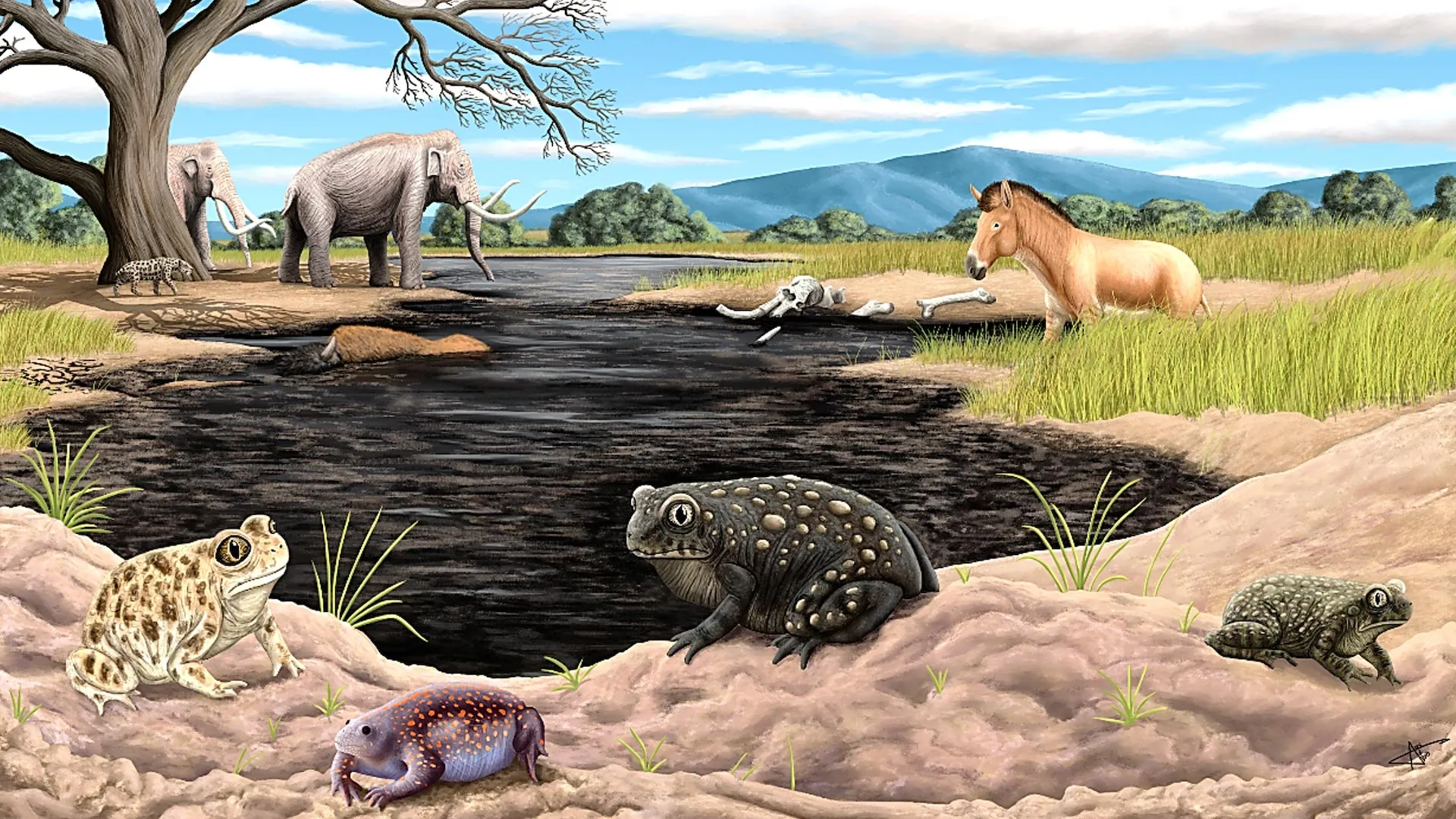
Researchers at the La Brea Tar Pits have identified a previously unknown amphibian that lived in Los Angeles during the Ice Age. The extinct spadefoot toad, named Spea la brea, is the first new extinct amphibian species discovered at the famous fossil site.
Discoveries like this are extremely rare. Only one other extinct Pleistocene amphibian—the Florida tree frog—has been identified in North America. Although S. la brea was small compared with the mammoths and saber-toothed cats associated with the La Brea Tar Pits, its fossils could provide important clues about climate and environmental changes near the end of the last Ice Age.
Published in the Journal of Vertebrate Paleontology, the discovery also demonstrates that important scientific findings continue to emerge from the Samuel Ossin World Center for Ice Age Research at the La Brea Tar Pits, even as the museum undergoes a historic transformation.
An unexpected discovery from an old fossil collection
Lead author Dr. Alberto Cruz did not initially set out to identify a new species. While working as a postdoctoral researcher, he began studying the La Brea Tar Pits’ relatively understudied reptile and amphibian collections. Cruz remains affiliated with the La Brea Tar Pits and also works as a full-time researcher at the SECIHTI Paleontology Quinamezine Survey and Research Center (CIPAQ), part of Mexico’s National Institute of Anthropology and History (INAH).
“I’m not a taxonomist, but more of a paleoecologist and paleogeographer,” says Dr. Cruz. His research ultimately revealed that S. la brea was distinct from every known spadefoot toad.
Cruz initially thought the unusual bones belonged to animals that had been sick or injured during their lifetimes. He wondered whether they might represent an example of paleopathology. However, comparisons with modern spadefoot toads eventually convinced him that the differences represented an entirely new species.
“We examined a lot of specimens until we were satisfied. We thought, ‘Oh my God, this is a new species.’ The material was originally collected in the 1950s, but when we studied it again, we realized that there was still valuable information hidden in these specimens. That’s pretty exciting.”
The fact that the fossils were collected decades ago highlights how much scientific information remains undiscovered in museum collections.
“This is a great example of how, even after a century of excavation and research, new discoveries are still being made at the La Brea Tar Pits,” says Dr. Emily Lindsay, curator and excavation site director at the Samuel Ossin World Center for Ice Age Research at the La Brea Tar Pits. “There is definitely more to come.”
Tiny amphibians can reveal ancient climate
Although large Ice Age mammals receive much of the attention at the La Brea Tar Pits, the smaller reptiles and amphibians studied by Cruz can provide scientists with detailed information about past climate and environmental conditions.
Amphibians usually do not migrate long distances during their lifetimes and are highly sensitive to changes in their surroundings. These characteristics make them valuable indicators of ancient climate. By determining where particular amphibian species lived—or where they were absent—researchers can reconstruct environmental changes on a local scale.
“When the environment changes, vegetation shifts, or the climate becomes warmer or colder, these factors directly affect amphibians,” Cruz said.
Studying amphibians also presents significant challenges. Frogs, toads, and salamanders have delicate skeletons that rarely fossilize. Their remains are especially unlikely to survive outside unusual preservation environments such as the asphalt deposits at the La Brea Tar Pits. This makes the discovery of small extinct amphibians such as S. la brea particularly important.
The fragility of amphibian skeletons may also mean that many extinct reptiles and amphibians have vanished completely from the fossil record. Cruz and other researchers believe additional species may once have lived in the region but were too delicate to survive long enough to be discovered.
Comparing fossil and modern spadefoot toads
To determine whether the fossil represented a new species, Cruz closely examined amphibian bones in the La Brea Tar Pits Collection. These specimens had not undergone a detailed evaluation for nearly 30 years. He documented differences in bone shape and size, then compared the fossils with 80 modern specimens housed in the Herpetology Collection at the Natural History Museum of Los Angeles County and the Museum of Vertebrate Zoology at the University of California, Berkeley.
The comparisons demonstrated that the La Brea fossil was not an unusual individual belonging to a known species. Instead, it represented a distinct species of spadefoot toad: Spea la brea.
Another toad reveals a dramatically different Los Angeles
The research produced another unexpected finding. Scientists identified the first known record of a burrowing toad from Mexico in the genus Cynophrynus, a group now associated with the southwestern United States and Mexico.
These toads no longer live near Los Angeles. Today, the closest living populations are approximately 2,500 kilometers away in southern Mexico, suggesting that the species once occupied a dramatically different geographic range.
This major shift in distribution adds another dimension to the complex history of environmental change that followed the end of the last Ice Age. By studying how amphibians responded to ancient climate changes, researchers may also gain insight into how similar animals could respond to human-caused climate change today.
Source: www.sciencedaily.com