


Close Menu
HitechubHitechub
    What's Hot
    Space

    Unusual planet with no atmosphere discovered

    AI

    What the most advances humanoid robot predicts for the human race in 100 years?

    Science

    New discoveries in physics suggest that we are living in a simulation

    Important Pages:
    • About Us
    • Privacy Policy
    • Terms & Conditions
    Facebook X (Twitter) Instagram Pinterest
    Facebook X (Twitter) Instagram
    HitechubHitechub
    Wednesday, June 3
    • Technology
      1. AI
      2. Gadgets
      3. View All

      This is the most popular CEO in the world

      Sectors in which “Chat-GPT” is most often used

      AI Pioneer Expresses Concern About Potential for AI to Surpass Humanity

      Artificial intelligence has begun to “swallow” professions

      What’s new in Android 14

      Europeans have about 700 million old mobile phones in their drawers

      Here’s how you can tell if your phone is being tapped

      “Sneaker X” – computer case in the shape of a sneaker

      NASA Astronaut Casts Historic Vote from Space

      Discover the Future of Comfort: What If You Could Wear a Chair?

      How Cell Phones and Screens Disrupt Your Child’s Sleep: Tips for Better Rest

      Empowering Girls: Launching Africa’s First Private Space Satellite

    • Science
      1. Space
      2. Wheels
      3. View All

      Galaxies in the universe are growing more slowly than they should

      “Espace” presented the new lander “Apex 1.0”

      The largest asteroid sample ever collected has arrived on Earth

      (VIDEO) Incredible flight of the Parker Solar Probe

      Toyota wants to make a new generation battery with a range of up to 1,200 km

      Meet Toyota’s lunar “baby” that could make exploring the Moon easier

      Microlino – Is this the perfect city car?

      Alfa Romeo 4C gets an electric successor

      Hurricane Season Kicks Off: Below-Average Forecast Highlights First Time in a Decade

      How Plants Altered Magma Chemistry: Insights from Sciworthy

      Matt Freeze: Harvard Graduate from a Renowned Scientific Family Poised to Lead the U.S. to FIFA World Cup Glory

      Fishing Restrictions Lifted in Western Reservoirs Facing Drought-Related Drying

    HitechubHitechub
    Home » Ötzi’s Frozen Remains: Potential Home to Active Microorganisms
    Science

    Ötzi’s Frozen Remains: Potential Home to Active Microorganisms

    Share Facebook Twitter Pinterest WhatsApp
    Share
    Facebook Twitter LinkedIn Pinterest WhatsApp

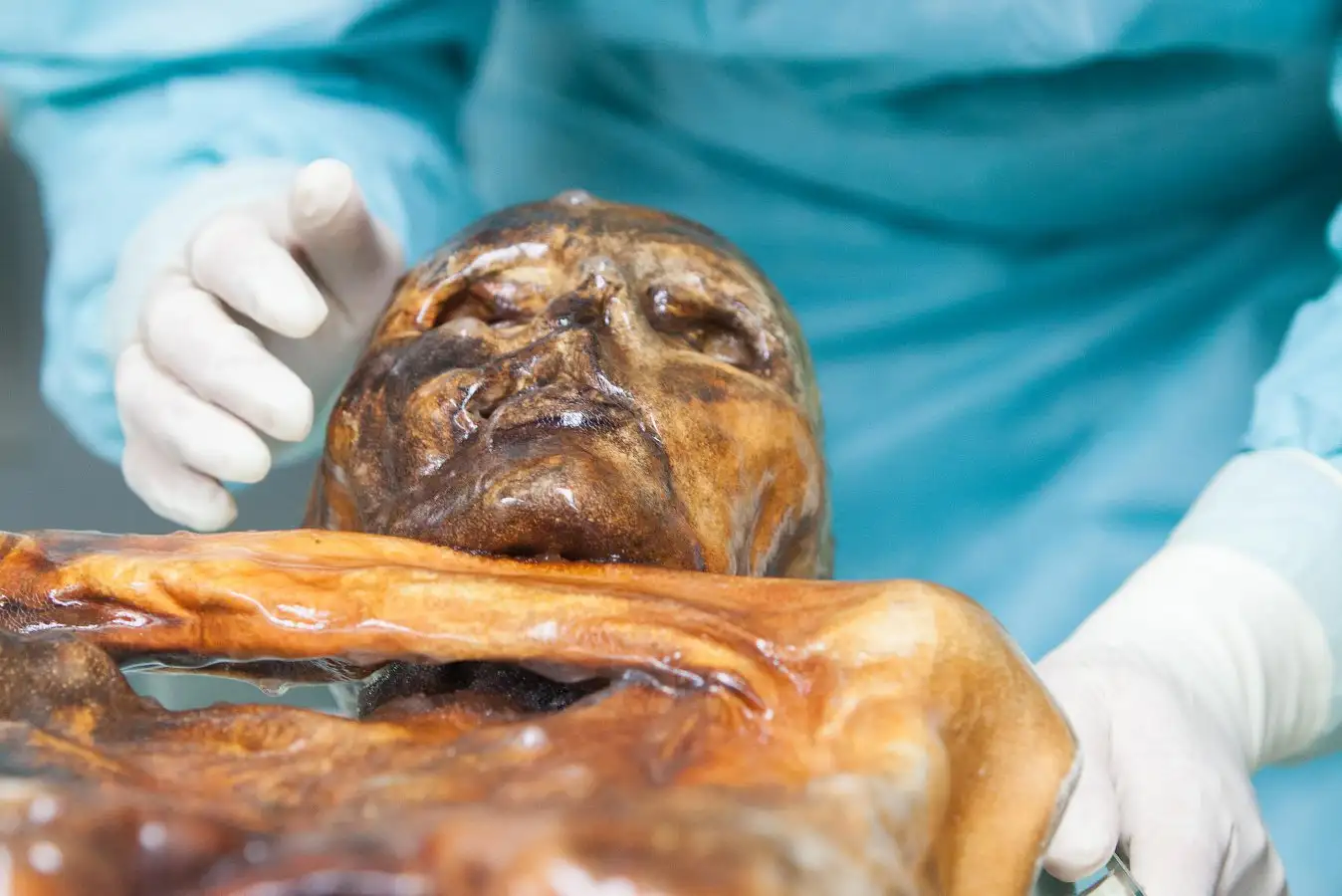
    Ötzi the Iceman will be stored in a cold room at a constant temperature of -6°C.

    South Tyrol Archaeological Museum/Eurac Research/Marion Lafogler

    Research indicates that some microorganisms found in the 5,300-year-old remains of Ötzi the Iceman may still be metabolically active, even after long-term ice preservation.

    Discovered in 1991 while melting from a glacier along the Austria-Italy border, Ötzi is believed to have lived between 3350 and 3120 BC. Over the past 35 years, extensive studies have uncovered fascinating details about him, suggesting he was likely dark-skinned and bald. He also had numerous tattoos and sustained an arrow wound, indicating he may have been murdered.

    Ötzi is currently preserved at the South Tyrol Archaeological Museum in Bolzano, Italy, under conditions that replicate the glacier’s environment: -6°C (21°F) and 99% relative humidity.

    Research led by Frank Meixner at the Eulac Institute Mummy Research Institute in Bolzano assessed bacteria and fungi from skin swabs, tissue fragments, and thawed water samples collected in 1992, 2010, and 2019. These samples were analyzed in comparison to soil and ice samples from the discovery site taken in the 1990s.

    The findings include both ancient and modern microorganisms within Ötzi, some of which appear to be metabolically active. “We can differentiate between Ötzi’s endogenous gut bacteria and the external microbes that colonized after his death,” said Meixner.

    Metagenomic analyses of internal tissues identified specific bacteria that thrive in mammalian intestines in low-oxygen environments, such as Treponema and Kineotrix. Based on DNA damage levels, it is likely that these bacteria were present during Ötzi’s life.

    As observed in other prehistoric gut microbial communities, the diverse microbes are indicative of the richer diets consumed by Chalcolithic humans compared to modern Western diets, according to Meixner.

    In addition, bacteria from the Pseudomonas genus were found, typically found in soil and water. The level of DNA damage suggests they were part of an ancient community at the site, Meixner reports.

    The research team also detected cold-tolerant or psychrophilic yeasts in external samples from Ötzi, including Phenoripheria, Graciojima, Gofojima, and Murakia.

    DNA analysis revealed these yeasts are ancient, with Graciojima increasing in abundance from 2010 to 2019 and becoming the dominant strain, suggesting metabolic activity or replication potential under current storage conditions.

    Reconstruction of Ötzi

    Reconstruction of Ötzi the Iceman

    South Tyrol Archaeological Museum/Augustin Ochsenreiter

    “This is compelling evidence. The Graciojima yeasts seem to have settled post-mortem and appear to be proliferating,” noted Nikolai Oskolkov. However, more data points are needed to confirm that these results reflect authentic biological activity rather than experimental artifacts.

    The increased prevalence of yeast is intriguing, according to Damra Kaptan from the University of Stavanger, Norway. Yet, the active status of the yeast remains uncertain until RNA produced from its DNA is analyzed, indicating gene expression. “There’s a possibility that the yeast was dormant or partially activated during thawing,” she explained.

    Some of these yeasts possess enzymes that can degrade proteins and collagen, raising concerns about potential damage to the mummies, yet researchers found no evidence of harm.

    The research team also identified microorganisms with genes capable of breaking down the toxic compound phenol. Professor Meixner speculated this might be a consequence of previous treatments during mummy processing in the 1990s, which aimed to eradicate fungal growth. “When Ötzi was discovered, mold growth was already present, and he was treated with a phenol-containing solution,” he said. “It’s possible this treatment fortified the microbiome.”

    This research suggests that Ötzi is not merely a frozen time capsule, but rather a dynamic ecosystem sustained by microbial inheritance post-mortem, millennia of glacial layers, and subsequent preservation efforts. “Given that these microbes have been associated with the mummy since its discovery, should we consider them part of his biological identity?” asked Professor Meixner.

    He recommends ongoing genomic monitoring to track signs of microbial activity, such as RNA and metabolite production. If indicators of revival emerge, this may necessitate reassessing the storage conditions, potentially lowering temperature or humidity to curtail microbial proliferation.

    Topic:

    Source: www.newscientist.com

    Share. Facebook Twitter Pinterest LinkedIn WhatsApp
    Previous ArticleWhat Are the Chances of an Asteroid Hitting the Earth?
    Next Article How Earth’s Water Enabled the Evolution of Intelligent Life – Cyworthy

    Related Posts

    Science

    Hurricane Season Kicks Off: Below-Average Forecast Highlights First Time in a Decade

    Science

    How Plants Altered Magma Chemistry: Insights from Sciworthy

    Science

    Matt Freeze: Harvard Graduate from a Renowned Scientific Family Poised to Lead the U.S. to FIFA World Cup Glory

    Science

    Fishing Restrictions Lifted in Western Reservoirs Facing Drought-Related Drying

    Science

    Revolutionary Mathematics AI Solves Decades-Old Research Problems in Just Weeks

    Science

    Astronomers Discover Clearest Evidence of an Exoplanet’s Magnetic Field Yet

    Science

    Ancient Oceans Lost Oxygen Millions of Years Before End-Triassic Mass Extinction

    Science

    Discovering the Universe: How the Electromagnetic Spectrum Expanded Our Understanding

    Add A Comment
    Leave A Reply Cancel Reply

    Stay In Touch
    • Facebook
    • Twitter
    • Instagram
    • Pinterest
    Top Picks
    Technology

    Test flight of an air taxi in Jerusalem

    The Chinese company for the production of light aircraft, “KANDO”, carried out testing of the so-called. air taxi, in Jerusalem, Israel.

    The largest asteroid sample ever collected has arrived on Earth

    Matt Freeze: Harvard Graduate from a Renowned Scientific Family Poised to Lead the U.S. to FIFA World Cup Glory

    Unusual planet with no atmosphere discovered

    What does a night drive look like with one of the most beautiful cars in the world: the Rolls-Royce Ghost

    Most Popular
    Technology

    The end of passwords

    AI

    AI created opening credits for the series “Friends”

    Categories
    • AI (13)
    • Gadgets (10)
    • Science (28)
    • Space (9)
    • Technology (35)
    • Wheels (9)
    Our Picks
    Science

    New discoveries in physics suggest that we are living in a simulation

    Technology

    Empowering Girls: Launching Africa’s First Private Space Satellite

    © 2026 Hitechub.
    • Home
    • About Us
    • Privacy Policy
    • Terms & Conditions

    Type above and press Enter to search. Press Esc to cancel.

    We are using cookies to give you the best experience on our website.

    You can find out more about which cookies we are using or switch them off in .

    Ad Blocker Enabled!
    Ad Blocker Enabled!
    Our website is made possible by displaying online advertisements to our visitors. Please support us by disabling your Ad Blocker.
    Hitechub
    Powered by  GDPR Cookie Compliance
    Privacy Overview

    This website uses cookies so that we can provide you with the best user experience possible. Cookie information is stored in your browser and performs functions such as recognising you when you return to our website and helping our team to understand which sections of the website you find most interesting and useful.

    Strictly Necessary Cookies

    Strictly Necessary Cookie should be enabled at all times so that we can save your preferences for cookie settings.